

On this page
Who was Ellen Gleditsch?
Ellen Gleditsch was a pioneering Norwegian radiochemist and Norway's second female professor. She started her career as a pharmacist's assistant before securing a highly sought-after place in Marie Curie's Paris laboratory in 1907 (Wikipedia). There, she spent five years mastering fractional crystallisation, the punishingly slow chemical process required to separate pure radium from barium.
This meticulous training made her one of the world's foremost experts in purifying radioactive elements. When she later moved to Yale University to work with Bertram Boltwood, she brought these world-class chemical skills to a physical problem that was frustrating the scientific community: how long does radium actually last?
Why did the half-life of radium matter?
In the early 20th century, scientists used radium as the baseline to understand other radioactive elements. Because they compared the decay rates of other substances to radium, an inaccurate number for radium would throw off every other radioactive decay calculation.
Previous estimates for the half-life of radium had varied wildly. If this foundational constant was unstable, the entire timeline of radioactive decay chains — and early attempts to date the age of the Earth — remained uncertain. Physicists needed a chemist who could prepare a flawless sample.
What was Ellen Gleditsch's radium half-life?
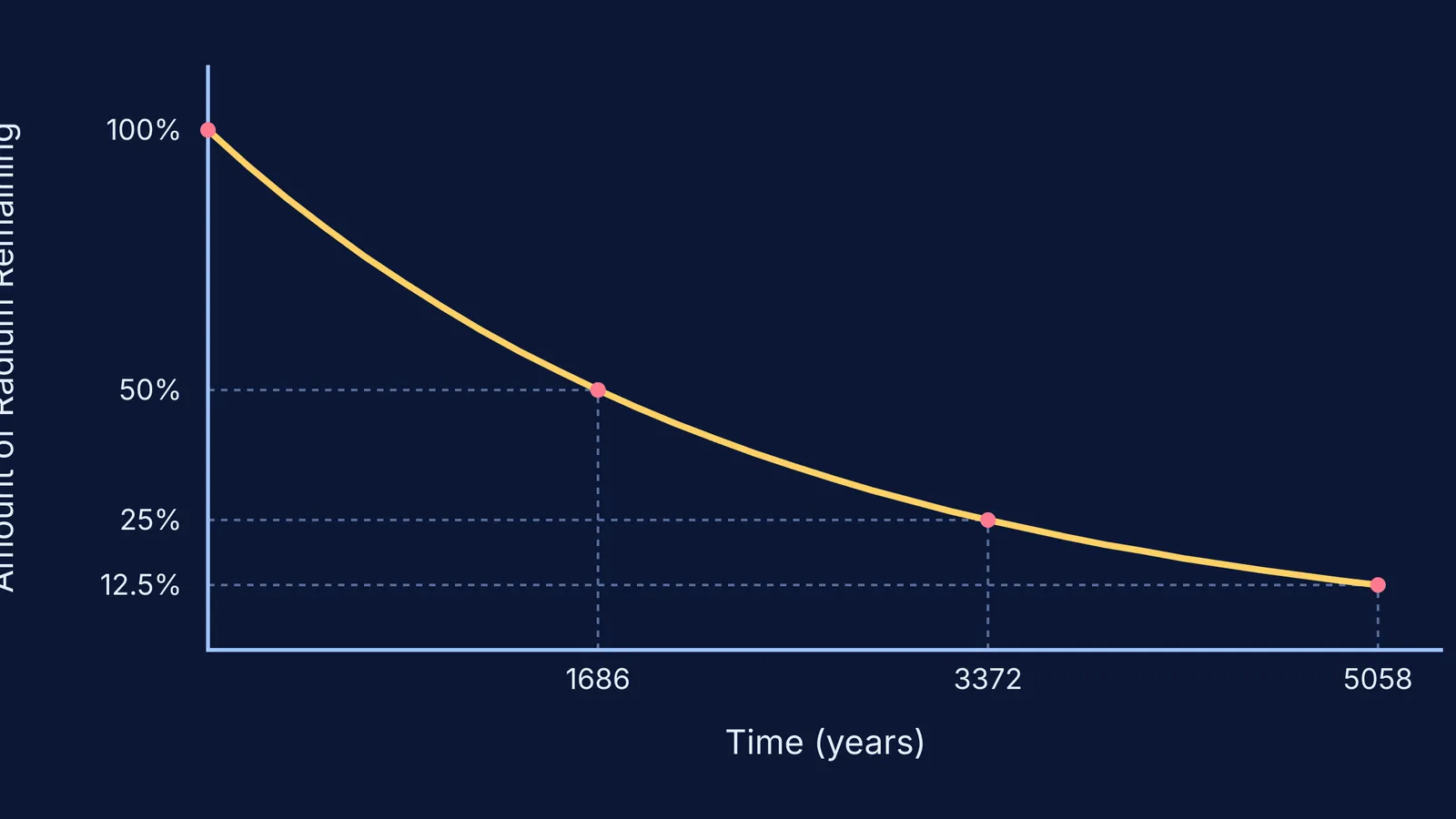
The half-life of a radioactive element is the time it takes for half of its atoms to decay into another substance. In her 1916 paper, "The Life of Radium", Gleditsch reported her measurement of the half-life of radium as 1,686 years (Gleditsch, 1916).
To find this number, she did not just watch a sample decay. A 1,686-year half-life means a sample loses only a tiny fraction of its mass each year, which is too slow to measure directly over a few months. Instead, she measured the ratio of radium to uranium in ancient rocks. Because radium is continuously created by the decay of uranium and then decays itself, older rocks reach a steady state where the ratio of the two elements depends directly on their half-lives. By extracting and weighing both elements with extreme chemical precision, she calculated the decay constant.
Her value of 1,686 years became the international standard. Even today, the modern accepted value remains very close to her measurement.
How did her work prove isotopes exist?
Beyond just measuring a number, Gleditsch's meticulous separations helped confirm a radical new idea: isotopes. At the time, scientists like Irène Joliot-Curie and others were unravelling the complex nature of atoms.
Gleditsch measured the atomic weight of lead found in different radioactive minerals. She proved that lead created from the decay of uranium had a different atomic weight from ordinary lead, even though chemically they were exactly the same element. This provided some of the first hard experimental evidence that isotopes — atoms of the same element with different masses — were real.
If you are struggling to make sense of decay chains or isotope calculations, Fermi's AI tutor can help. It works out what you already know and builds a plan for the session, teaching through the concepts step by step so you sit down to a clear next step instead of a blank page.
A legacy of precision
Gleditsch returned to Norway and continued her research. Her insistence on careful, repeated chemical purification shows why physics and chemistry rely so heavily on each other. You cannot measure a physical constant accurately if your chemical sample is impure.


