

On this page
If you have ever been asked to "convert ethanol into butan-2-ol" and stared at the page, you have met the kind of problem E. J. Corey set out to make logical. Corey, born on 12 July 1928 in Methuen, Massachusetts, was at Harvard University when he received the 1990 Nobel Prize in Chemistry "for his development of the theory and methodology of organic synthesis", according to the Nobel Prize facts page.
What is retrosynthetic analysis?
Retrosynthetic analysis means starting from the molecule you want to make, the target, and deciding which bonds to break so that the structure gets simpler step by step, as the Royal Swedish Academy of Sciences' 1990 press release describes it. You keep breaking the pieces down until you reach compounds whose synthesis is already described or that can be bought. Only then do you turn around and build forwards.
The same press release says Corey coined the term and developed the concept beginning in the 1960s. It adds that many earlier syntheses were performed more or less intuitively. It notes that synthesis planning has been likened to a game of three-dimensional chess with 40 pieces on each side, and that over 35,000 usable methods of synthesis are described in the chemical literature. With that many options, a rule for working backwards cuts the search down.
Because the logic was strict, it suited computers. The press release says Corey showed that strictly logical retrosynthetic analysis was amenable to computer programming, and in 1969 he and W. Todd Wipke published a paper in Science titled Computer-Assisted Design of Complex Organic Syntheses. The Academy also credits him with synthesising about a hundred important natural products, among them a ginkgolide from the ginkgo tree, and with developing some fifty entirely new or considerably improved reactions or reagents along the way.
How do you work backwards on a conversion problem?
A school conversion question is a small retrosynthesis. You are given a start and a target, and the target is where you begin.
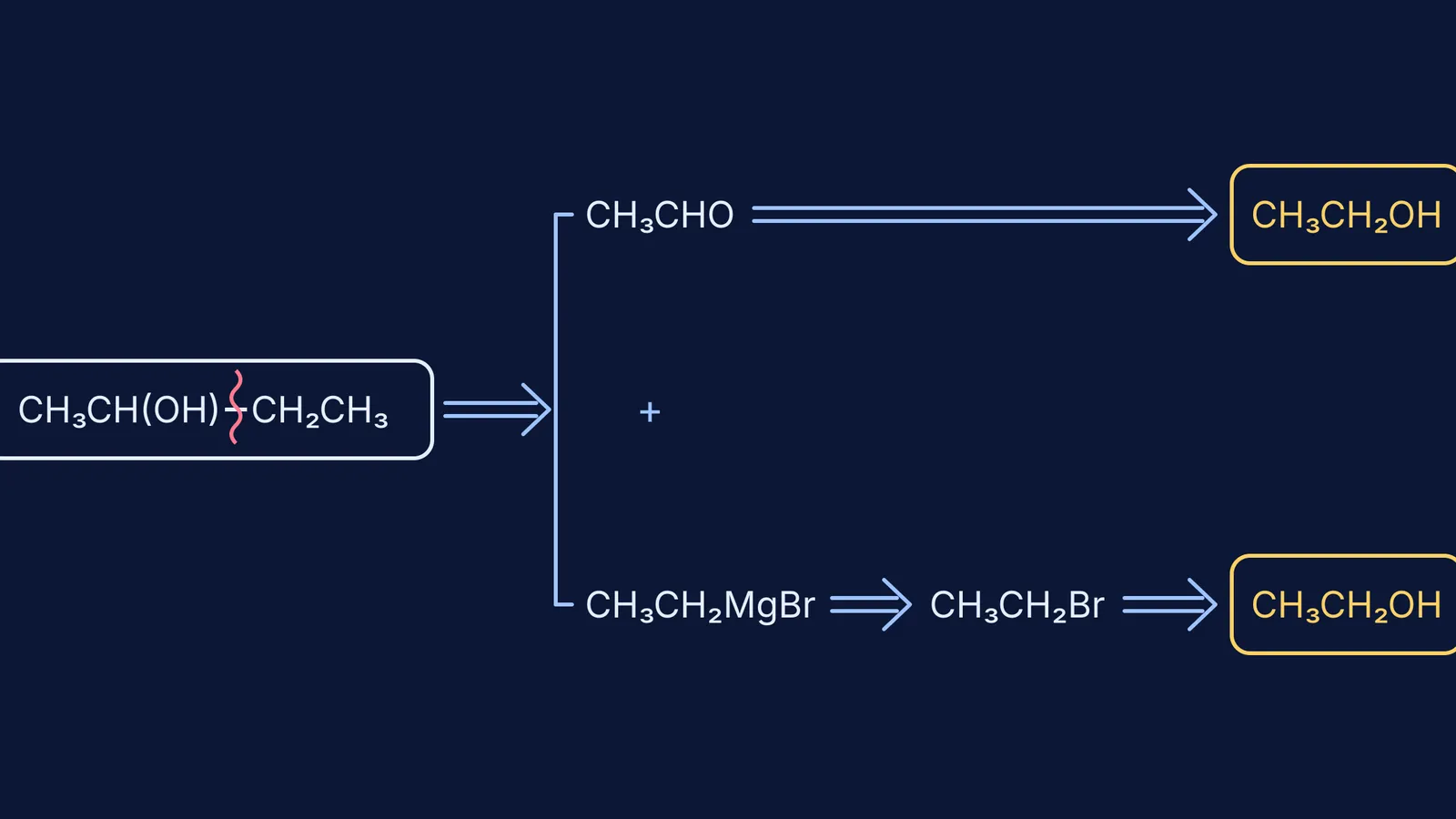
Problem: make butan-2-ol, CH₃CH(OH)CH₂CH₃, using ethanol as the only organic starting material.
Count carbons. The target has four; ethanol has two. So a new carbon–carbon bond must form.
Name the target's functional group. It is a secondary alcohol. NCERT's Class 12 chapter on alcohols, phenols and ethers says Grignard reagents give secondary alcohols with aldehydes other than methanal, and its equation shows that reaction forming a C–C bond.
Disconnect. Break the bond between C2 and C3. The carbon carrying the OH, with its methyl group, comes from ethanal, CH₃CHO. The other two carbons come from ethylmagnesium bromide, CH₃CH₂MgBr. Both pieces have two carbons, which matches ethanol.
Go backwards again on each piece. The same NCERT chapter names pyridinium chlorochromate (PCC) as a better reagent for oxidising primary alcohols to aldehydes in good yield, so ethanol gives ethanal. NCERT's haloalkanes chapter shows alcohols turning into alkyl bromides with phosphorus tribromide, and bromoethane reacting with magnesium in dry ether to give CH₃CH₂MgBr.
Write it forwards. Ethanol with PCC gives ethanal. Ethanol with PBr₃ gives bromoethane, which with Mg in dry ether gives CH₃CH₂MgBr. Add the Grignard reagent to ethanal, then hydrolyse, and you have butan-2-ol.
Each backwards step asked one question, and the textbook answered it. For a wider map of these moves, see our roadmap for organic conversions, and our post on Grignard reagents and their exam traps for the reaction doing most of the work here.
Why does working backwards help in chemistry exams?
Forward thinking starts with every reaction ethanol can do, and most of them lead nowhere. Backwards thinking starts with the one thing you are sure of, the target, and uses its structure to rule options out. Use this checklist on any conversion:
Count carbons in the start and the target. More carbons means you need a C–C bond-forming step.
Circle the target's functional group and list the reactions you know that make it.
Disconnect a bond next to that functional group first.
Check whether each piece is your starting material, or one step away from it.
Write the route forwards with reagents and conditions, and check every step is one you have studied.
If a piece leads nowhere, go back and try a different bond.
For another C–C bond-former, see our post on Alexander Borodin and the aldol reaction.
If you keep picking the wrong bond to break, the Fermi Problem Library has worked problems with a step-by-step solver that explains the reasoning rather than printing an answer, so you can see why one disconnection works and another does not. If a step fails because you have forgotten what a reagent does, the Fermi Concept Library has a lesson for every concept in chemistry.
Pick one conversion from your last test tonight and solve it from the target end first.


