

On this page
In 1686 the English astronomer Edmond Halley published a paper with a long title: An historical account of the trade winds, and monsoons, observable in the seas between and near the Tropicks, with an attempt to assign the physical cause of the said winds. It appeared in the Royal Society's Philosophical Transactions, volume 16. In it, Halley tried to explain India's monsoon with one physical idea: the Sun heats some places more than others, and air moves because of it. Most people know him from Halley and his comet; this was a very different kind of science.
What did Halley actually write in 1686?
Halley built his account from sailors' experience and his own. In the full text of the 1686 paper he says he had "the opportunity of conversing with Navigators acquainted with all parts of India", and had lived "a considerable time between the Tropicks". He also drew a "Scheme", a map showing "at one view all the various Tracts and Courses of these Winds".
His central rule is one sentence. Air "which is less rarified or expanded by heat, and consequently more ponderous, must have a Motion towards those parts thereof, which are more rarified". In modern words: heated air expands and becomes less dense, and cooler, denser air flows in towards it. Halley added that heated air "must ascend in a continued stream", with the upper air flowing back the other way.
How did Halley explain the monsoon?
Halley applied the same rule to the seasons. His account of the Indian seas reads: "in April, when the Sun begins to warm those Countries to the North, the S.W. Monsoon begins, and blows during the Heats till October". Then, with the Sun "retired" and the north growing cooler, the north-east winds return.
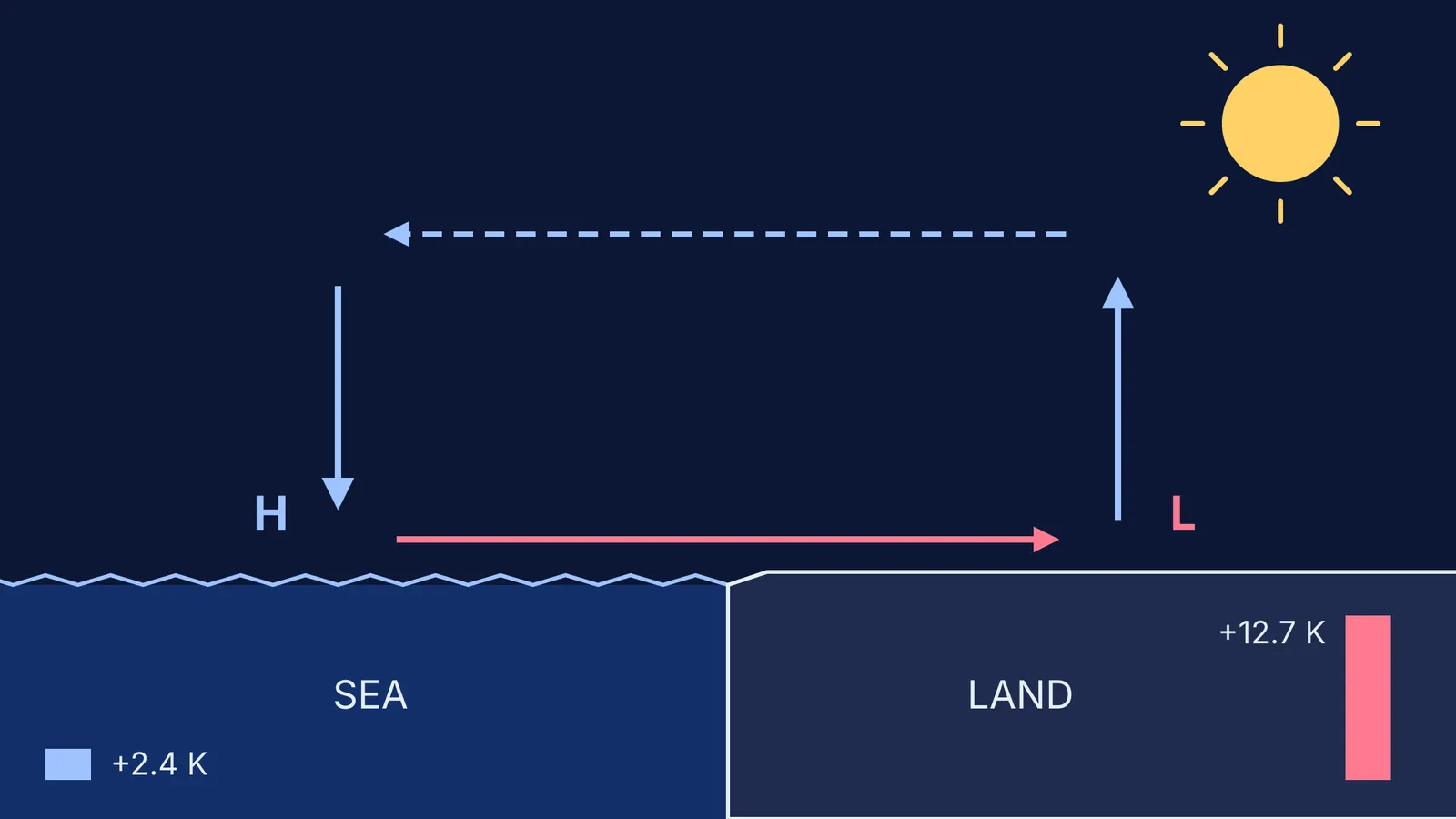
So the monsoon, for Halley, was a wind that follows the heat: in summer air from the sea flows towards the warm land to the north, and in winter the pattern flips. He was honest about the gaps, writing that "if I am not able to account for all particulars, yet 'tis hoped the thoughts I have spent thereon, will not be judged wholly lost".
Why does land heat up faster than the sea?
Halley wrote of hot sand holding the Sun's heat; specific heat explains why. Use Q = mcΔT with values from the HyperPhysics specific heat table: water has a specific heat of 4.186 J/g·K, and granite, a common rock, has 0.790 J/g·K.
A worked example you can check with a calculator:
Give 1 kg of water and 1 kg of granite the same 10,000 J of sunlight.
Water: ΔT = 10,000 ÷ (1 × 4,186) = 2.4 K.
Granite: ΔT = 10,000 ÷ (1 × 790) = 12.7 K.
Ratio: 12.7 ÷ 2.4 is about 5.3, so the rock warms about five times as much.
The real sea also mixes heat downwards and loses it by evaporation, but the direction matches Halley's story. The India Meteorological Department's monsoon FAQ describes the same thing today: as the Sun moves north, the land around the Arabian Sea takes in large amounts of heat, and a "heat low", a trough of low pressure, forms over the region.
If Q = mcΔT problems trip you up, the Fermi Problem Library has a step-by-step solver that explains the reasoning rather than printing an answer.
What did Halley get wrong?
For the steady trade winds, Halley's explanation went wrong. Meteorologist Anders Persson's 2006 history of the trade-wind debate explains that Halley's main mechanism was the daily east-to-west movement of the Sun's heating across the tropics. Halley put it this way: the Sun, "continually shifting to the Westwards", drags the region of strongest heating with him. Persson also notes that Halley privately began to doubt this hypothesis after the mathematician John Wallis questioned it.
In 1735 George Hadley offered a better cause: the rotation of the Earth itself, which turns air flowing towards the equator into north-east and south-east winds. Persson notes that Hadley's idea took more than a century to be widely accepted; read more on George Hadley and the trade winds.
How is the monsoon explained today?
Halley's land-sea picture lasted a long time. Sulochana Gadgil of the Indian Institute of Science wrote in a 2003 review in the Annual Review of Earth and Planetary Sciences that "for over 300 years, the monsoon has been viewed as a gigantic land-sea breeze". She argues that satellite and other observations support a different view: the monsoon as the seasonal migration of the intertropical convergence zone (ITCZ), the band of rising air and rain near the equator.
So Halley's heating idea is part of the story, not the whole of it. The rest came from centuries of measurement, including the first official forecasts: see Henry Blanford's monsoon forecasts.
Test yourself: redraw the loop in the diagram from memory, arrows the right way round. If moving air is hard to picture, the Fermi Simulation Lab has interactive simulations for ideas that are easier to see than to read.


