

On this page
The blind spot in the human eye was discovered by French physicist Edme Mariotte in the 1660s. He proved that the point where the optic nerve leaves the eye is completely insensitive to light, a discovery that amazed the French royal court and overturned centuries of assumptions about how vision works.
Who discovered the blind spot in the eye?
In the 17th century, scientists largely believed that the point where the optic nerve entered the eye must be the most sensitive part of the retina. Edme Mariotte, a French physicist and priest, disproved this theory in the 1660s.
By carefully mapping human vision, Mariotte showed that there is a specific region in the visual field where objects disappear entirely. He first presented his discovery to the French royal court, where the demonstration amazed his audience, and later published his formal findings in a short 1668 paper titled *Nouvelle découverte touchant la veüe* (New discovery concerning vision).
Who was Edme Mariotte?
Born around 1620, Mariotte was one of the founding members of the French Academy of Sciences. Beyond his anatomical discoveries, he made major contributions to physics. He is well known for formulating Boyle's law—which states that the pressure and volume of a gas have an inverse relationship—independently of Robert Boyle, leading to it being called Mariotte's law in France. He is also credited with designing the first Newton's cradle, the familiar desk toy that demonstrates the conservation of momentum.
Why does the blind spot exist?
When light enters your eye, it is focused by the lens onto the retina, a complex layer of light-detecting photoreceptor cells at the back of the eyeball. These cells translate light into electrical signals and send them to the brain through the optic nerve.
However, all these nerve fibres must eventually bundle together and exit the eyeball to reach the brain. The specific circular area where they pass through the retina is called the optic disc). Because this exact spot is entirely taken up by nerve fibres and blood vessels, it has no light-detecting cells (rods or cones). Consequently, any light that falls on the optic disc cannot be seen.
In humans, this physiological blind spot is located about 12 to 15 degrees) towards the temporal side of the visual field (the side of the ear) and 1.5 degrees below the horizontal. It is roughly 7.5 degrees high and 5.5 degrees wide.
How do you test your blind spot?
You do not notice this gap in daily life, but you can find it easily with a simple experiment.
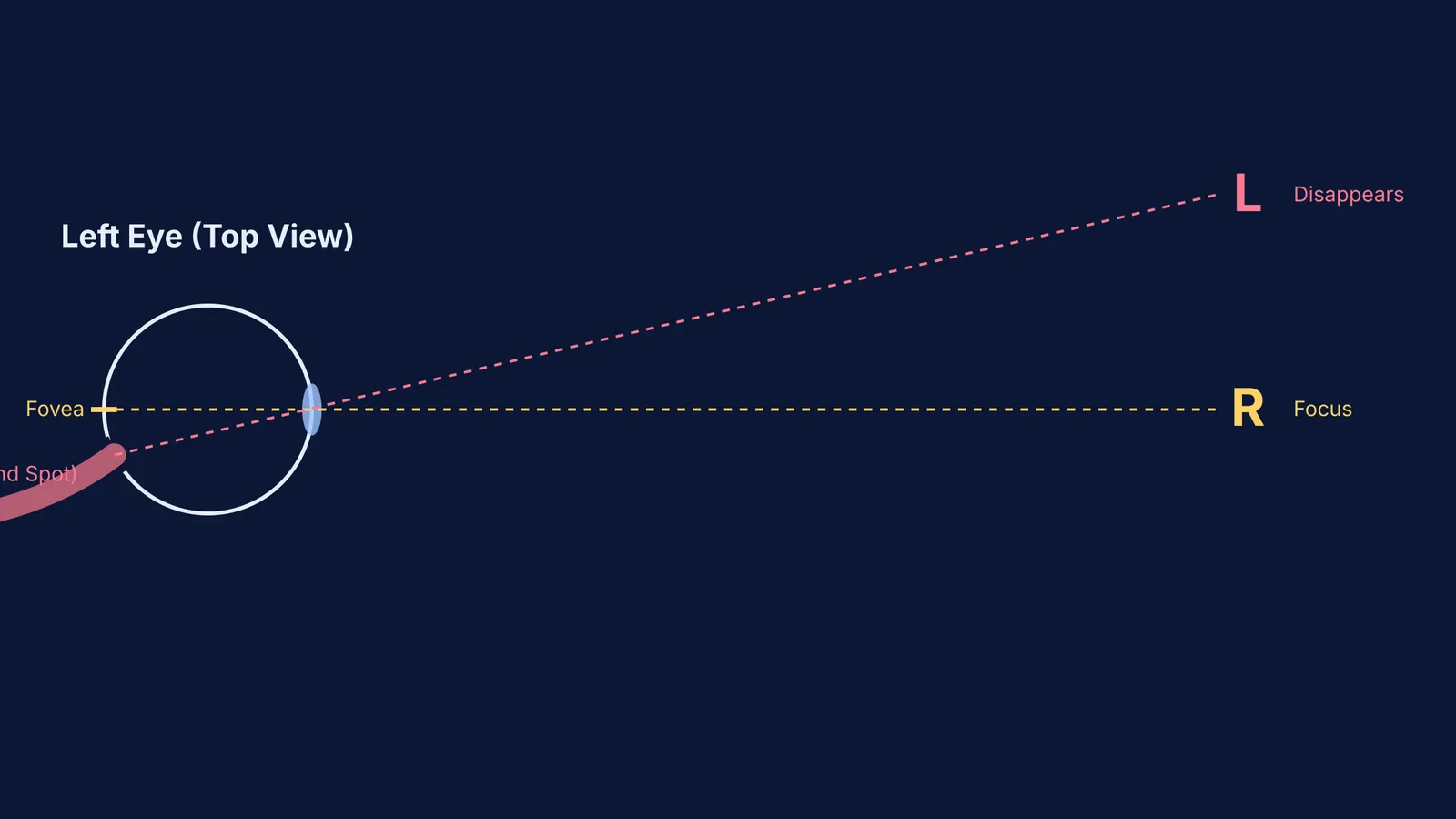
Draw two large letters, L and R, horizontally on a piece of paper, about 15 centimetres) apart.
Hold the paper in front of you at roughly three times the distance between the letters (about 45 cm).
Close your right eye and focus your left eye strictly on the R.
Slowly move the paper closer to your face, and then further away, keeping your eye locked on the R.
At a specific distance, the letter L will completely vanish from your peripheral vision. This happens because the light from the L is falling exactly on your optic disc.
How does the brain hide the blind spot?
Even though a measurable portion of your retina is completely blind, you do not see a black hole in your peripheral vision. This is due to a neurological process known as interpolation). Your brain actively constructs the missing piece of the picture by filling in the gap with the colours and patterns immediately surrounding it.
Furthermore, because your two eyes are positioned a short distance apart, their visual fields overlap. The right eye can clearly see the area that falls into the left eye's blind spot, and vice versa. This stereoscopic vision ensures that as long as both eyes are open, no part of your environment is lost to you.
When studying optics and human anatomy, turning abstract biological facts into physical tests is a highly effective way to learn. When an idea is hard to picture, the Fermi Simulation Lab provides interactive simulations for concepts that are easier to see than read. For more practice with the physics of vision, try tracing a ray through a glass slab or proving why a lens's object and real image are at least 4f apart.


