

On this page
Hormones are the body's chemical messengers. They travel through the blood to tell target tissues what to do. But for a long time, biologists did not know how a hormone actually passed its instructions to the cell's machinery.
How do water-soluble hormones act?
You will meet two main classes of hormones in biology. Steroid hormones are made of lipids, so they can slip straight through the lipid membrane of a cell and act on the nucleus.
However, protein and peptide hormones, such as adrenaline (epinephrine), glucagon, and follicle-stimulating hormone (FSH), are water-soluble. They cannot cross the oily cell membrane. Instead, they must stop at the surface.
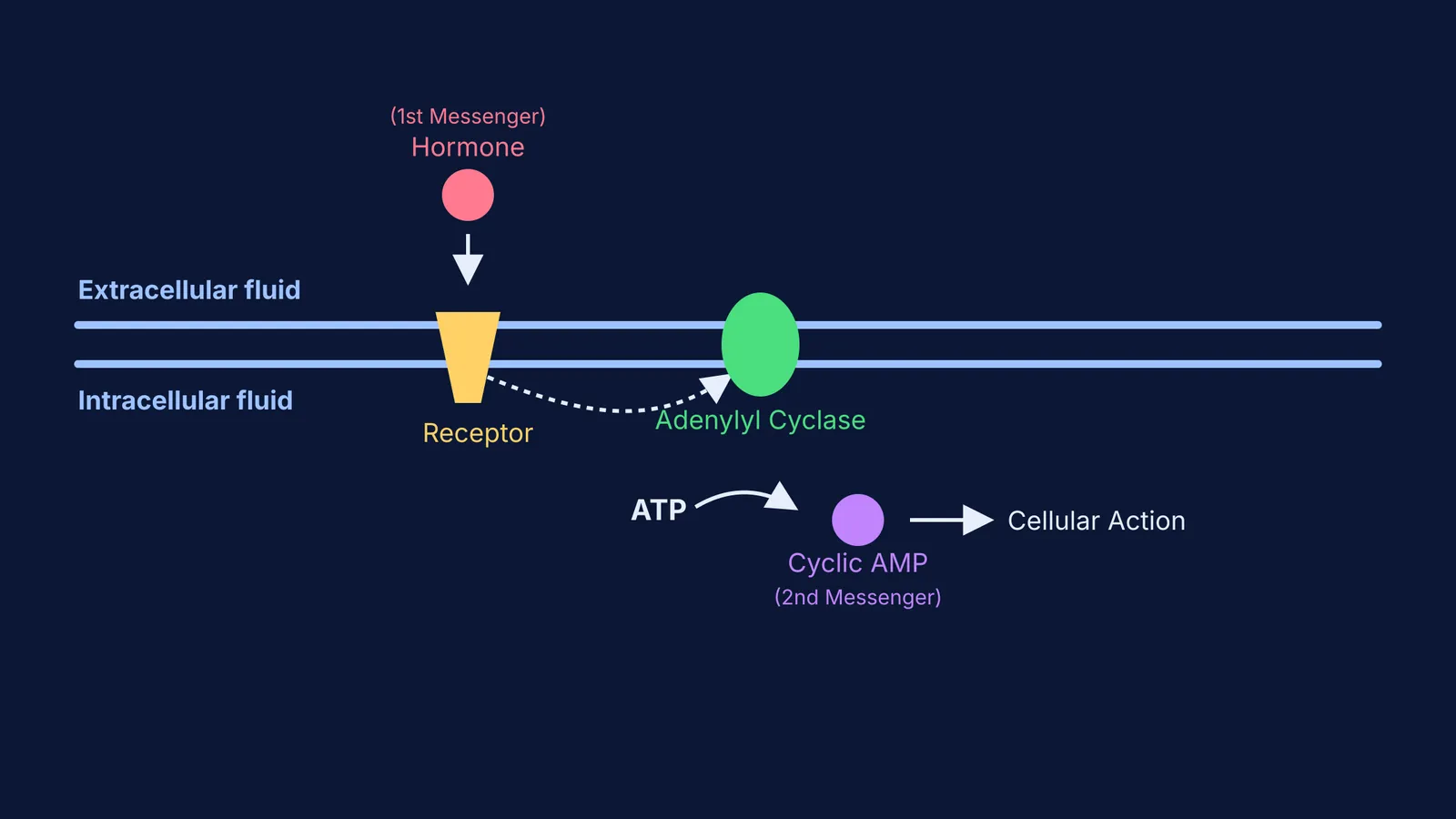
These hormones bind to a specific receptor protein on the outside of the cell, forming a hormone-receptor complex. Because they never enter the cell, they are called the "first messengers". For the signal to go any further, the receptor must hand the message to something on the inside. You can study how hormones act: membrane receptors vs intracellular receptors in the Fermi Concept Library, where every concept in physics, chemistry, biology, mathematics and computing has its own lesson and its place in the map.
What is a second messenger?
When the first messenger binds to the outside of the receptor, it changes the receptor's shape. This change wakes up an enzyme built into the inner side of the membrane, usually adenylyl cyclase.
Adenylyl cyclase acts as a manufacturing plant. It takes ATP — the energy currency of the cell — and converts it into a molecule called cyclic adenosine monophosphate, or cyclic AMP (cAMP).
Cyclic AMP is the "second messenger". It spreads through the interior of the cell, hunting down the enzymes that will actually perform the work, such as breaking down stored glycogen into glucose. This process is a cascade: a single hormone molecule binding to the outside can trigger the production of many cAMP molecules on the inside, amplifying the signal.
How did Earl Sutherland discover cyclic AMP?
In the 1950s, Earl W. Sutherland Jr. was studying how adrenaline and glucagon make liver cells release glucose. At the time, researchers assumed that hormones somehow slipped inside the cell to activate enzymes directly.
Working with Theodore Rall at Case Western Reserve University, Sutherland tested broken-open liver cells. They found that if they added the hormone to the cell membrane alone, it produced a heat-stable factor. When they poured this factor onto the interior contents of the cell, the enzymes woke up. The hormone was not doing the work; the membrane was making a new chemical that did.
In a 1958 paper published in the Journal of Biological Chemistry70724-4/pdf), Sutherland and Rall definitively identified this factor as cyclic adenine ribonucleotide, now known as cAMP.
Why did cyclic AMP win a Nobel Prize?
Before Sutherland's work, the inner workings of cell signalling were a black box. His discovery proved that the cell membrane is not just a passive wall, but an active translator that converts external signals into internal action.
For this breakthrough, Sutherland was awarded the 1971 Nobel Prize in Physiology or Medicine. The Nobel committee cited him "for his discoveries concerning the mechanisms of the action of hormones." Today, we know that cAMP is not just for human liver cells; it acts as a second messenger across almost all animal tissues and even in bacteria.
Understanding these signalling pathways can be tricky when you only have flat diagrams in a textbook. If you find it hard to picture how enzymes and messengers move, you can watch the cascade happen in the Fermi Simulation Lab, or review the equation for enzyme speed to see how enzymes operate once activated.


