

On this page
When you look up at a clear night sky, the thousands of stars scattered across the darkness can feel overwhelming to navigate. But long before digital planetariums, astronomers relied on meticulously compiled lists to map the heavens. One of the most important figures in this effort was the American astronomer Dorrit Hoffleit (1907–2007), who dedicated her nearly 80-year career to cataloguing the stars and measuring their light.
Hoffleit did not just leave behind the definitive map of the stars we can see with our own eyes. She also left a legacy of mentorship, insisting that young women should do real, rigorous science at a time when they were often sidelined.
What is the Bright Star Catalogue?
If you have ever learned the names of the stars in the Big Dipper or Orion, you have indirectly relied on the work Hoffleit managed for decades. The Bright Star Catalogue (often known as the Yale Bright Star Catalogue) is considered the standard reference for every star visible to the naked eye.
Hoffleit served as the primary editor for the catalogue's most famous modern editions. It tabulates precise data on the 9,110 brightest stars in the night sky. For each star, it lists its exact coordinates, its spectral type (which tells us its temperature and composition), and its apparent magnitude. It remains a foundational tool for anyone studying the night sky, much like how measuring the number of photons emitted per second forms a foundation for modern optics.
How do variable stars work?
Not all stars shine with a steady, unchanging light. Hoffleit spent her early career at the Harvard College Observatory identifying and studying variable stars. These are stars whose brightness changes over time, either because they physically pulsate (swelling and shrinking) or because another star passes in front of them in a binary system.
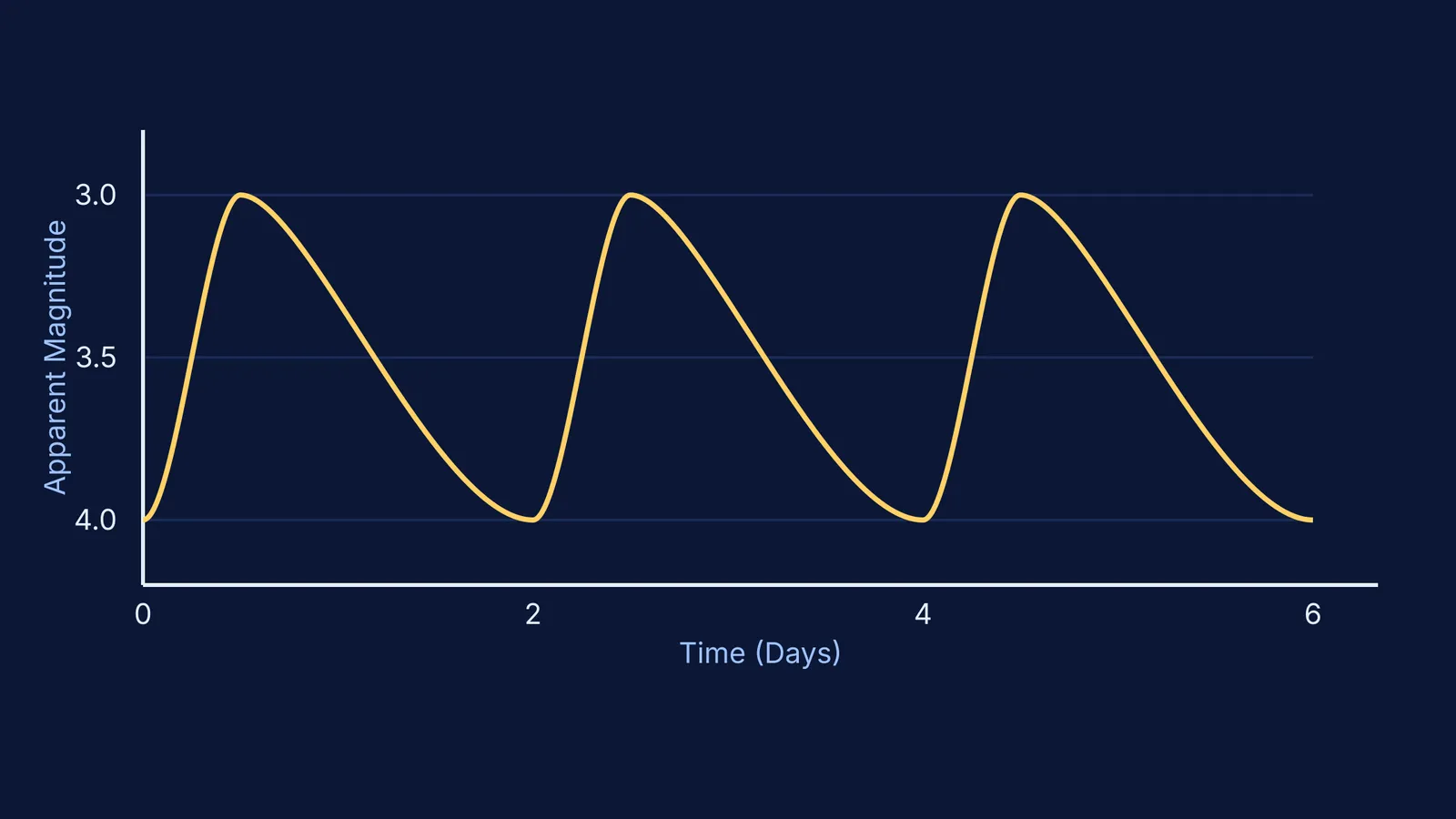
By examining hundreds of photographic plates taken on different nights, Hoffleit discovered numerous variable stars and tracked their light curves. A light curve is simply a graph showing how a star's brightness rises and falls over days or weeks. Later in her career, she applied her expertise in measuring brightness changes to co-discover the optical variability of 3C 273, the very first quasar ever identified.
If you are inspired by the rigour of astronomical observation but struggle to picture the physics behind a pulsing star or orbital mechanics, the Fermi Simulation Lab lets you adjust variables and see the effects instantly.
A beginner's framework for tracking variable stars
You do not need an observatory to start doing real science. If you want to build the same careful observation habits that Hoffleit taught her students, you can track a bright variable star (like Algol in the constellation Perseus) from your backyard.
Find a reference chart: Look up a star chart that shows your chosen variable star and its non-variable neighbours.
Note the baseline magnitudes: Identify two nearby "comparison stars" whose brightness is constant—one slightly brighter than your target, and one slightly fainter.
Observe over time: Check the star at the same time every few nights.
Estimate the brightness: Compare the variable star's brightness to your two constant reference stars and record your estimate.
Plot your data: Graph your estimates against time in days. You will eventually see the curve rise and fall, mirroring the physical processes happening light-years away.
If you get stuck working out a physics or maths problem about light curves and orbital periods, the Fermi Problem Library has worked examples with a step-by-step solver that explains the reasoning.
How did she mentor the next generation of women?
Beyond her catalogues and discoveries, Hoffleit's most enduring impact may be the scientists she trained. From 1957 to 1978, she served as the director of the Maria Mitchell Observatory on Nantucket.
During a time when women were heavily underrepresented in the physical sciences and often restricted to data-entry roles, Hoffleit created an environment where they could thrive as independent researchers. She established a summer research program specifically designed for undergraduates. She insisted that her students engage in the complete scientific process: operating the telescopes, analyzing the photographic plates, and publishing their own research papers.
Under her direct supervision, she mentored over 100 students. Many of these young women went on to earn Ph.D.s and build successful careers in astronomy, creating a ripple effect that helped change the demographics of the field. Hoffleit's approach—demanding rigorous work while providing unwavering support—shows that great science is often a collaborative effort built across generations. Much like how Annie Maunder mapped the sunspot cycle and George Johnstone Stoney gave the electron its name, Hoffleit's catalogues ensure that her meticulous work will guide stargazers for centuries to come.


