

On this page
Dorothy Mary Moyle Needham (1896–1987) spent her career at the University of Cambridge mapping the biochemical pathways that fuel muscle activity. Born in London, she developed an early interest in science and attended Girton College, Cambridge, before joining the university's biochemistry laboratory. Known affectionately in the department as "The Moyle"—a nod to her maiden name that distinguished her from her husband and collaborator, Joseph Needham—she was a dedicated researcher who helped shape modern biochemistry (source). In 1948, her contributions were formally recognised when she and Joseph became the first married couple to both be elected Fellows of the Royal Society (source).
Her crowning achievement as an author came late in her career, when she bridged the gap between rigorous laboratory chemistry and the history of science.
What did Dorothy Needham write in Machina Carnis?
Published in 1971, *Machina Carnis: The Biochemistry of Muscular Contraction in its Historical Development* is a comprehensive 782-page book by Dorothy Needham (source). The book traces the long evolution of muscle research, starting from the early "animal spirits" theories of the 1600s and continuing all the way to the molecular biology of the mid-20th century.
The work is unique because it was written by a primary actor who lived through the "Golden Age" of biochemistry. Needham synthesized centuries of experimental data into a coherent narrative, carefully covering the shift from purely mechanical explanations to chemical ones. She documented how the discovery of oxygen and the laws of thermodynamics fundamentally transformed the field, and how scientists painstakingly unspooled the complex metabolic pathways of glycolysis and cellular respiration. If you are studying these metabolic pathways today, you can find them mapped out in the Fermi Concept Library, where every concept in physics, chemistry, biology, mathematics and computing has its own lesson and its place in the map.
Beyond biochemistry, the book also highlighted comparative physiology. Needham devoted sections to examining muscle function across many different species, comparing the well-studied striated muscle with the less-understood smooth muscle, and exploring how various diseases affect muscle structure.
How do muscles get their fuel?
Before the 1930s, scientists knew that muscles contracted to create movement, but the exact mechanism linking chemical fuel to this mechanical action was a profound mystery. Needham was at the absolute forefront of the search for this answer.
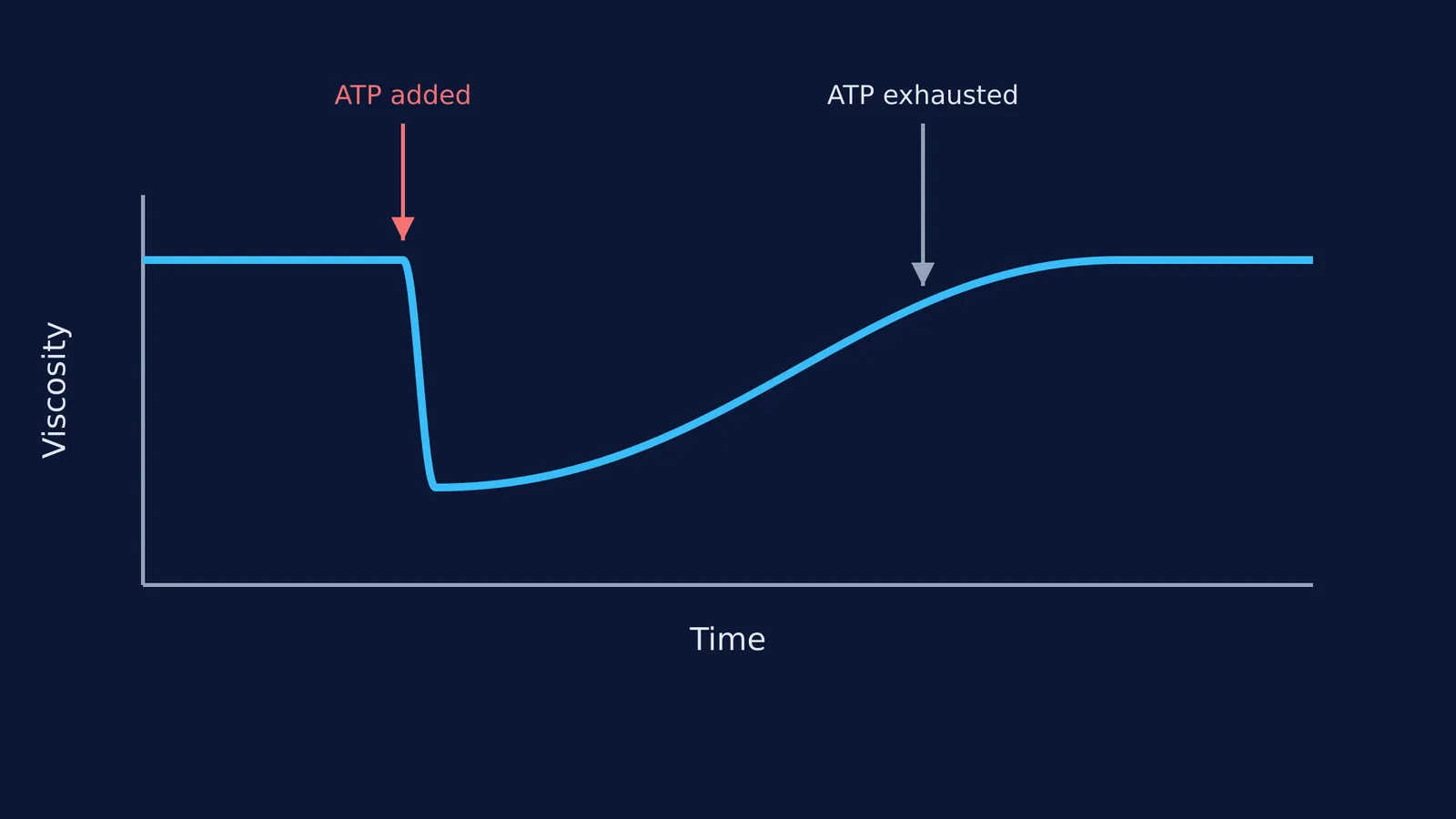
In a landmark June 1941 paper in *Nature* titled "Myosin Birefringence and Adenylpyrophosphate", Needham and her colleagues (including her husband Joseph and Shih-Chang Shen) demonstrated a crucial physical change in muscle proteins. They showed that adding adenosine triphosphate (ATP) to a solution of myosin caused a rapid, reversible drop in the solution's flow birefringence and viscosity (source). They confirmed earlier findings that myosin, the main structural protein of the muscle, also functioned as an enzyme that broke down ATP.
This proved that the "muscle machine" and its "fuel processor" were the exact same molecule. As the ATP was consumed by the enzymatic action of myosin, the viscosity of the solution slowly returned to its normal, higher level. This provided the first clear physical evidence of a direct interaction between a structural protein and its energy source. This breakthrough fundamentally changed biology, laying the groundwork for our modern understanding of the sliding filament mechanism. To see how other scientists explored the physical demands and adaptations of muscles, read about August Krogh and how capillaries open when muscles work.
Why is the history of science useful for studying biology?
Needham’s work reminds us that science is not just a static list of final facts, but a continuous, often messy thread of human reasoning. *Machina Carnis* is highly valued by historians precisely because it documents the "false trails", the discarded hypotheses, and the fierce controversies that preceded major biological discoveries.
When you study complex biological processes, tracing the history of how they were discovered can make the facts stick in your memory:
Map the inputs and outputs: Just as Needham historically mapped how muscles convert glycogen into lactic acid, draw out the start and end points of a metabolic pathway before memorising the middle steps. For an example of how interconnected these pathways are, see Respiration as an amphibolic pathway.
Track the proteins: Identify which specific molecules are doing the physical work, such as myosin acting astonishingly as both a structural filament and an enzyme.
Follow the reasoning: Don't just memorise the final model; strive to understand the experiments that proved it. If tracing a long line of reasoning gets confusing, Fermi's AI tutor can help. It teaches rather than answers: it holds a line of reasoning across a whole session, notices where you are stuck, and decides whether to explain, ask, or show.
Dorothy Needham's remarkable legacy lives on in both the molecular models of modern biology and the detailed historical record she so carefully preserved.


