

On this page
Dorothy Hansine Andersen wanted to be a surgeon, but in the 1920s, surgical residencies for female doctors were virtually non-existent. Instead, she became an assistant pathologist at the Babies Hospital of Columbia-Presbyterian Medical Center in New York. There, by looking carefully at tissue samples, she solved a medical mystery that was costing the lives of infants.
Why was cystic fibrosis confused with celiac disease?
In the 1930s, children who failed to gain weight despite eating normally were often diagnosed with celiac disease. In 1935, when a three-year-old girl died of what was thought to be celiac disease, Andersen performed the autopsy. She noticed something unusual: the child's lungs were clogged with thick secretions, and her pancreas was scarred.
Realising this was not celiac disease, Andersen combed through hospital records and contacted other researchers to find similar cases.
How did Dorothy Andersen first describe cystic fibrosis in 1938?
Andersen collected the clinical and autopsy records of 49 similar cases. She noticed a clear pattern: children with these symptoms had microscopic, fibrous cysts forming around the acini (the clustered cells) of the pancreas. These cysts, rather than a food intolerance, were the real reason the children failed to gain weight, as they were unable to properly process nutrients.
She published her findings in August 1938 in the *American Journal of Diseases of Children*, in a paper titled "Cystic Fibrosis of the Pancreas and Its Relation to Celiac Disease". Her meticulous study was the first to name the disease and define its clinical criteria, separating it entirely from celiac disease.
How did the "salty sweat" clue lead to a diagnosis?
Having identified the disease, Andersen set out to find its cause. In 1946, working with Richard Hodges, she published a study showing that cystic fibrosis is a recessive Mendelian disorder.
How to trace a recessive trait
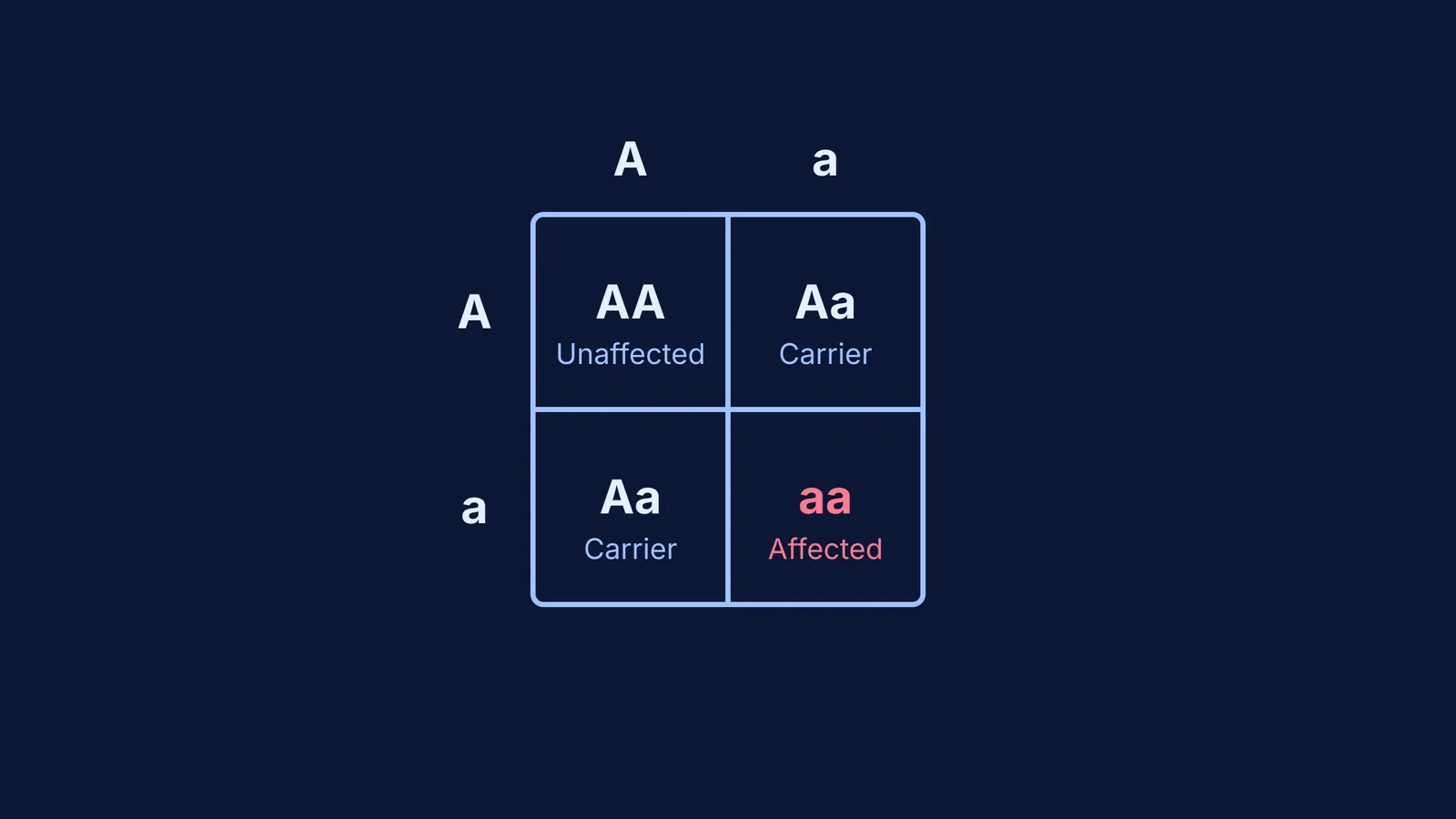
When a disease like cystic fibrosis behaves as a recessive trait, you can use a Punnett square to find the probability of a child inheriting it. If both parents are healthy carriers (they have one normal gene 'A' and one mutated gene 'a'):
Parents' genotype: Aa × Aa
Offspring probabilities:
25% AA (unaffected, not a carrier)
50% Aa (unaffected carrier)
25% aa (affected by the disease)
This 25% chance for each pregnancy matched the population prevalence Andersen and Hodges observed when they studied the families of children with cystic fibrosis.
When learning about inheritance, students often struggle to see how a recessive trait skips generations or appears when both parents are healthy. Fermi's AI tutor can work out what you already know and build a plan for the session, drawing the genetic crosses on a board and checking your understanding as it goes.
The next breakthrough came in 1948, when a heatwave hit New York and several children were admitted to Babies Hospital with heat exhaustion. Andersen noticed most of them had cystic fibrosis. She hypothesized that their susceptibility to heat exhaustion was related to a difference in their sweat. In 1951, she and medical resident Walter Kessler published the first observation that the sweat of patients with cystic fibrosis had a significantly higher chloride content. This insight led to the "sweat test" that is still the standard diagnostic tool today.
What is Dorothy Andersen's legacy today?
Before Andersen began her research, babies born with cystic fibrosis did not live past childhood. She developed the first treatments for the disease, including a high-protein, low-fat diet and replacement therapy for pancreatic enzymes. Today, with modern treatments building on her foundational work, babies born with cystic fibrosis can expect to live well into their 60s and beyond.
Beyond cystic fibrosis, Andersen contributed significantly to the understanding of other diseases. In 1956, she described a rare glycogen storage disease, now known as Andersen's Disease. She also investigated inherited heart malformations in children, and her systematic specimens became a vital reference for the first surgeons attempting open-heart surgery.
For students aiming for a career in medicine, Andersen's path shows how meticulous observation and studying the fundamental mechanisms of the body can change thousands of lives.


