

On this page
Every photo you send on WhatsApp leaves your phone as many small pieces, each finding its own way across the network and being put back together at the other end. The person who named those pieces was Donald Davies, a Welsh physicist and mathematician working at the National Physical Laboratory (NPL) near London. NPL itself says his packet-switching work is the way that today's internet works.
Who was Donald Davies?
Davies was born on 7 June 1924 and died on 28 May 2000, according to the Oxford DNB entry reproduced by the MacTutor archive. He took degrees in physics and mathematics at Imperial College London, then joined NPL in 1947 and was briefly Alan Turing's assistant, working on the Pilot ACE computer.
By the 1960s, many users shared each computer from remote terminals, sending short bursts of data with long pauses between. The telephone network was built for the opposite: a voice call holding a whole line open.
What did Davies propose in 1965?
On 10 November 1965 Davies wrote a paper, "Remote On-line Data Processing and its Communication Needs", arguing that a store-and-forward network would work well if its lines ran at 10,000 bits per second or more, as described by the History of Computer Communications project. The same source records that his lecture on 16 March 1966 drew at least 120 people, when such talks usually drew 20 to 30.
The core idea, in the words of his Oxford DNB biography: long messages were split into chunks sent separately to minimise the risk of congestion. Each chunk carries its own address, every switch on the way stores it briefly and forwards it, and the receiver puts the pieces back in order.
Why did he call them packets?
Davies's June 1966 paper, "Proposal for a digital communication network", was the first use of the word "packet", chosen to separate the message a user wants to send from the smaller units that actually travel. He picked the word after consulting an NPL linguist, because it translated into other languages without compromise.
He was not alone. Paul Baran at the RAND Corporation had earlier worked on sending data in small chunks routed independently, and Vint Cerf has said that ["Kleinrock, Baran, Davies, and Roberts developed their [packet-switching] ideas pretty much independently"](https://www.internethalloffame.org/2012/09/11/why-do-we-call-them-internet-packets-his-name-was-donald-davies/). It was Davies's word that stuck.
How did packets reach the internet?
In 1967 Roger Scantlebury presented the NPL paper "A digital communication network for computers giving rapid response at remote terminals", by Davies, Keith Bartlett, Scantlebury and Peter Wilkinson, at an ACM symposium in Gatlinburg, USA. Influenced by the NPL design, the planned ARPANET line speed was upgraded from 2.4 kbit/s to 50 kbit/s, and Larry Roberts built these concepts into the ARPANET design.
According to the Oxford DNB, the ARPANET and the NPL local network became the first two computer networks in the world to use packet switching. Parts of the NPL network were running in early 1969, and the IEEE Computer Society dates its completion to 1971. ARPANET later grew into the internet, whose packets follow the rules described in our post on Vint Cerf, Bob Kahn and TCP/IP.
How much faster do packets arrive?
Here is the arithmetic that makes the idea click. Take the 10,000 bits per second from Davies's 1965 paper and ignore headers, processing time and signal travel time.
Send an 8,000-bit message from A to B through two switches, so it crosses three links.
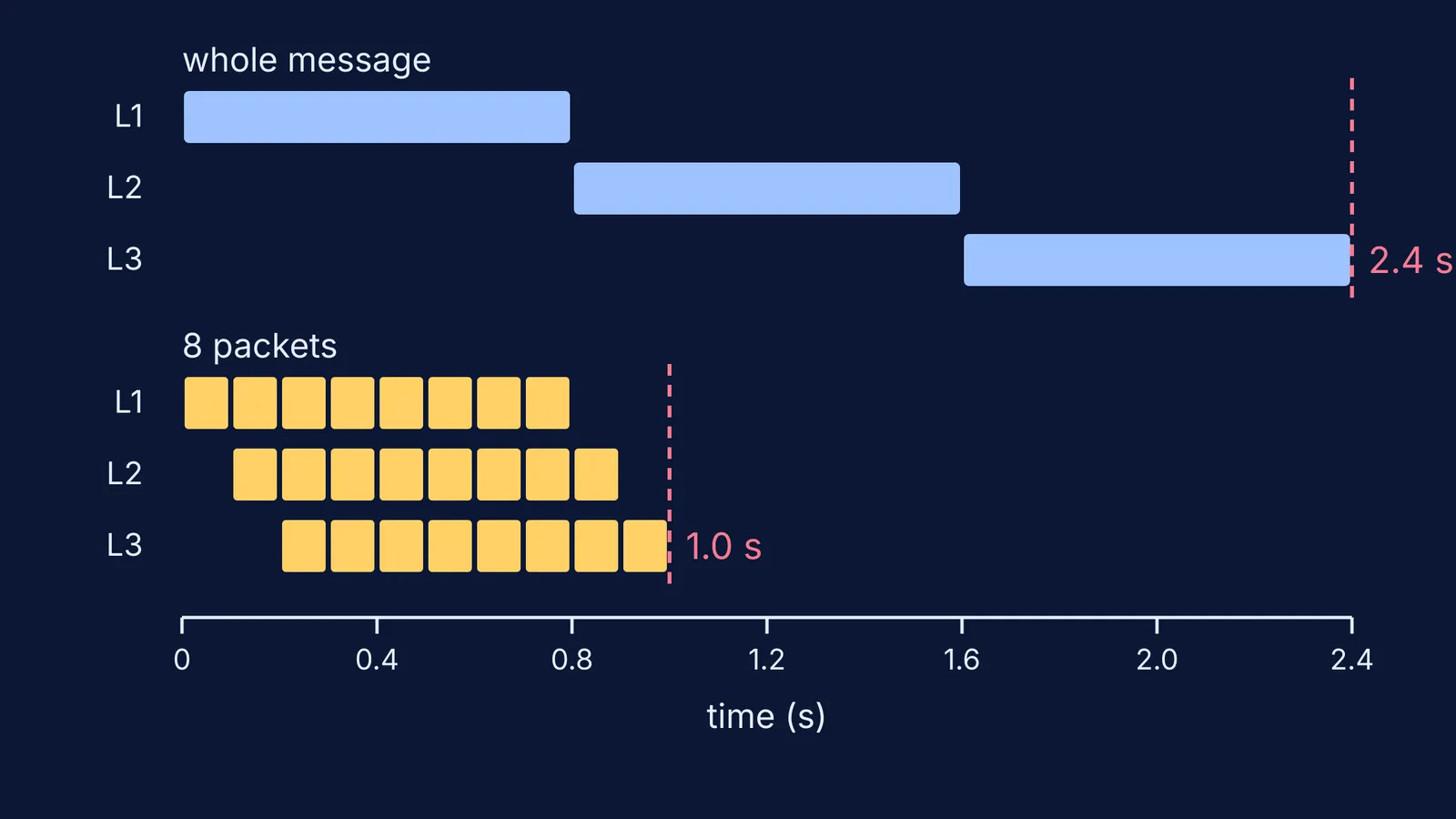
Whole message. Each switch must receive all 8,000 bits before forwarding. One link takes 8,000 ÷ 10,000 = 0.8 s. Three links in turn: 3 × 0.8 = 2.4 s.
Eight packets of 1,000 bits. One packet crosses one link in 0.1 s. While packet 2 is on link 1, packet 1 is already on link 2, so the links work in parallel like a relay. The last packet leaves A at 0.8 s and needs two more hops: 0.8 + 0.2 = 1.0 s.
General rule. With n packets over k links, each taking time t per link, the total is (n + k − 1) × t. Here (8 + 3 − 1) × 0.1 = 1.0 s.
The second gain is fairness: packets stop short messages getting stuck behind long ones. A short 1,000-bit message stuck behind the 8,000-bit one waits 0.8 s on a shared link; if packets take turns, it waits about 0.1 s.
If pipelining feels slippery, draw one row of boxes per link, as in the diagram above. Fermi's AI tutor can work through a problem like this alongside you and check your understanding as it goes, and the Fermi Concept Library covers the computing ideas behind it.
Davies's other lesson is about splitting big things into small, checkable pieces. Two related stories show where that leads: Claude Shannon measuring information in bits and Richard Hamming's codes that fix their own errors.


