

On this page
Peter Gustav Lejeune Dirichlet was born on 13 February 1805 in Düren and died on 5 May 1859 in Göttingen, where he was offered Gauss's chair on Gauss's death in 1855, according to his MacTutor biography. The same biography records that in 1837 he proved every arithmetic progression whose first term is coprime to the common difference contains infinitely many primes.
The idea most students meet under his name is humbler, and olympiad-ready: the box principle.
What is the pigeonhole principle?
In its basic form: if n items are put into m containers and n is greater than m, at least one container holds more than one item, as Wolfram MathWorld states it.
The general form, from the same MathWorld page, says that if n objects are placed in k boxes, some box holds at least n/k objects, rounded up.
So 13 people must include two born in the same month, because there are only 12 months. And 50 students split across 7 sections means some section has at least 8, since 50/7 is about 7.1 and rounding up gives 8.
Did Dirichlet invent the pigeonhole principle?
No. Historians Benoît Rittaud and Albrecht Heeffer traced it to a 1622 book by the French Jesuit Jean Leurechon in their paper The pigeonhole principle, two centuries before Dirichlet in The Mathematical Intelligencer. Leurechon's 1622 Selectæ Propositiones mentions it briefly, and a 1624 book spells it out in more detail, as summarised on Leurechon's Wikipedia page, which cites that paper. His example, as translated in the Wikipedia article on the principle: two men must have the same number of hairs, écus (coins) or other things.
The principle is still usually credited to Dirichlet, and MathWorld dates his statement of it to 1834. Writing in French and German, he used the words tiroir and Schubfach, both meaning drawer, which is why it is also called Dirichlet's box or drawer principle. The English word pigeonhole means a small compartment in a desk for papers and letters, not a bird's nest, as the same Wikipedia article explains.
How does the box principle prove Dirichlet's approximation theorem?
In 1842 Dirichlet answered a basic question of Diophantine approximation: how closely can a real number be approached by fractions, given a limit on the denominator? Peter Thurnheer's article in Elemente der Mathematik dates the answer to that year.
Alan Baker's textbook A Comprehensive Course in Number Theory states the result: for any real θ and any integer Q > 1, there are integers p and q with 0 < q < Q and |qθ − p| ≤ 1/Q. Baker proves it with the pigeonhole principle, sorting Q + 1 numbers into Q intervals of length 1/Q.
Worked example: approximating √2 with five boxes
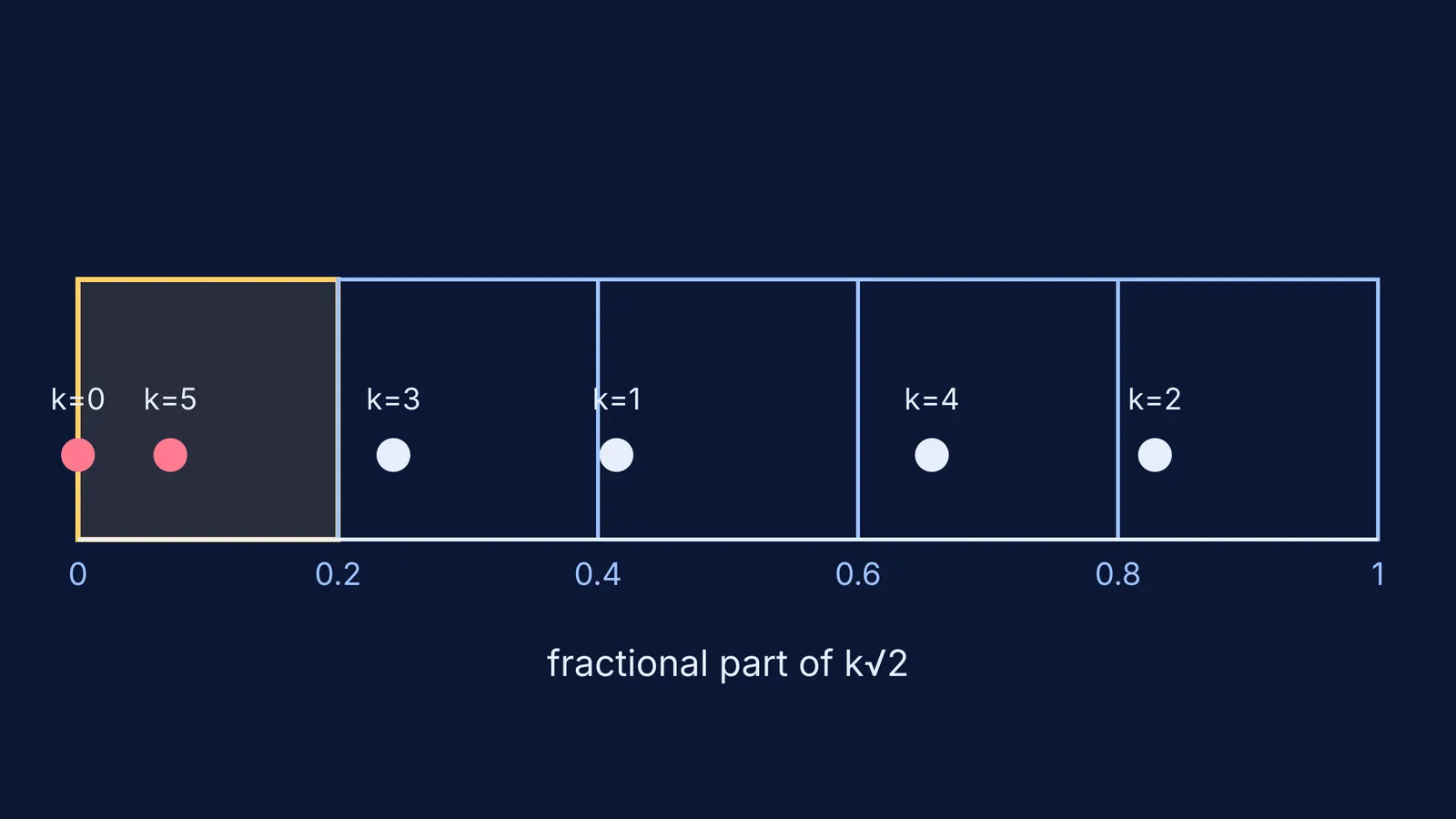
Take the multiples k√2 for k = 0, 1, 2, 3, 4, 5. They are 0, 1.414, 2.828, 4.243, 5.657 and 7.071.
Keep only the part after the decimal point: 0, 0.414, 0.828, 0.243, 0.657, 0.071.
Split the interval from 0 to 1 into five boxes of width 0.2.
Six numbers, five boxes: two must share a box. Here k = 0 and k = 5 both land in the first box.
So 5√2 is within 0.2 of a whole number. In fact 5√2 = 7.071, just 0.071 away from 7.
Divide by 5: √2 is close to 7/5 = 1.4, with an error of about 0.014, smaller than 1/25.
Notice that you never searched for a good fraction. The box argument guaranteed one would appear.
How do you spot a pigeonhole problem in an olympiad?
Use this five-step check:
Read the claim. Words like "prove that at least two" or "there exist" signal an existence proof.
Count your objects: numbers, points, people, subsets, partial sums.
Design the boxes: remainders, intervals, regions of a figure, or pairs.
Check the count: more objects than boxes, or n objects and k boxes giving at least n/k rounded up.
Write it cleanly: name the pigeons, name the holes, state the count, conclude.
Try this one. Pick any six numbers from 1 to 10 and prove two of them add up to 11. The boxes are the pairs {1, 10}, {2, 9}, {3, 8}, {4, 7} and {5, 6}. Six numbers, five boxes: one pair is chosen completely.
For more practice, see our guide to IOQM combinatorics and pigeonhole questions. To turn a box argument into a full write-up, read how INMO proofs are marked, and if you are new to the contest, start with getting started with the maths olympiad in India.
If remainders still feel shaky, the Fermi Concept Library gives each mathematics concept its own lesson. When your boxes keep failing, the Fermi Problem Library has worked problems with a step-by-step solver that explains the reasoning rather than printing an answer.
Next time a problem asks you to prove that two things must match, count the boxes first.


