

On this page
In 1971, psychologist Edward Deci paid some university students to solve puzzles and left others unpaid. Once the money stopped, the paid students showed less interest in the puzzles than students who had never been paid. That small result went against the common idea that rewards always help, and it helped start decades of research. With his colleague Richard Ryan, Deci turned it into self-determination theory, a framework for understanding why students study, give up, or keep going.
What did Edward Deci's 1971 puzzle experiment find?
Deci published the study as Effects of externally mediated rewards on intrinsic motivation in the Journal of Personality and Social Psychology. Students worked on Soma cube puzzles over three sessions. One group was paid for puzzles they solved in the second session only; a control group was never paid. Each session included a break in which students were free to do whatever they wanted, and Deci recorded whether they kept working on the puzzles.
The finding, as the Boston Globe's obituary of Deci summarised it, was that students in the third phase "were significantly less motivated to complete the task than those in a control group who had never received money." Deci put it simply: "When we began to reward people for things they found interesting, they stopped finding it interesting anymore." He died in February 2026, aged 83, after a career spent at the University of Rochester, where he and Ryan set up the Human Motivation Program in 1981.
What is self-determination theory of motivation?
Self-determination theory (SDT) says people are most self-motivated, and mentally healthier, when three basic psychological needs are met: competence, autonomy and relatedness, as Ryan and Deci set out in American Psychologist in 2000. When these needs are thwarted, the same paper says, motivation and well-being fall.
Autonomy: feeling that you chose what you are doing and agree with why you are doing it.
Competence: feeling that you can get better at it, with challenges that stretch you but are within reach.
Relatedness: feeling connected to and cared for by the people around you.
The theory also separates kinds of motivation. Intrinsic motivation is doing something because it is interesting. Other motivation can be controlled from outside (studying to avoid a scolding) or more autonomous (studying chemistry because you value becoming a doctor). The same 2000 paper reports that threats, deadlines, directives, pressured evaluations and imposed goals tend to reduce intrinsic motivation, while choice, acknowledging feelings and chances for self-direction tend to increase it.
Do rewards always kill motivation?
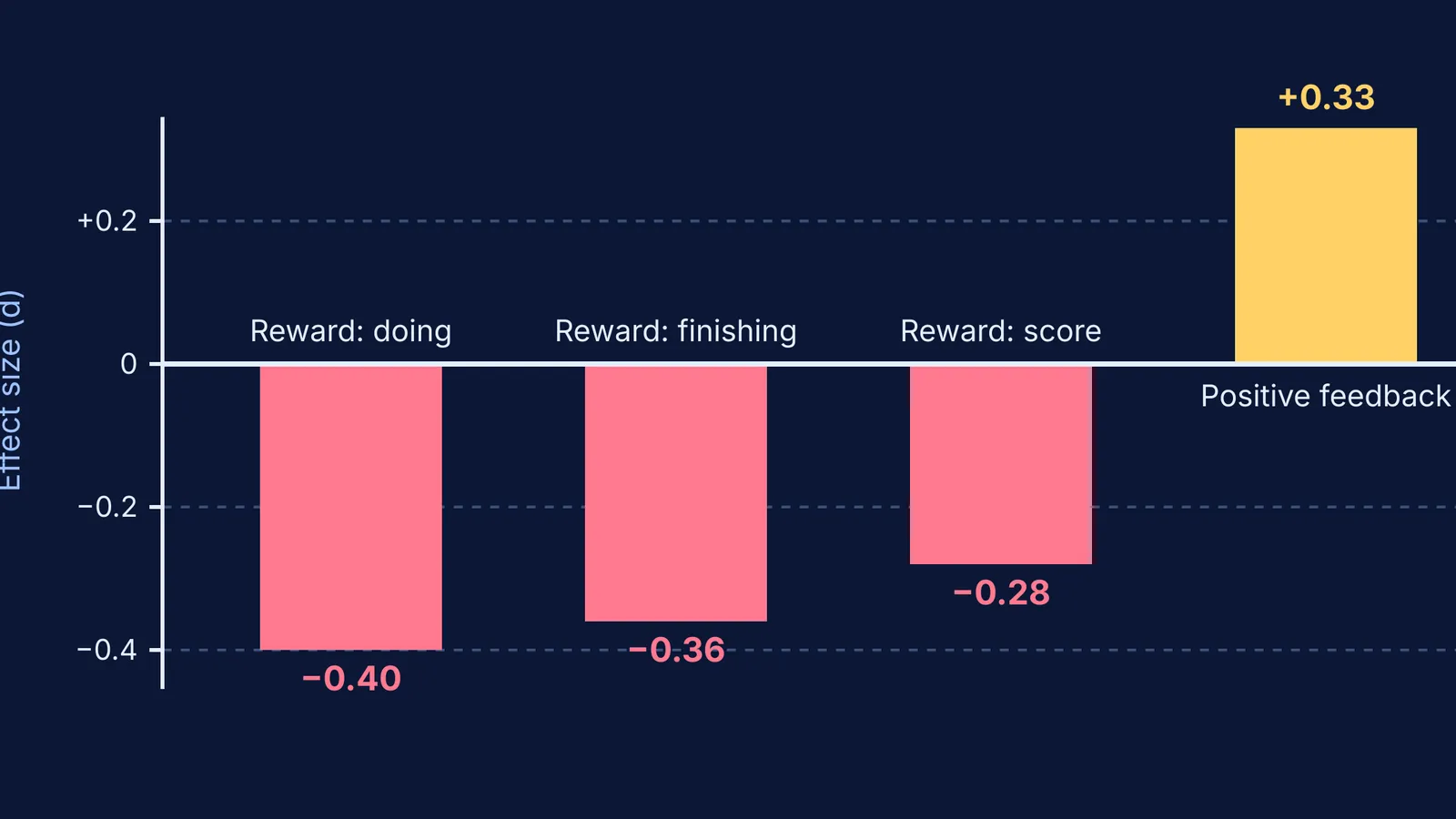
No. A key test is a 1999 meta-analysis of 128 studies by Deci, Koestner and Ryan. Expected tangible rewards given for doing, finishing or scoring well on a task reduced free-choice intrinsic motivation, with effect sizes of d = -0.40, -0.36 and -0.28. Positive feedback did the opposite: it raised free-choice behaviour (d = 0.33) and self-reported interest (d = 0.31). Tangible rewards tended to be more harmful for children than for college students.
The school setting matters too. A 2022 meta-analysis of 144 studies covering more than 79,000 students found that teachers' support for autonomy predicted students' need satisfaction and self-determined motivation more strongly than parents' support did.
We covered the reward question in more depth in do rewards help or hurt study motivation. The idea of competence also overlaps with Albert Bandura's work on self-efficacy.
How can you use self-determination theory when studying?
Here is a weekly check you can do in five minutes, one question per need.
Autonomy: did I choose anything this week? Pick the order of your chapters, or the time slot for revision, yourself. Write one sentence on why this subject matters to you, in your own words.
Competence: was it the right difficulty? If every problem felt impossible, drop down a level; if every one felt easy, step up. Track what you can now do that you could not do last week.
Relatedness: did I study with or talk to anyone? One doubt-clearing session with a friend or teacher counts.
When competence is the weak spot because you keep getting stuck without knowing why, the Fermi Problem Library has worked problems with a step-by-step solver that explains the reasoning rather than printing an answer.
For parents, small changes in wording do a lot of the work. Instead of "Finish physics before dinner or no phone", try: "Physics and maths are both on today's list. Which do you want to start with, and when?" Instead of "Good, 92%", try: "You set up the free-body diagram before writing any equations. That's why the answer came out right." Instead of cash for marks, offer company: sit nearby with your own reading.
If a child has lost interest for weeks, our guide on what to try when your child loses interest in studies goes step by step. If low motivation comes with persistent sadness, sleep changes or withdrawal, talk to a doctor or counsellor, or call the government's toll-free Tele MANAS helpline on 14416.
Start with the three questions this week, and change one thing: give one real choice.


