

On this page
D.D. Kosambi weighed thousands of punch-marked coins and proved that their age could be determined by how much weight they had lost to wear. By analysing the growing variance in their weights, he transformed numismatics from descriptive archaeology into a rigorous statistical science.
Punch-marked coins, known as *karshapanas*, are India's earliest currency. Unlike modern money, they bear no dates or written text, only stamped symbols of animals, hills and trees. For decades, historians struggled to arrange these hoards in chronological order.
The breakthrough came from outside archaeology. D.D. Kosambi, a polymath and mathematician who later formulated the Kosambi mapping function in genetics, realised that you should not just look at the pictures on the coins. You should weigh them 1.
How did D.D. Kosambi use statistics for punch-marked coins?
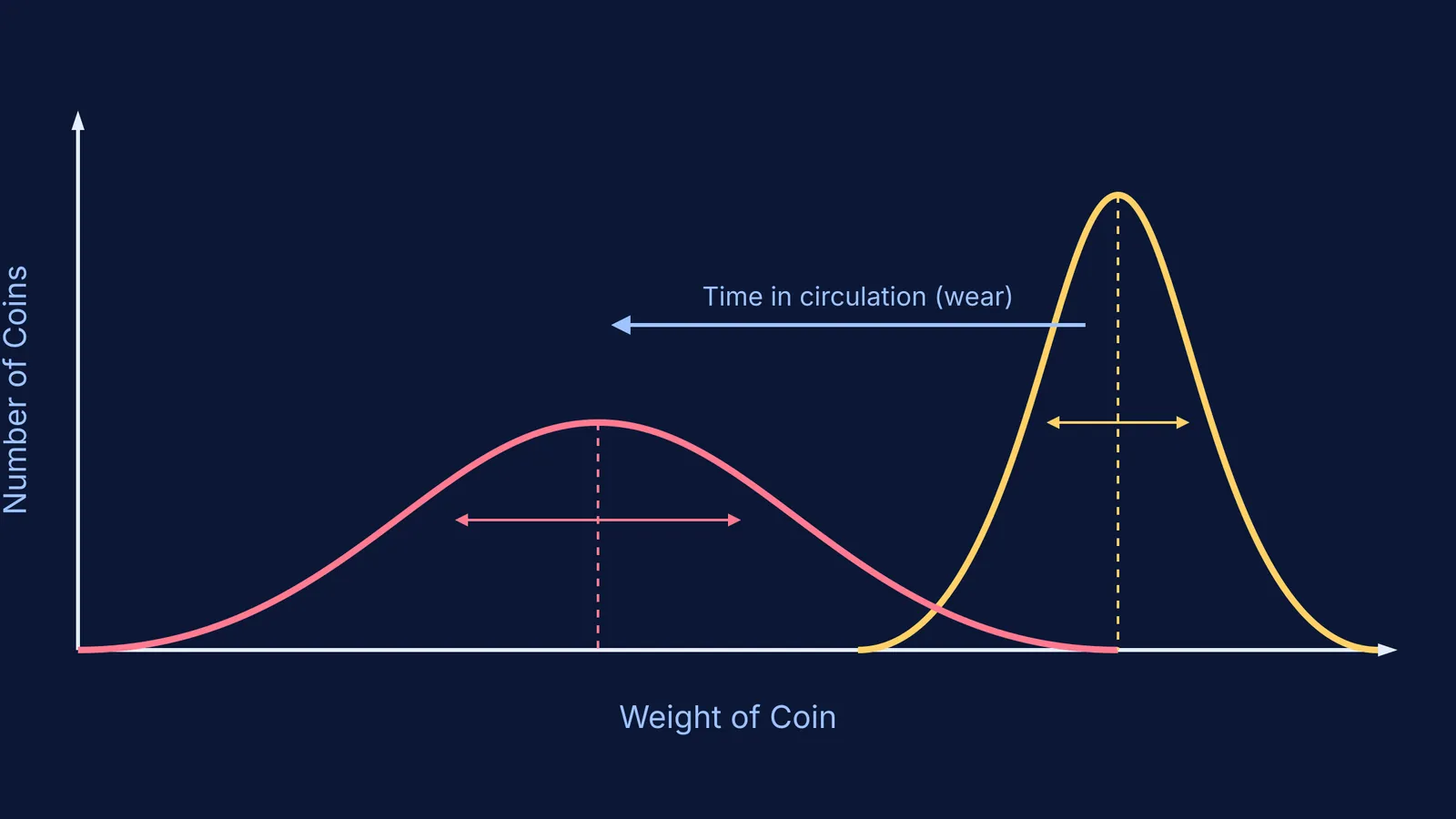
Kosambi's logic was based on a simple physical reality: when coins are passed from hand to hand over decades, tiny bits of silver rub off. He theorised that this wear was a measurable chronometer 1.
When a central authority mints a batch of coins, they are designed to have exactly the same weight. There is very little variation. However, as the coins enter circulation, two things happen:
The average drops: The longer a group of coins circulates, the more silver is lost to wear, lowering the group's average weight.
The variance increases: Because some coins are used daily while others sit in a merchant's pot, they wear at different rates. The spread of their weights grows wider.
Older coins have a lower average weight and a higher variance 1. By applying statistical tests to change the mean and variance of different hoards, Kosambi could definitively prove which group of coins was older, effectively dating them without needing a written year.
What do the reverse marks on punch-marked coins mean?
Kosambi did not stop at weight. He also analysed the small, seemingly random punches on the reverse side of the coins. Historians had long debated their purpose.
Using regression analysis, Kosambi established a relationship between the number of reverse marks and the loss of weight. He argued that these were checking marks, added by traders or guilds at regular intervals to validate the coin's purity as it circulated. The more reverse marks a coin had, the longer it had been in circulation and the lighter it tended to be.
His 1940 paper, *"A statistical study of the weights of the old Indian punch-marked coins,"* showed that ancient objects could yield deep historical truths when subjected to modern mathematical analysis 1.
What can students learn from Kosambi's variance?
Kosambi's method of looking past the surface is directly applicable to how you study.
Many students track only their total mock test scores, treating them like the pictures on a coin. If you score the same total on three consecutive physics tests, the average tells you that you are stuck. But the *variance* tells you how to get unstuck.
If you lost those marks on completely different topics in each test, your variance is high; you likely have a broad problem with recalling formulas under time pressure. But if you lost them on the exact same rotational mechanics and thermodynamics questions every time, your variance is low. You have a specific, structural gap in your understanding.
You do not have to calculate this by hand. Fermi's AI tutor works on a similar principle of tracking patterns. It does not just score your final answer; it holds a line of reasoning across a session, notices where you are stuck, and decides whether to explain, ask, or show. By working out what you already know, it builds a plan for the session so you sit down to a clear next step instead of guessing what to revise.
When you track the specific nature of your errors rather than just the total, you stop studying blindly and start fixing the exact concepts that are costing you marks.


