

On this page
In the early 1990s, medical science faced an agonizing paradox. Following the initial identification of HIV, which built upon Françoise Barré-Sinoussi's 1983 isolation of HIV, infected individuals often lived for seven to ten years with no outward symptoms. Because viral concentrations in blood remained steady during this period of clinical latency, researchers assumed the virus was dormant, replicating sluggishly in hiding.
Physician-scientist David Ho, who treated early AIDS cases in Los Angeles in 1981 after studying physics at Caltech and earning his medical degree at Harvard, suspected otherwise. In physical systems, a steady quantity often reflects a dynamic equilibrium: a roaring waterfall where creation matches destruction.
How did David Ho prove HIV replicates at extreme speed?
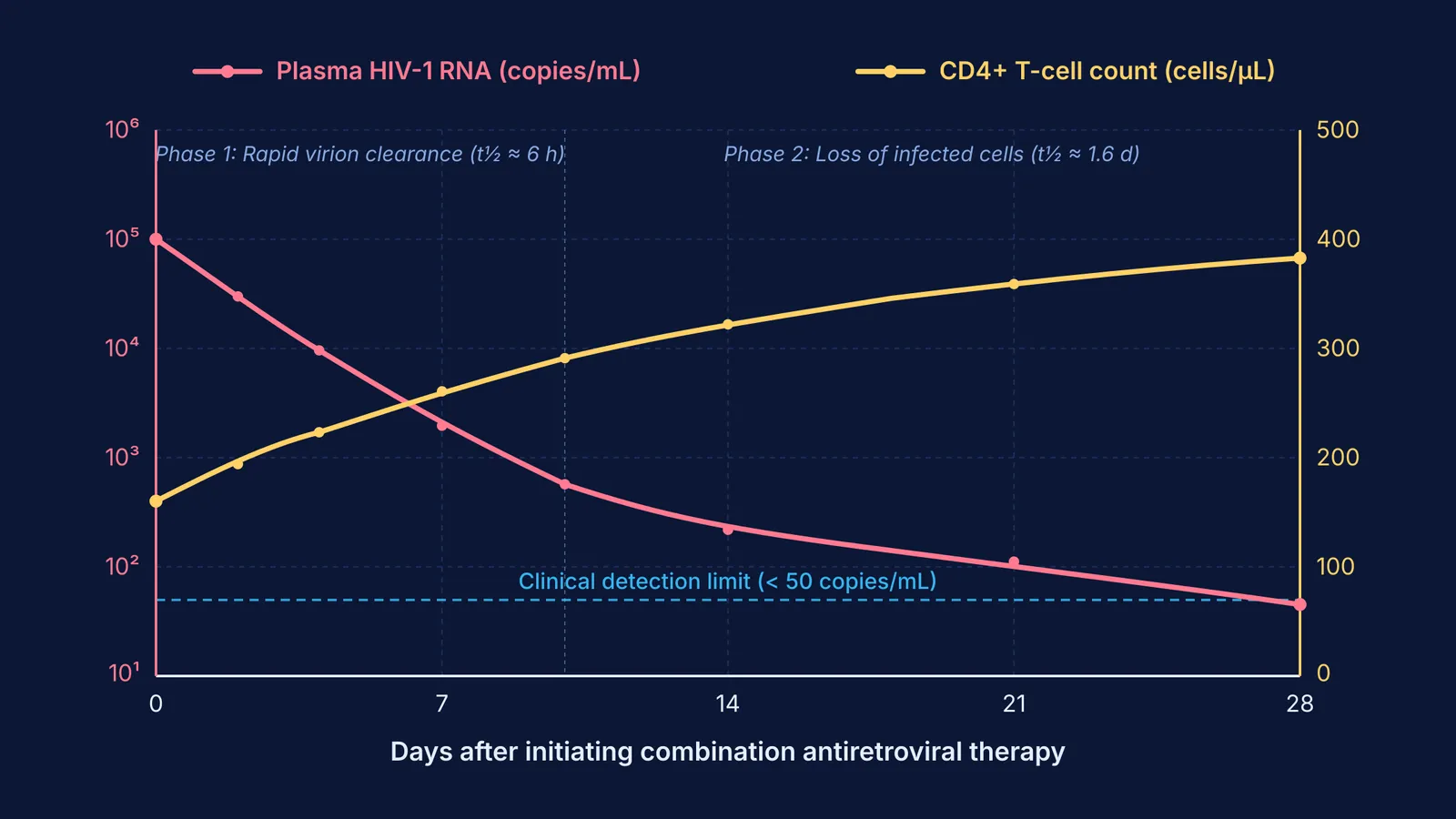
To measure viral activity, Ho gave patients a newly developed protease inhibitor, ABT-538. Protease inhibitors stop infected cells from assembling functional virions. In a January 1995 study published in Nature, Ho and his team found that blocking new infections caused blood viral RNA to plunge exponentially, revealing a virion clearance half-life of roughly 2.1 days.
In a 1996 follow-up in Science with Alan Perelson, earlier sampling showed plasma virions clear with a half-life of roughly 6 hours (mean lifespan of 0.3 days), while infected CD4+ T cells survive only 2.2 days. Because viral load had been stable before treatment, production had to equal clearance. Ho calculated that a patient produces roughly 10.3 billion (10¹⁰) new virions every day, forcing the body to replace 2 billion CD4+ T cells daily, a massive immune burden linked to Jacques Miller's research on thymus T cells.
Why did single-drug treatments fail against HIV?
This rapid turnover explained why monotherapy failed. In 1987, zidovudine (AZT) became the first approved drug, but patients relapsed within months. As documented in Science, HIV reverse transcriptase lacks proofreading and introduces roughly 3.4 × 10⁻⁵ mutations per base pair per replication.
With 10¹⁰ virions produced each day across a 10,000-base genome, every possible single point mutation occurs thousands of times daily in one person. As detailed in our guide on how HIV replicates inside helper T cells, drug-resistant mutants pre-exist before therapy begins. Single drugs simply eliminate sensitive strains and leave resistant mutants to multiply.
How does combination therapy trap the virus mathematically?
In August 1995, Ho argued in the New England Journal of Medicine that doctors must hit HIV early and hard with combination drug therapy. Combining three drugs from different classes creates a steep compound probability barrier:
Single drug: The chance of resistance is roughly 1 in 100,000 (10⁻⁵). In 10¹⁰ virions daily, 100,000 resistant copies arise every day.
Double combination: Resistance requires two simultaneous mutations, a probability of 10⁻¹⁰. In 10¹⁰ daily virions, double mutants still occasionally emerge.
Triple combination: Resistance requires three independent mutations at once, dropping odds to 10⁻¹⁵. Generating one triple mutant demands 10¹⁵ virions, or over 270 years of replication.
Because triple therapy suppresses viral replication by over 99%, daily virion production drops below 10⁶, freezing the mutation process entirely.
How did combination therapy transform global healthcare?
At the July 1996 International AIDS Conference in Vancouver, Ho presented clinical trial data showing that triple combination therapy drove viral loads below detection limits. Halting active replication before drug-resistant strains could emerge transformed HIV from a fatal diagnosis into a manageable chronic condition, prompting *Time* magazine to name David Ho its 1996 Man of the Year.
Today, the World Health Organization reports that 89% of diagnosed individuals received antiretroviral therapy by 2025, with 95% achieving viral suppression. In India, the Ministry of Health and Family Welfare provides free combination therapy across more than 700 centres, helping lower annual AIDS-related deaths by 77% since 2010.
How to connect viral kinetics to STEM problem-solving?
David Ho's work shows how mathematical rate laws clarify biological systems. When you study kinetics, exponential decay, or probability in advanced STEM courses, seeing how rate equations in Science proved HIV produces 10¹⁰ virions daily bridges theory and practice.
When you practice multi-step rate calculations, the Fermi Problem Library offers worked problems with a step-by-step solver that explains the reasoning rather than printing an answer. If you want to see how inhibitor molecules bind to viral enzymes, the Fermi Simulation Lab provides interactive simulations for ideas that are easier to see than to read. And when you need to connect formulas across biology and chemistry, Fermi's AI tutor works out what you already know and builds a plan for the session, holding a line of reasoning through each topic.


