

On this page
David Baker was awarded one half of the 2024 Nobel Prize in Chemistry for his work on computational protein design. While evolution has spent billions of years creating the proteins that run our cells, nature has only explored a tiny fraction of what is possible. Baker's lab at the University of Washington used their Rosetta software suite to build entirely new proteins that do not exist in the natural world.
These bespoke molecules are not just academic curiosities. They are already being used as vaccines, nanomaterials, and microscopic sensors, showing that we can now write the atomic blueprints for life from scratch.
Why did David Baker win the Nobel Prize in Chemistry?
Proteins are long chains of amino acids that fold into complex three-dimensional shapes. The final shape dictates what the protein does. For decades, the "protein folding problem" was a one-way street: scientists struggled to predict how a natural string of amino acids would fold. If you are reviewing the basics of how these chains assemble, see our guide on protein structure from primary to quaternary.
Baker realised that the rules of folding could be run in reverse. If you know the physical forces that govern how amino acids as zwitterions attract and repel each other, you can define a target shape first and then calculate the sequence needed to form it.
In 2003, his team showed this was possible. They published a paper in *Science* detailing the creation of Top7, a 93-residue protein with a fold never before seen in nature (Source). When they synthesised it and measured its structure using X-ray crystallography, the physical protein matched their computer's prediction to within 1.2 angstroms. It was the first time a completely novel, stable protein had been designed with atomic-level accuracy.
If you have gaps in your understanding of the forces that hold these macromolecules together, the Fermi Concept Library contains every concept in chemistry and biology, each with its own lesson and its place in the map.
How does Rosetta design new proteins?
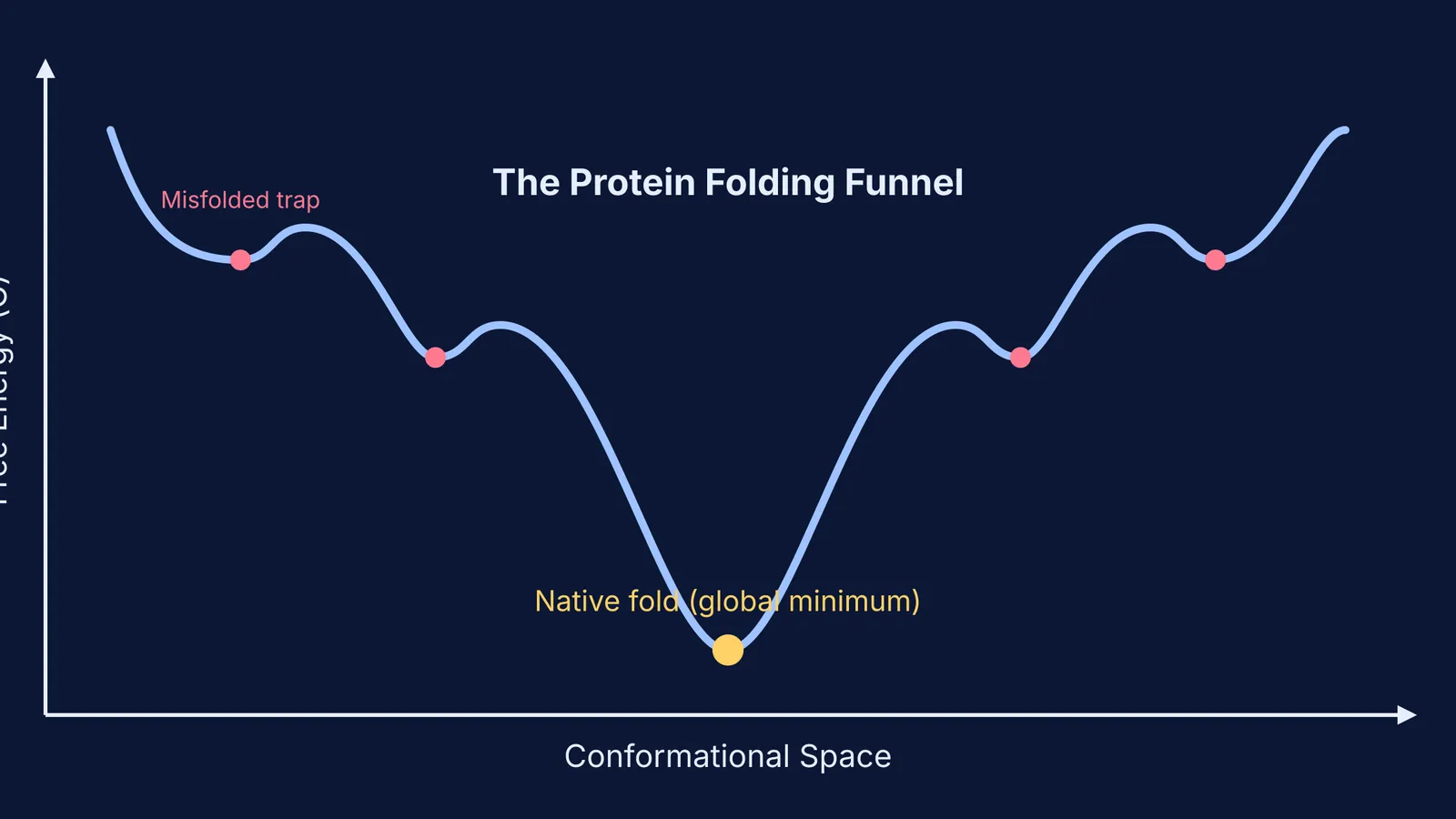
The secret to designing a new protein is finding the sequence that has the lowest possible free energy for the shape you want. If the target shape is the global energy minimum, the protein will naturally fold into it like a ball rolling to the bottom of a deep funnel.
Here is how the Rosetta software tackles the problem:
Pick the shape: The designer specifies a backbone blueprint, arranging alpha helices and beta strands into a useful 3D geometry.
Search the sequences: Rosetta tries millions of amino acid combinations. It uses a method called Monte Carlo sampling, constantly swapping amino acids to see which combinations lower the physical energy score.
Check for traps: The software then checks if the chosen sequence might accidentally prefer a different, misfolded shape. It explicitly destabilises these alternative states (a process called negative design) to ensure the target shape is the deepest well in the energy landscape.
Build and test: Once the sequence is finalised on the computer, the corresponding DNA is synthesised and put into bacteria to mass-produce the physical protein for testing.
When you are stuck trying to follow a complex biological process, Fermi's AI tutor can work out what you already know and build a plan for the session, teaching you step by step until the concepts click.
What are designed proteins used for?
Because Rosetta allows scientists to dictate the exact geometry of a protein, they can build molecular machines tailored for specific tasks. These could one day serve as custom catalysts, similar to the natural six enzyme classes that drive cellular reactions.
One of the most significant real-world applications so far is the SKYCovione COVID-19 vaccine, which was approved for use in South Korea in June 2022 (Source). The vaccine uses a computationally designed protein nanoparticle as a core. This core is studded with 60 copies of the viral receptor-binding domain. Because the computer designed the scaffold to hold the viral fragments in a highly organised, symmetric pattern, the vaccine triggered a powerful immune response in clinical trials.
Unlike many mRNA vaccines, this nanoparticle is highly stable and can be stored at standard refrigerator temperatures (2 to 8°C). This makes it far easier to distribute globally. By mastering the code that translates sequence into structure, Baker's lab has turned protein design from a theoretical puzzle into a practical tool for medicine.


