

On this page
In 1958 Daniel Koshland, then a biochemist at Brookhaven National Laboratory in New York, published a short paper in PNAS called "Application of a Theory of Enzyme Specificity to Protein Synthesis" (Koshland, PNAS, 1958). Inside it was an idea that now sits in the enzymes section of Class 11 biology: the active site is not a rigid slot. It changes shape as the substrate binds.
Here is what the model says, how it differs from Fischer's, the evidence, and an answer frame for the exam hall.
What is Koshland's induced fit model of enzymes?
The induced fit model says that an enzyme changes its conformation (its three-dimensional shape) when a substrate binds, so the active site moulds itself around the substrate (Koshland, Angewandte Chemie). In that later review, the comparison is a glove: it changes shape as a hand slips into it.
UC Berkeley, where Koshland taught from 1965, put it simply in its 2007 obituary: he argued that the substrate "stretches and rearranges the pocket slightly, akin to the way a hand fits into a glove" (UC Berkeley News). The same obituary records that he was born in 1920, died in 2007, and edited the journal Science from 1985 to 1995.
How is induced fit different from Fischer's lock and key model?
Emil Fischer's lock and key idea came first, in the 1890s, and Koshland presented induced fit as an extension of it rather than a rejection (Koshland, Angewandte Chemie). If you want the back story, read how Emil Fischer arrived at the lock and key idea. The differences an examiner looks for:
Active site: rigid and already the right shape in lock and key; flexible, and only fully formed once the substrate binds, in induced fit.
What moves: nothing in lock and key; the enzyme itself in induced fit.
What it explains: lock and key explains specificity; Koshland's review says induced fit also explains regulation and cooperative effects.
Analogy: a key in a lock versus a hand in a glove.
What evidence showed enzymes really change shape?
Koshland built his case with laboratory experiments, which his Berkeley obituary says eventually convinced the scientific world. X-ray crystallography then let researchers compare an enzyme's structure with and without its substrate. A clear example came in 1978, when William Bennett and Thomas Steitz compared crystal structures of two forms of yeast hexokinase, one crystallized with glucose bound and one without it (Bennett and Steitz, PNAS, 1978).
Here is a worked reading of their abstract, step by step:
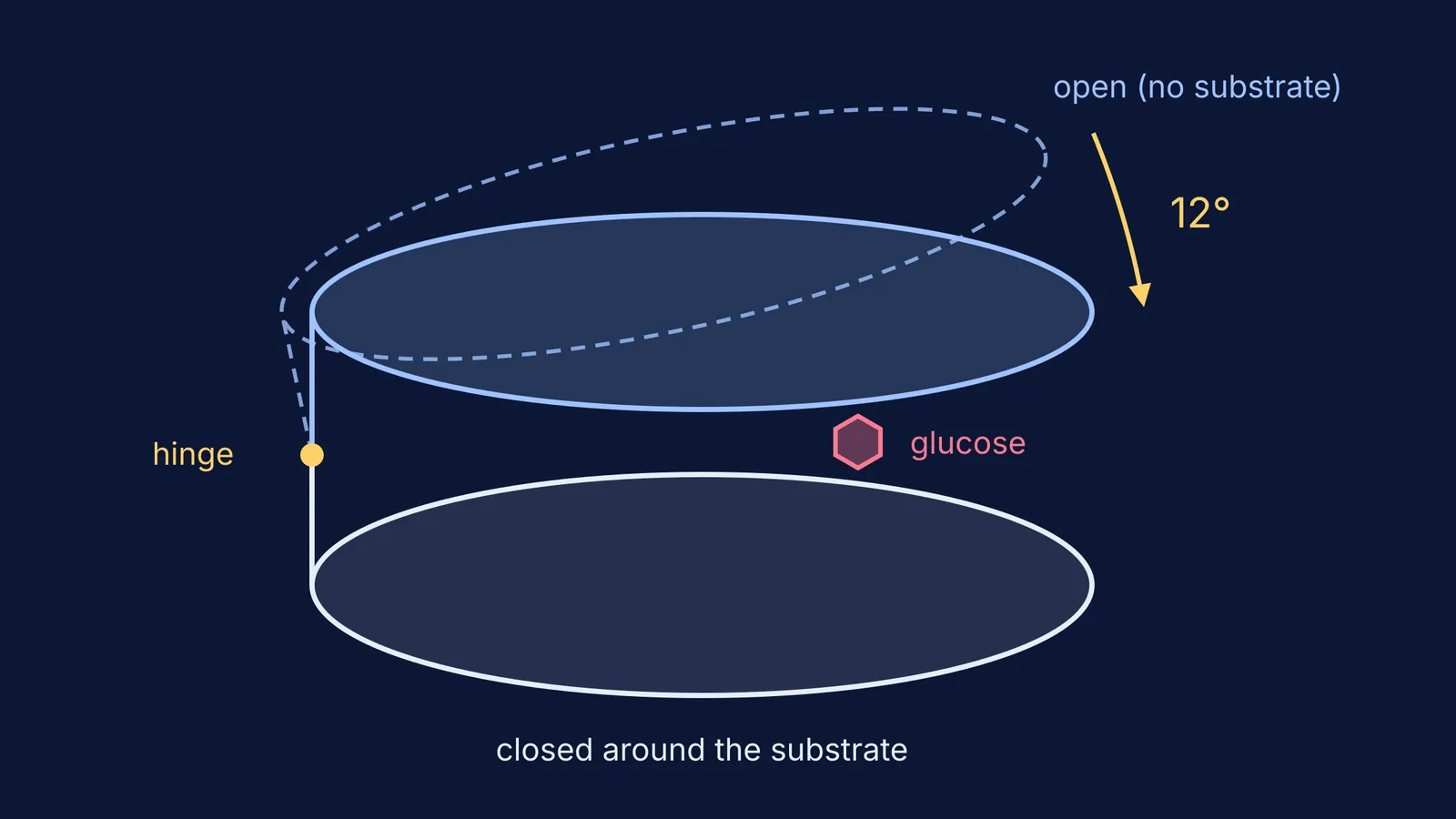
Hexokinase has two lobes with a cleft between them, and glucose binds in that cleft.
With glucose bound, one lobe is rotated by 12 degrees relative to the other.
Parts of the protein backbone move by as much as 8 Å. Since 1 Å is 0.1 nm, that is 0.8 nm, enough to close the cleft around the glucose.
The authors note that the change is produced by glucose binding and is essential for catalysis, and that it "thus provides an example of induced fit".
That 12 degree swing is the hero diagram at the top of this page: the dashed outline is the open enzyme, the solid outline is the enzyme closed around its substrate.
If a hinge moving in three dimensions is hard to picture from a flat textbook figure, the Fermi Simulation Lab has interactive simulations for ideas that are easier to see than to read.
How do you write the induced fit model in a Class 11 answer?
Use this five-line frame for a 3-mark question.
Define it: on binding the substrate, the enzyme's active site changes shape to fit the substrate closely.
Name and date it: proposed by Daniel Koshland in 1958 as a modification of Fischer's lock and key model.
Give the sequence: substrate binds the active site, the enzyme changes conformation, the enzyme-substrate complex forms, the reaction occurs, the products are released and the enzyme is free again.
Add evidence: hexokinase closes around glucose, with one lobe rotating 12 degrees.
Finish with the analogy: a hand in a glove, not a key in a lock.
Then run a quick self-check:
Did you use the words "active site" and "conformational change"?
Did you contrast it with lock and key in one clear sentence?
Did you avoid saying the substrate fits "exactly" before binding? That is the lock and key claim.
Read about Michaelis, Menten and the equation for enzyme speed to see how binding shows up in reaction rates, and revise the six enzyme classes with examples (hexokinase moves a phosphate group, so it belongs with the transferases). If enzymes still feel like a list of separate facts, the Fermi Concept Library gives every concept in biology its own lesson and its place in the map, so you can see where induced fit sits among the topics around it.
Next time you draw an active site, draw two shapes: before the substrate arrives, and after.


