

On this page
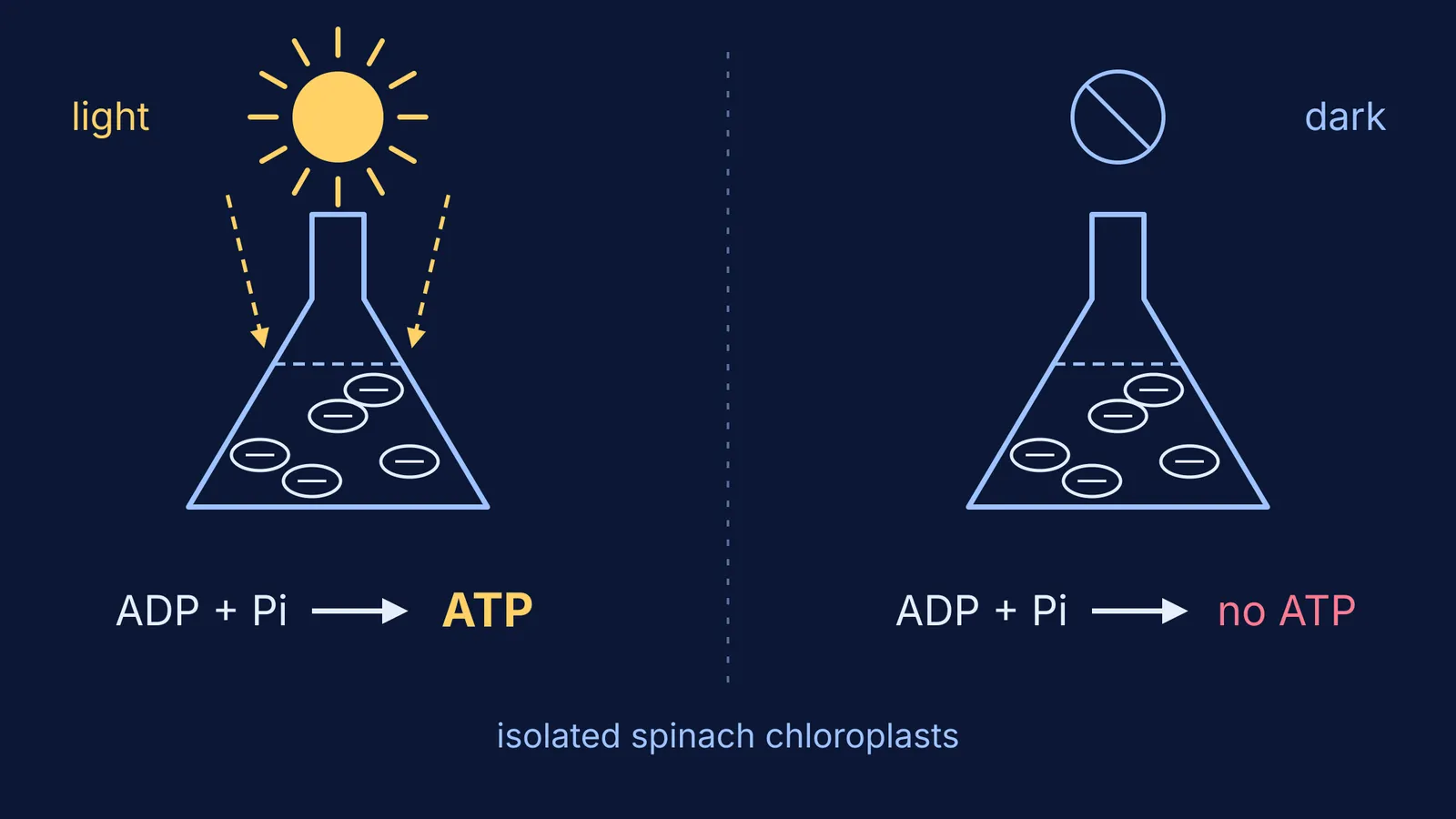
In 1954, Daniel Arnon's lab at the University of California, Berkeley, took chloroplasts out of spinach leaves, gave them ADP and phosphate, and shone light on them. They made ATP. Arnon called the process photosynthetic phosphorylation. Today it's the ATP-making step of the light reactions in your Class 11 biology book.
Who was Daniel Arnon?
The National Academy of Sciences biographical memoir of Arnon records that he was born in Warsaw, Poland, on 14 November 1910 and died on 20 December 1994. He completed his PhD in 1936 under Dennis Hoagland and spent his whole career at Berkeley, apart from military service in the Second World War. He also studied plant nutrition. He and his collaborators showed that plants need molybdenum to grow, and his work with Hoagland produced the formula for Hoagland's solution, a nutrient solution the memoir says is still used worldwide.
He received the US National Medal of Science in 1973 "for fundamental research into the mechanism of green plant utilization of light to produce chemical energy and oxygen", according to the National Science and Technology Medals Foundation.
What did Arnon show with isolated chloroplasts in 1954?
Arnon, Mary Belle Allen and F. R. Whatley published "Photosynthesis by Isolated Chloroplasts" in Nature in August 1954 (Nature 174, 394-396). A longer paper followed that December, and its subtitle gives the result away: "Photosynthetic Phosphorylation, the Conversion of Light into Phosphate Bond Energy" (Journal of the American Chemical Society 76, 6324-6329).
The NAS memoir says the work was done "with chloroplasts isolated from spinach leaves". It also says Arnon showed that "chloroplasts use the energy of sunlight to generate adenosine triphosphate (ATP)". A 2019 review in Annals of Botany puts it in one line: Arnon and colleagues "showed that isolated chloroplasts can produce ATP in light". The same review notes that intact isolated chloroplasts could even carry out complete photosynthesis, fixing CO2.
Why did it matter that the chloroplasts were isolated? NCERT notes that cells make ATP in both mitochondria and chloroplasts. If you pull the chloroplasts out and then show that light drives ATP formation, the chloroplast itself has to be the light-powered ATP factory.
The memoir credits Arnon with discovering two types. In cyclic photophosphorylation, ATP is the only product. In noncyclic photophosphorylation, ATP forms alongside oxygen release and NADPH. The memoir also records that his discoveries "were for years either unaccepted or unappreciated by influential workers" in the field.
The work fits into a longer story. It built on Robert Hill's finding that isolated chloroplasts release oxygen, and it supplies the ATP that drives Melvin Calvin's path of carbon. How the ATP is actually made was explained later by Peter Mitchell's chemiosmotic idea.
What is photophosphorylation in the NCERT light reactions?
These points come from NCERT's Class 11 Biology chapter, Photosynthesis in Higher Plants:
Photophosphorylation is the synthesis of ATP from ADP and inorganic phosphate in the presence of light.
Non-cyclic: PS II and PS I work in series, and both ATP and NADPH + H+ are made.
Cyclic: only PS I works and electrons cycle back to it, so only ATP is made. This probably happens in the stroma lamellae, and also when only light beyond 680 nm is available.
Mechanism: protons pile up inside the thylakoid lumen, and ATP synthase makes ATP as they flow back out to the stroma.
How would you design Arnon's experiment yourself?
Examiners like questions about the logic of a classic experiment. This walk-through follows that logic. It isn't the exact protocol from the 1954 paper.
Ask the question: can chloroplasts on their own turn light into ATP?
Pick the material: chloroplasts isolated from leaves (Arnon used spinach), so most of the rest of the cell is left behind.
Supply the raw materials: ADP and inorganic phosphate.
Set up two identical tubes and change only one thing: one in light, one in the dark.
Measure ATP in each tube.
Predict: ATP forms in the lit tube and little or none in the dark tube. That links ATP formation to light.
Now stretch it, using the NCERT definitions. Suppose a lit sample makes ATP but releases no oxygen and makes no NADPH. Which type is running? Cyclic, because only PS I is working and the electrons return to it. If oxygen, NADPH and ATP all appear, it's non-cyclic.
Test yourself before you check your notes:
Why is a dark tube needed? (It shows that light, not something else in the mix, drives ATP formation.)
Which photosystem works alone in cyclic flow? (PS I.)
Where do protons build up during the light reactions? (In the thylakoid lumen.)
If the Z scheme and proton flow are hard to see on a flat page, the Fermi Simulation Lab has interactive simulations for ideas that are easier to see than to read. If one step keeps slipping, the Fermi Concept Library gives every biology concept its own lesson and shows where it sits in the map.
Next time you draw the light reactions, label the ATP arrow "photophosphorylation" and write "Arnon, 1954, spinach chloroplasts" beside it.


