On this page
Electrons, alpha particles and cosmic rays are far too small to see. Yet for half a century physicists photographed their paths as thin white lines. That was the work of Charles Thomson Rees Wilson, who set out to copy mountain mist in a jar. This post covers how he got there, the physics of his chamber with a worked calculation, and what you can take from his patience.
Who was C. T. R. Wilson?
His Nobel biography records that he was born on 14 February 1869 in the parish of Glencorse, near Edinburgh. His father, a farmer, died when he was four, and the family moved to Manchester. He studied at Owens College intending to become a physician, then went to Sidney Sussex College, Cambridge, on a scholarship in 1888 and took his degree in 1892. There he turned to physics.
He later taught advanced practical physics at the Cavendish Laboratory, became Jacksonian Professor of Natural Philosophy in 1925, and died on 15 November 1959. He shared the 1927 Nobel Prize in Physics with Arthur Compton, "for his method of making the paths of electrically charged particles visible by condensation of vapour".
How did a mountain top lead to particle physics?
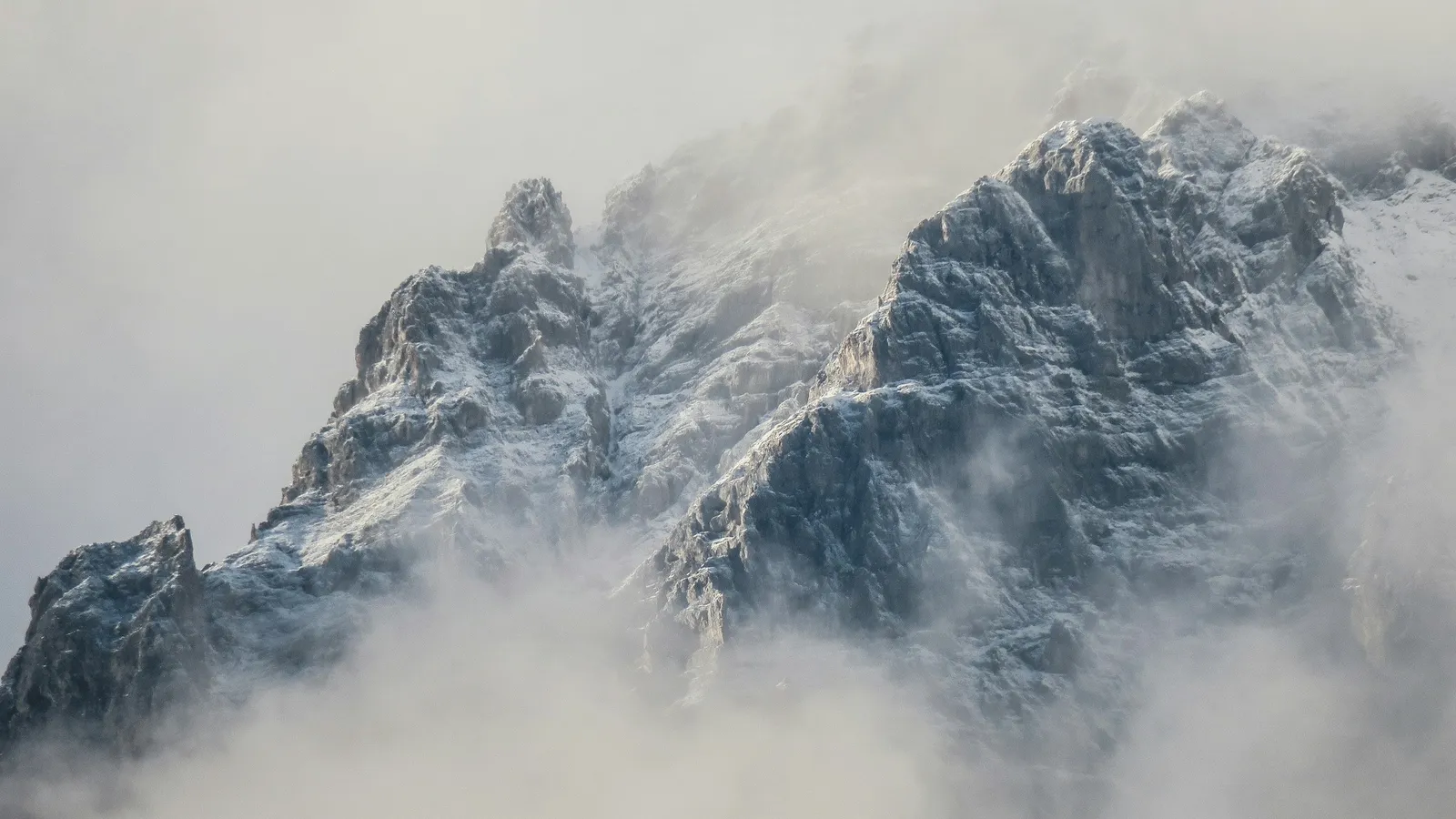
In his Nobel lecture, Wilson says that in September 1894 he spent a few weeks at the observatory on the summit of Ben Nevis. The coloured rings around the sun and around shadows on the mist made him want to copy them in the laboratory.
In early 1895 he made clouds by suddenly expanding moist air. Air cleaned of dust formed no cloud at small expansions. But when the expansion ratio v₂/v₁ passed a critical value of 1.25, about fourfold supersaturation, a shower of drops fell, and the drops kept coming back however often he repeated it. Something in the air was always being regenerated. At a second, larger limit, about eightfold supersaturation, dense clouds formed even in perfectly clean air.
When X-rays were discovered, he tried them on his chamber in early 1896. With X-rays on, expansions between the two limits produced a dense fog. The nuclei were ions. He later found that negative ions needed the 1.25 expansion, while positive ions needed about 1.31, roughly sixfold supersaturation.
When did he first see a track?
In spring 1911, testing rough apparatus with X-rays, he was, in his words, "delighted to see the cloud chamber filled with little wisps and threads of clouds", the tracks of electrons knocked out by the rays. He then saw the tracks of alpha particles from a speck of radium. A short paper went to the Royal Society that April: On a method of making visible the paths of ionising particles through a gas.
His lecture lists what good pictures need: expand without stirring the gas, so the floor of a wide shallow chamber drops suddenly; clear away stray ions with an electric field; and keep the order right. First make the supersaturation, then let the particle pass, then flash the light.
Worked example: how much does the expansion cool the air?
A sudden expansion has no time to take in heat, so it is close to adiabatic. For an adiabatic process, TV^(γ−1) stays constant, so T₂ = T₁ × (V₁/V₂)^(γ−1). For air, NASA gives γ = 1.4 under standard conditions.
Take room temperature, T₁ = 293 K, and Wilson's ratio V₂/V₁ = 1.25.
Ratio: V₁/V₂ = 1/1.25 = 0.8.
Exponent: γ − 1 = 0.4.
Factor: 0.8^0.4 ≈ 0.915.
Result: T₂ ≈ 293 × 0.915 ≈ 268 K, a drop of about 25 K.
For the positive-ion limit, 1.31, the same steps give 0.763^0.4 ≈ 0.898 and T₂ ≈ 263 K. Colder air holds far less vapour, so the vapour that was there a moment ago is now supersaturated. Treat these as estimates: the chamber holds moist air, not dry air, and real expansions are not perfectly adiabatic.
Mistakes to avoid:
Using Celsius. The formula needs kelvin. Using 20 for T₁ gives nonsense.
Inverting the volume ratio. Expansion cools, so the factor must be below 1.
Using γ as the exponent. For temperature and volume the power is γ − 1.
If the adiabatic formula still feels like magic, the Fermi Concept Library has every concept in physics with its own lesson and its place in the map, so you can see where TV^(γ−1) comes from.
What did the cloud chamber make possible?
His Nobel biography lists some of the discoveries made with it: the recoil electrons that confirmed the Compton effect, Carl Anderson's discovery of the positron, and the visual record of pair creation and of nuclear transmutation. Along the way, Wilson noted in his lecture that a value of the electron's charge worked out from the supersaturation needed for negative ions agreed within 1 percent with Millikan's value. Our post on Millikan's oil drop experiment covers that measurement.
What can a student take from how he worked?
Follow the surprise. He set out to study coloured rings and noticed a few stubborn raindrops instead.
Measure the threshold. Finding exact expansion ratios turned a curiosity into a tool.
Be patient. About 16 years passed between his first expansions and his first track photographs.
Get the order of steps right. His pictures worked because expansion, particle and flash came in sequence.
Try it: what final temperature would an expansion ratio of 1.38 give, starting from 293 K?