

On this page
Long before cables and radio waves connected the world, moving information across a country as large as France took days by a fast horse. The need for rapid, secure communication during the turbulence of the French Revolution drove a priest turned engineer, Claude Chappe, to devise a completely new solution. In 1792, he and his brothers demonstrated a system that would soon become the first practical telecommunications network of the industrial age (Wikipedia).
The system became known as the *télégraphe*, a new word derived from the Greek for "writing at a distance." It was a network that relied not on electricity, but on precision mechanics and optics.
How did the optical semaphore telegraph work?
Chappe's network relied on a chain of relay towers built on prominent hills or tall purpose-built structures, typically spaced 12 to 25 kilometres apart to maintain a clear line of sight (Wikipedia).
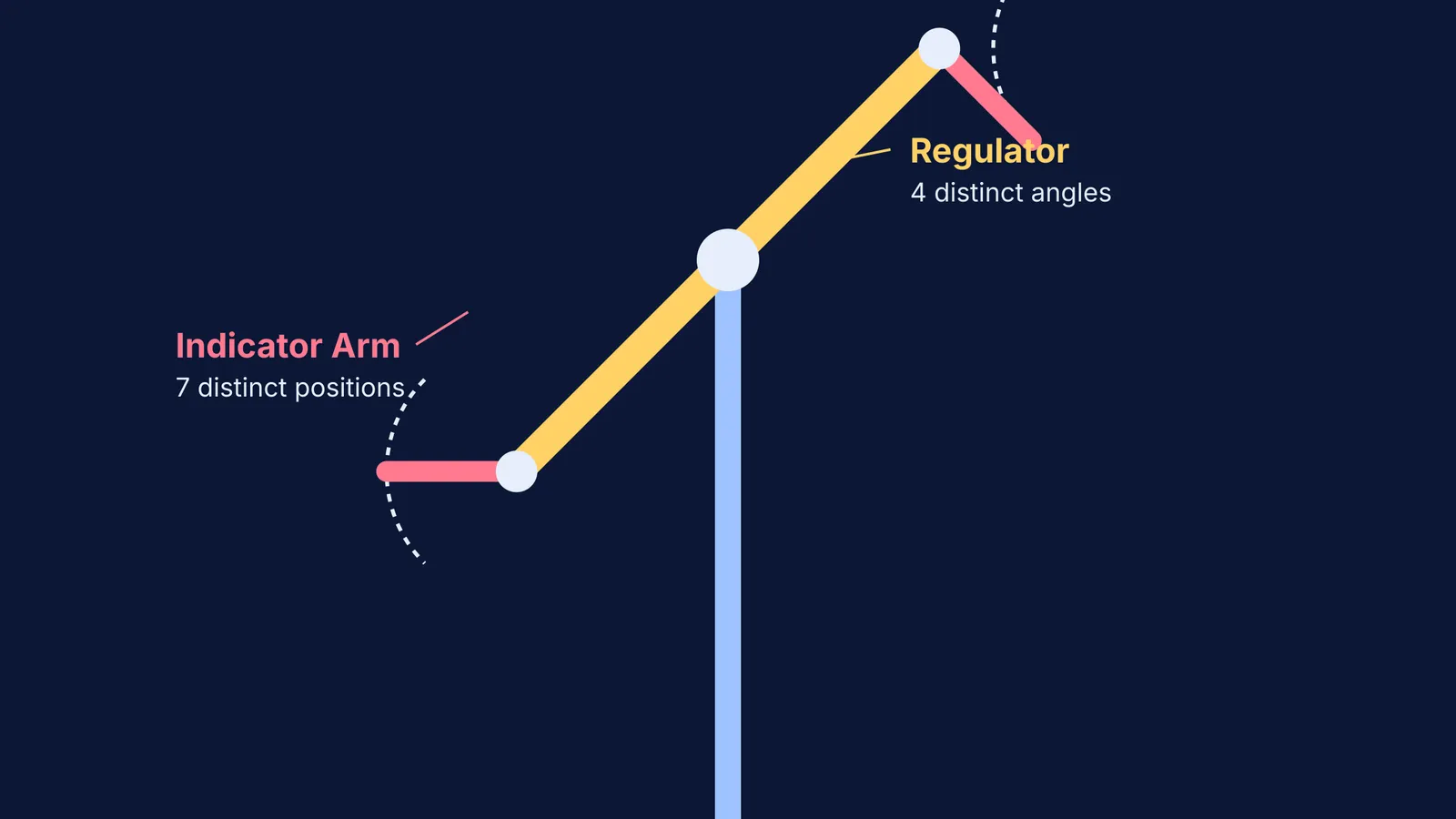
Each tower was topped with a heavy wooden rig manipulated by a trained operator stationed inside. The apparatus consisted of a tall central mast, a 4.6-metre horizontal crossbar called the regulator, and two 2-metre indicator arms attached to the ends of the crossbar.
Operators moved these heavy wooden arms using a system of pulleys and counterweights known as "forks." By setting the regulator and the two indicators to specific, pre-defined angles, the tower formed a distinct, geometric shape against the sky.
To transmit a message, the operator in one tower observed the shape of the neighbouring tower through a high-powered telescope. They immediately replicated it on their own rig to pass it along the line, and then waited for the subsequent tower to confirm the signal.
How fast could a semaphore message travel?
Despite the physical effort required to move the wooden beams, the system was remarkably fast. Operators could typically transmit 2 to 3 symbols per minute once a line was fully synchronised (Wikipedia).
A single signal sent from Paris to Lille—a prominent route covering 22 stations—could arrive in just 2 minutes, while a complete 36-symbol message usually took about 32 minutes to traverse the same distance. This transmission speed transformed military and state administration, allowing news of battles or changes in government policy to easily outpace any physical rider. For example, in 1794, the system famously delivered the news of the French capture of Condé-sur-l'Escaut from the Austrians.
At its peak in the mid-19th century, the French optical network had grown into a massive web, including 556 stations spanning approximately 4,800 kilometres across the country.
How did the codebook compress language?
If operators had to spell out every dispatch letter by letter, the semaphore would have been far too slow for long military communications. Instead, Chappe used an early system of data compression based on combinatorics.
The main regulator beam could be placed in 4 different positions, and each of the two indicator arms could take 7 distinct angles. This yielded a total of 196 unique mechanical shapes (4 × 7 × 7) (Wikipedia). Calculating the possible positions of a physical system like the semaphore is a classic exercise in the fundamental counting principle. Fermi's AI tutor can work out what you already know about combinatorics and build a plan for the session, so you sit down to a clear next step.
From those 196 shapes, a subset of 92 symbols was dedicated specifically to data transmission. Messages were encoded by sending these basic symbols in pairs. The first symbol indicated a page number in a massive official codebook, and the second symbol pointed to a specific line on that page. This two-part sequence allowed the system to represent 8,464 unique words and phrases (92 × 92), vastly reducing the number of mechanical movements needed to convey a complete sentence.
The idea of encoding data to save transmission time and bandwidth mirrors the much later digital methods explored in David Huffman and the term paper that taught data to shrink.
Why was the semaphore replaced?
The optical telegraph was an undeniable engineering triumph, but it suffered from strict physical limits. It was entirely useless at night, in heavy fog, or during torrential rain, leaving the government cut off during bad weather.
When the electric telegraph emerged in the 1840s, it offered a way to send signals almost instantly over copper wires, completely unaffected by visibility. The French government officially decided to replace the optical system with electrical wires in 1846, and by the 1850s, the great wooden towers were decommissioned.
Yet the underlying logic of Chappe's network—discrete nodes passing encoded information step by step across vast distances—laid the conceptual groundwork for the telecommunications infrastructure we use today. The relay logic of these hilltop towers echoes the way data moves through modern circuits, much like the early computing networks described in Konrad Zuse and the Z3: a programmable computer built from relays.


