

On this page
In the mid-nineteenth century, biology taught that animals could only destroy complex organic molecules. Leading chemists such as Jean-Baptiste Dumas asserted that plants alone synthesized starches and proteins, while animals merely combusted those nutrients for fuel. Claude Bernard dismantled this dogma between 1848 and 1857 by proving the liver manufactures, stores, and releases carbohydrates, establishing the principle of internal secretion.
What did scientists believe about animal nutrition before 1857?
Before Bernard's work, nutrition was treated as a one-way balance sheet. In 1844, Dumas asserted that animals could not synthesize any organic substances from simpler precursors, a doctrine reviewed in the European Journal of Applied Physiology. Animals were thought to obtain all sugars directly from plants, oxidizing them during respiration.
Bernard sought to identify where ingested sugar was combusted. To establish a baseline, he fed dogs exclusively on cooked meat for several weeks, expecting zero sugar in their circulation. Sampling blood entering the liver through the portal vein confirmed no sugar came from the gut. But blood leaving the liver through the hepatic vein contained substantial glucose, detected via copper reduction methods similar to standard tests for reducing and non-reducing sugars. The animal was synthesizing carbohydrate internally.
How did the 1855 washed liver experiment work?
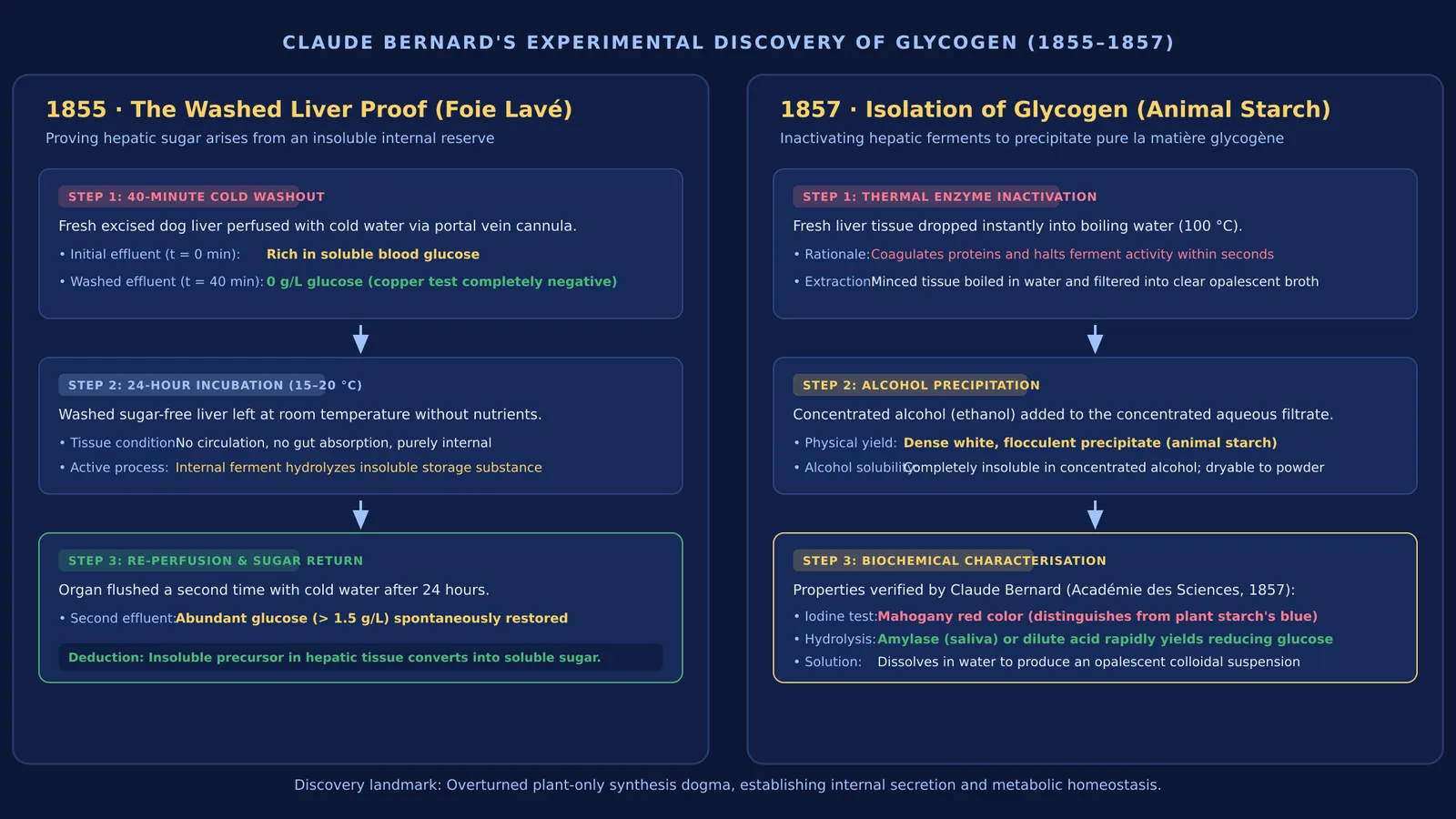
To prove the liver was not merely trapping dietary sugar from past meals, Bernard devised his *foie lavé* (washed liver) procedure in September 1855, recorded by F. G. Young in the British Medical Journal:
Perfusion: Bernard inserted a cannula into the portal vein of a freshly excised dog liver.
Complete washout: He flushed cold water through the organ for 40 minutes, clearing all blood and free glucose until hepatic vein effluent tested sugar-free.
Incubation: Bernard left the washed liver in an open dish at room temperature (15 °C to 20 °C) for 24 hours.
When flushed the next morning, the liver ran rich with sugar. Because the organ had been stripped of soluble glucose 24 hours earlier, it must have generated glucose from an insoluble internal reserve.
How was glycogen isolated in 1857?
Because hepatic ferments broke down the precursor into glucose within minutes of death, Bernard had to halt enzymatic action instantly.
In March 1857, Bernard announced his isolation technique in the Académie des Sciences, documented in the British Medical Journal. He dropped fresh liver tissue directly into boiling water to denature the enzymes. He then minced the tissue, boiled it in water, filtered the liquid, and precipitated the dissolved substance using concentrated alcohol.
The resulting white powder showed distinct properties:
Insoluble in concentrated alcohol, it dissolved in water to form an opalescent solution.
Staining with iodine produced a mahogany red tint, distinct from the blue of plant starch.
Incubation with saliva, pancreatic extracts, or dilute boiling acid rapidly yielded reducing glucose.
Bernard named the powder *la matière glycogène*—glycogen, or 'sugar-former'—identifying it as animal starch.
Why did Bernard's discovery change physiology and endocrinology?
Bernard's discovery established two foundational principles in biology:
First, he introduced internal secretion (*sécrétion interne*). Until 1857, glands were categorized by external ducts, such as the liver secreting bile. Bernard proved the liver also releases glucose directly into the bloodstream without a duct, founding endocrinology decades before the discovery of insulin by Banting and Best.
Second, glycogen provided the mechanism for the *milieu intérieur* (internal environment). By polymerizing excess glucose into glycogen after meals and releasing it during fasting, the liver stabilizes blood sugar within narrow limits. Biochemists later mapped this pathway in detail, notably in Gerty and Carl Cori's work on the glycogen cycle.
Students can trace how these hormonal and metabolic pathways connect in the Fermi Concept Library, where every concept in biology has its own lesson and its place in the map. Visualising dynamic flux across tissue compartments is supported in the Fermi Simulation Lab, which provides interactive simulations for the ideas that are easier to see than to read.
What is the NEET biology framework for liver glycogen?
For NEET preparation, Bernard's discovery unites organ physiology, hormones, and metabolism into a single model:
Postprandial storage (Glycogenesis): After meals, elevated portal glucose prompts insulin secretion. Hepatocytes convert glucose into branched glycogen polymers. A healthy adult liver stores roughly 80 to 100 grams of glycogen, representing 5% to 6% of wet liver weight, as summarized in Frontiers in Physiology.
Fasting release (Glycogenolysis): Between meals, glucagon activates glycogen phosphorylase, cleaving glycogen to release free glucose into systemic circulation via the hepatic vein.
Carnivorous synthesis (Gluconeogenesis): During prolonged fasting or carbohydrate-free diets, hepatocytes generate glucose from non-carbohydrate sources, matching Bernard's observations in meat-fed animals.
Viewing glycogen through Bernard's experiments turns a static definition into an active homeostatic buffer preserving organismal stability.


