

On this page
Why did the letters on your keyboard end up in such a peculiar order? Look at the top row beneath the numbers on your laptop or phone: Q, W, E, R, T, Y. It is neither alphabetical nor arranged by English letter frequency. The story behind this layout begins in nineteenth-century Wisconsin with an inventor named Christopher Latham Sholes, who solved a mechanical problem so effectively that his solution survived the death of the machine it was built for.
Why did Christopher Latham Sholes abandon the alphabetical keyboard?
In 1867, printer and former Wisconsin state senator Christopher Latham Sholes began designing a mechanical writing machine at Kleinsteuber's Machine Shop in Milwaukee alongside Carlos Glidden and Samuel W. Soule. Their initial working prototype, granted U.S. Patent 79,265 on June 23, 1868, featured a two-row keyboard arranged in simple alphabetical order.
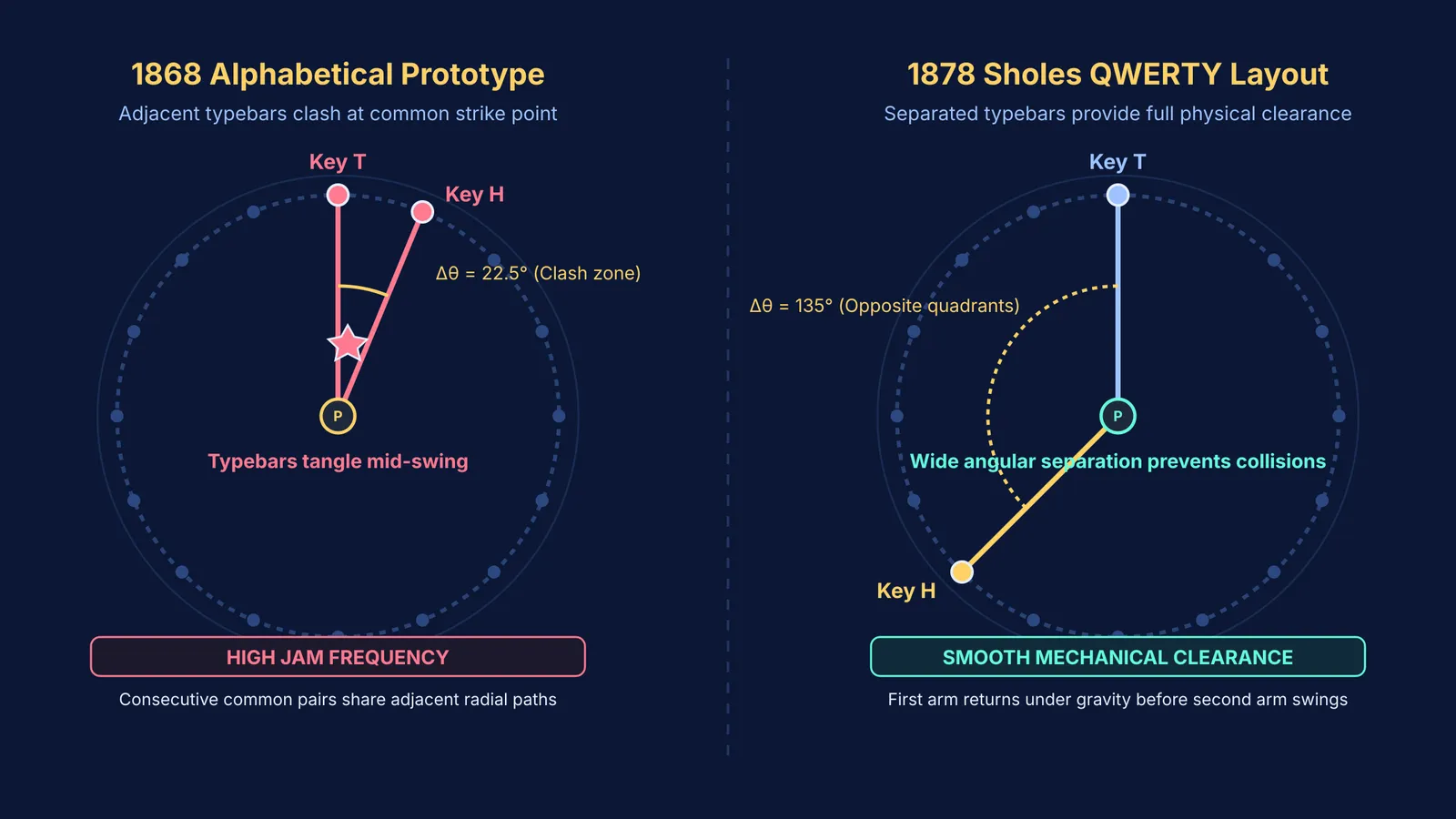
Inside that early typewriter, each key connected through mechanical linkages to a long metal arm called a typebar. The typebars hung suspended in a circular wire basket beneath the platen. When you pressed a key, its typebar swung upward in an arc to strike an inked ribbon against paper at a single central focal point.
The alphabetical arrangement quickly exposed an engineering flaw. When a typist struck common two-letter English combinations in rapid sequence, typebars located right next to each other in the circular basket swung upward at nearly the same moment. The ascending metal arm collided with the falling metal arm before gravity or return springs could pull it clear. The two arms tangled mid-stroke, locking the mechanism until the operator pulled them apart by hand.
To stop the clashing, Sholes and his financial backer James Densmore studied lists of common English letter pairs. By moving frequently paired letters to opposite quadrants of the circular typebar basket, they ensured consecutive keystrokes triggered arms on alternating sides of the ring. This layout was refined over several years and patented under U.S. Patent 207,559 on August 27, 1878.
How did telegraph operators and Morse code reshape QWERTY?
A widespread myth claims Sholes intentionally designed QWERTY to slow typists down so fragile machinery would not break. Historical evidence contradicts this legend. If the machine forced operators to type slowly, commercial customers would have rejected it immediately.
Archival research by Kyoto University scholars Koichi Yasuoka and Motoko Yasuoka, published in ZINBUN, revealed that early typewriters were tested by commercial telegraph operators transcribing American Morse code. In American Morse, certain characters sounded deceptively similar. For instance, the code for the letter Z was easily confused with the digraph SE.
Telegraph operators needed to transcribe incoming electrical pulses in real time without pausing. If ambiguous letters were positioned inconveniently, transcription errors multiplied. Sholes adjusted key positions based on feedback from telegraphers who needed maximum transcription clarity and speed. Just as ASCII and character encoding later mapped keystrokes into standardized binary bits, early typewriter mechanics had to adapt directly to the electrical rhythm of telegraph networks.
Why does QWERTY still dominate our phones and computers?
In 1873, Sholes and Densmore licensed their patents to arms manufacturer E. Remington and Sons. Remington manufactured the Sholes and Glidden typewriter in 1874 and introduced the upper-and-lower-case shift key on the Remington No. 2 in 1878. Remington also established typing schools across major commercial centers, training thousands of young operators in touch typing.
The critical turning point arrived on July 25, 1888, in Cincinnati, Ohio, during a celebrated public typing contest documented by the Smithsonian Institution. Court stenographer Frank Edward McGurrin typed without looking at the keys on a Remington No. 2, clocking approximately 98 words per minute and defeating typing teacher Louis Traub. By 1893, the five largest typewriter manufacturers merged into the Union Typewriter Company and standardized all manufacturing on QWERTY.
In economics, this lock-in is the classic example of path dependence, formalized by economist Paul A. David in The American Economic Review. When August Dvorak patented an ergonomically optimized keyboard in 1936, the switching costs of retraining millions of typists and retooling millions of machines proved insurmountable. The layout migrated from electromechanical teletypewriters onto early computer system hardware and modern workstations alongside Douglas Engelbart's computer mouse.
Understanding how mechanical limits shape conventions helps students analyze engineering trade-offs in modern computing. The Fermi Concept Library covers every concept in physics, chemistry, biology, mathematics and computing, each with its own lesson and its place in the map.
How do you break entrenched learning habits?
Just as QWERTY trapped millions of typists in a Victorian mechanical compromise, students often fall into inefficient study routines out of sheer inertia. Use this four-step diagnostic framework to examine and upgrade your learning workflows:
Identify the physical bottleneck: Pinpoint where your study session stalls. Are you passively copying notes when problem-solving slows down, or re-reading theory when a derivation fails?
Quantify the switching cost: Recognize that initial discomfort during a method change is temporary. Investing a few focused sessions to learn dimensional analysis or vector decomposition saves effort across an entire syllabus.
Separate familiarity from efficiency: Familiar routines feel effortless because motor memory runs on autopilot, not because the method produces the deepest conceptual grasp.
Build deliberate feedback loops: Test your reasoning against rigorous standards before accelerating your pace under exam conditions.
When an entrenched habit produces recurring errors in complex numericals, working through structured explanations helps you diagnose the root misconception. The Fermi Problem Library provides worked problems with a step-by-step solver that explains the reasoning rather than printing an answer, helping you rebuild problem-solving methods from the ground up.


