

On this page
Chika Kuroda (1884–1968) was a pioneering Japanese chemist who dedicated her career to understanding natural pigments. In 1916, she made history as the first woman in Japan to receive a Bachelor of Science (Wikipedia). Her defining work came a decade later when she solved the structure of carthamin, the prized red dye of the safflower plant.
Who was Chika Kuroda?
Born in Saga, Kyushu, Kuroda trained as a teacher before entering the Division of Science at Rika Women's Higher Normal School. In 1913, Tohoku Imperial University became the first Imperial University in Japan to admit women. Kuroda was one of the three women in that first cohort (Wikipedia).
She studied chemistry under Riko Majima, who sparked her interest in the organic chemistry of natural pigments. After graduating in 1916 and researching phthalonic acid derivatives at the University of Oxford under William Henry Perkin, she returned to Japan. In 1924, the RIKEN institute commissioned her to investigate carthamin, a traditional pigment with a long history.
What is the chemistry of carthamin?
Carthamin is a natural red pigment extracted from the safflower (*Carthamus tinctorius*). In Japan, this dye is known as *beni* and has been used for centuries to dye silk and make cosmetics (Wikipedia).
Despite its long history, the chemical makeup of carthamin remained a puzzle. The molecule is bulky and complex, composed of two chalconoid groups linked by glucose molecules. The red colour arises entirely from its conjugated bonds—a continuous chain of alternating single and double carbon-carbon bonds.
If you are stuck on how conjugated systems lead to coloured molecules, Fermi's AI tutor can build a plan for the session, drawing the electron orbitals on the board and checking your understanding of energy transitions as it goes.
How did Chika Kuroda figure out the structure of safflower red?
In the 1920s, chemists could not rely on modern tools like nuclear magnetic resonance (NMR) spectroscopy to map out a molecule. Instead, Kuroda had to use classical organic chemistry techniques. She systematically broke down the large carthamin molecule into smaller, identifiable fragments.
By studying these fragments, she identified the core chalcone structure (a type of aromatic ketone) that forms the backbone of the pigment. She published her findings in 1930 in a landmark paper titled *The constitution of carthamin* (Journal of the Chemical Society). This research earned her a doctorate in science in 1929, making her only the second woman in Japan to hold that degree (Wikipedia).
Why does carthamin look red?
We can understand the colour of any pigment by looking at its absorption spectrum. A molecule's colour is the exact opposite (or complement) of the light it absorbs.
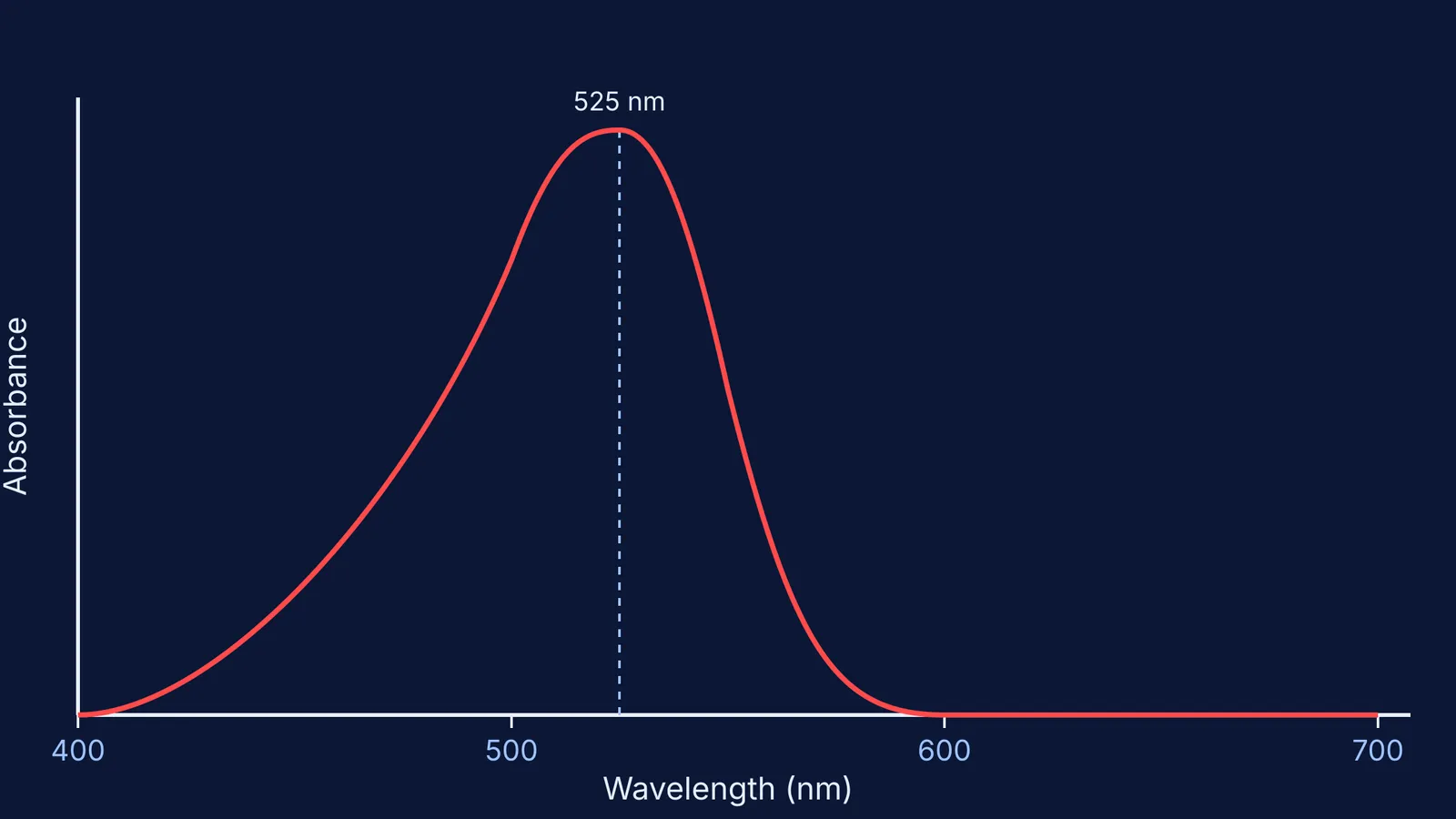
According to a 2007 study on its absorption spectra in aqueous solution, carthamin behaves like a typical red dye:
White light, containing all wavelengths from 400 nm to 700 nm, strikes the carthamin pigment.
The long chain of conjugated bonds in carthamin has a specific energy gap. This gap exactly matches the energy of green and blue photons.
Carthamin absorbs strongly between 400 nm and 550 nm, with a peak absorbance around 525 nm.
The remaining light—primarily red and yellow wavelengths (600 nm to 700 nm)—is reflected or transmitted, which is why we see the dye as a deep red.
Kuroda continued her work on natural colours throughout her life, extracting and mapping the pigments of eggplant skin, black soybeans and onion skin. Her rigorous classical methods laid the foundation for the study of flavonoid and chalcone dyes, proving that natural products yield their secrets to patient, systematic chemistry.
Read next:


