

On this page
In the early days of motoring, starting a car was a physical and dangerous chore. Drivers had to turn a heavy iron hand crank at the front of the engine to get it running. In 1911, American engineer Charles F. Kettering invented the first practical electric self-starter, fundamentally changing how we drive. His device was first installed on the 1912 Cadillac Model Thirty.
Why was hand-cranking a car dangerous?
Internal combustion engines rely on a continuous feedback loop. In a four-stroke engine, the combustion stroke releases energy that powers the exhaust, intake, and compression strokes of the next cycle. But to start that very first cycle, the engine must be forced through the intake and compression phases by an outside power source. In the beginning, that meant a driver had to physically turn the crankshaft.
The behavior of early engines during starting was not always predictable. If the spark timing was set incorrectly, the engine could fire early and run in reverse for a moment. This caused the heavy crank handle to "kick back" with immense force. This sudden reverse rotation frequently resulted in broken thumbs, wrists, and even dislocated shoulders).
The push for a safer alternative came after a highly publicized tragedy in 1908. Byron Carter, the founder of Cartercar, died from complications after a hand crank kicked back and broke his jaw while he was helping a stranded motorist on a bridge in Detroit. This prompted Cadillac's head, Henry Leland, a close friend of Carter, to commission Kettering to find a way to start a car safely from the driver's seat.
How did cash registers inspire the electric starter?
Before tackling the automobile starter, Kettering had already solved a surprisingly similar problem. Working at the National Cash Register Company (NCR) five years earlier, he had replaced the hand crank on cash registers with a small electric motor. Cash registers only needed to run for a very brief moment to open the drawer and record a sale. Kettering realised that a small electric motor could be overloaded with high current for a short burst without burning out.
He took this exact insight to the automotive world when he co-founded the Dayton Engineering Laboratories Company (DELCO).
How did Charles Kettering's electric starter work?
Other engineers had tried to build electric starters, but they used large, continuous-duty motors that were far too heavy and bulky for a passenger car. Kettering's breakthrough was applying his NCR experience: realizing that a starter only needs to run for a few seconds.
He designed a relatively small motor that was driven with much higher voltage and current than it could sustain continuously. At those high power levels, the motor would burn out if run for a few minutes, but it delivered enough torque to crank the engine for the brief moment required to start it.
To protect the system, the starter was mechanically connected to the engine using a gear coupling to the flywheel. To start the car, the driver pressed a pedal that engaged the gears. Once the engine fired, the driver released the pedal to disengage the gears, preventing the engine from driving the starter motor at dangerously high speeds.
Why was the single motor-generator a breakthrough?
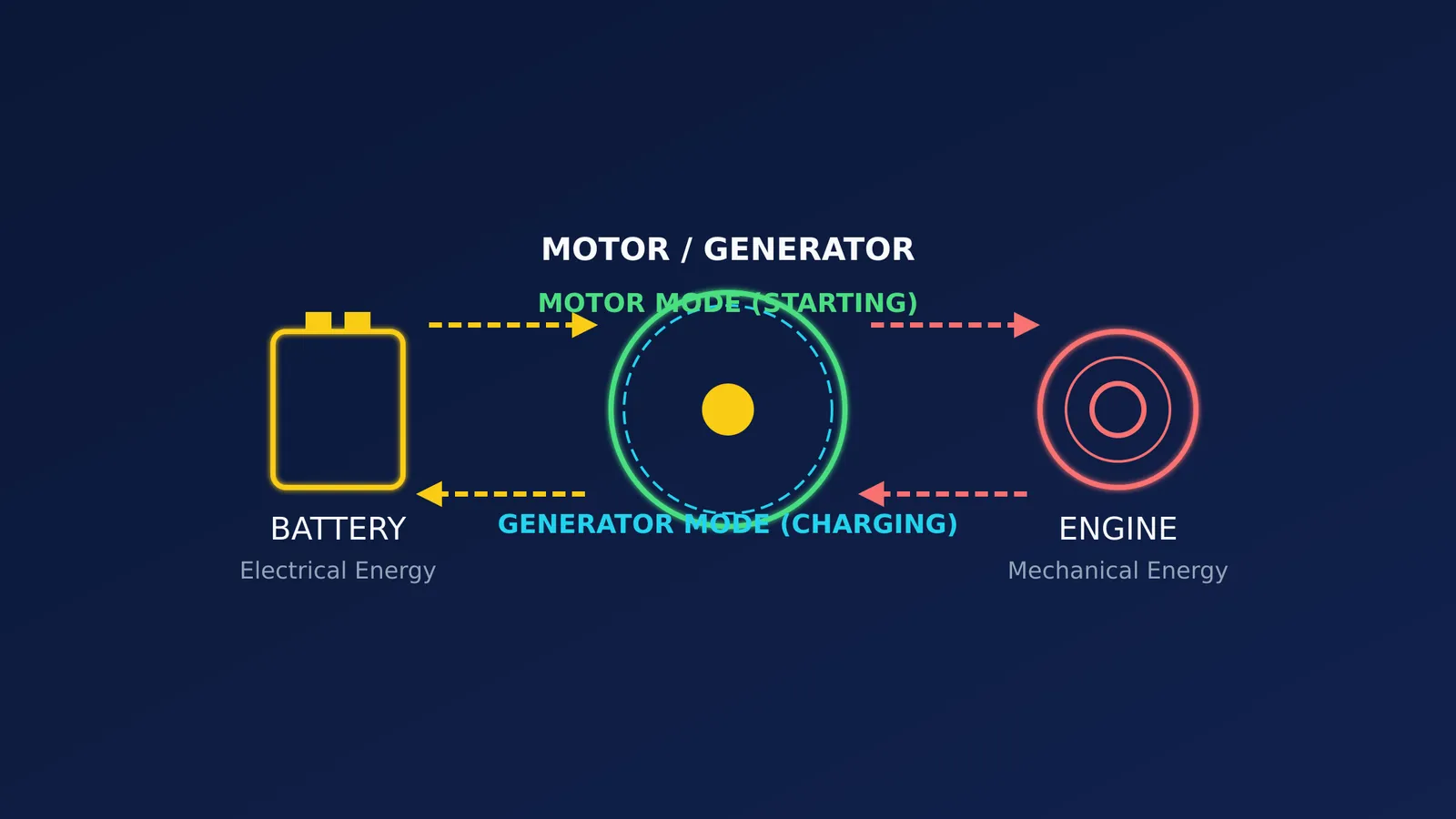
Kettering did not just add a motor; he designed an integrated electrical system. His starter used a dual-function motor-generator. When the driver pressed the starter pedal, the device acted as a motor, drawing power from the battery to turn the engine. Once the engine was running under its own power, the same unit switched roles. Driven by the engine, it acted as a generator to produce a continuous source of current.
This single system provided the initial rotation to start the engine, the spark necessary for the ignition, and the power for the vehicle's lights, all while recharging the battery. (To understand how the battery itself worked, you can read about Gaston Planté and the lead battery that could be recharged.)
When studying the physics of electric motors, torque, and magnetic fields, figuring out how the concepts connect can be daunting. If you are struggling with electromagnetism, Fermi's AI tutor can work out what you already know and build a plan for the session, so you sit down to a clear next step.
Kettering's invention completely removed the physical barrier and danger of the hand crank. The electric starter made automobiles accessible to millions of new drivers, especially women and the elderly, and shaped the future of the automotive industry. (The ignition system it powered relied on high-voltage sparks, a technology rooted in the work of Nicholas Callan and the induction coil that made big sparks.)
How do you tell a motor from a generator?
The beauty of Kettering's design was recognizing that motors and generators are physically the same machine, just run in reverse. Here is a quick checklist to understand the difference when you look at a device:
What goes in? If the machine takes in electrical current and turns it into physical rotation, it is acting as a motor.
What comes out? If the machine takes in physical rotation and turns it into electrical current, it is acting as a generator.
The role of the magnetic field: In a motor, current flowing through a wire in a magnetic field creates a force that pushes the wire. In a generator, pushing a wire through a magnetic field induces a current in the wire.
What to do next
To explore how motors and generators work in real time, try the interactive simulations in the Fermi Simulation Lab.


