

On this page
In 1873, the French mathematician Charles Hermite settled a major open question in mathematics by publishing the first proof that the base of natural logarithms, e, is a transcendental number. Before Hermite's publication, mathematicians knew that such numbers existed, but no one had been able to prove that a naturally occurring constant like e was one of them.
What does it mean for a number to be transcendental?
To understand what a transcendental number is, you first have to look at algebraic numbers. An algebraic number is any number that can act as the root, or solution, of a non-zero polynomial equation with whole-number coefficients. For example, √2 is an algebraic number because it is a solution to the polynomial equation x² − 2 = 0.
A transcendental number, however, is a number that is not algebraic, meaning it is never the root of a non-zero polynomial with integer coefficients. It completely transcends the power of ordinary algebra. Substituting a transcendental number into a polynomial with whole-number coefficients — such as a₀ + a₁x + a₂x² + ... + aₙxⁿ = 0 — will never make the equation equal exactly zero.
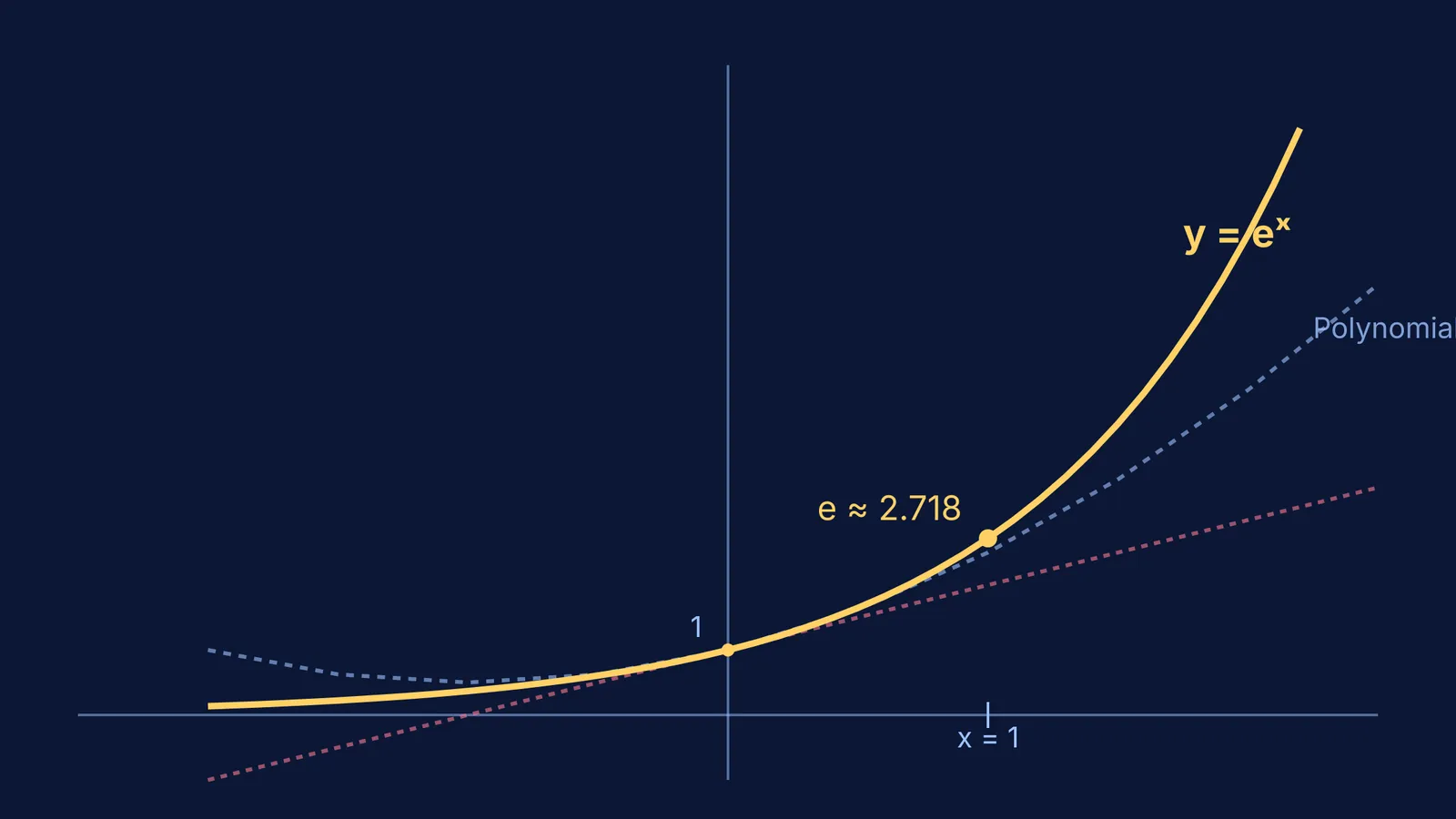
The French mathematician Joseph Liouville was the first to prove that transcendental numbers exist in 1844, but he had to construct highly artificial mathematical examples to do it. Proving that a familiar, naturally occurring constant like e (which is approximately 2.718) fell into this category was a far more complex challenge, requiring a completely new approach.
How did Charles Hermite prove e is transcendental?
Hermite approached the problem using a fundamental mathematical strategy: proof by contradiction. He started by assuming the exact opposite of what he wanted to show: he supposed that e was actually an algebraic number. If e were algebraic, it would have to satisfy a polynomial equation with integer coefficients. He assumed there was some perfectly balanced equation a₀ + a₁e + a₂e² + ... + aₙeⁿ = 0.
To expose the flaw in this assumption, Hermite invented a specific, highly complex polynomial that featured a very large prime number in its denominator. By applying the technique of integration by parts repeatedly, he was able to link this newly created polynomial to the powers of e (such as e, e², and so on up to eⁿ). This relationship between the polynomial's derivatives and the exponential function is now known as Hermite's identity.
This clever algebraic manipulation led directly to a logical impossibility. His equations forced a non-zero integer to be strictly equal to a fractional remainder made up of integrals. Because Hermite's constructed polynomial contained a large prime in the denominator, this remainder fraction would shrink closer and closer to zero as the prime number grew infinitely large. Since a non-zero integer must be at least 1 or −1, it cannot equal a tiny fraction. The original assumption had to be false. Therefore, e could not be algebraic — it was definitively transcendental.
Why was this 1873 proof so important?
Hermite's 1873 discovery did more than just correctly classify the number e. It introduced an entirely new set of analytical tools for proving the nature of constants. Mathematics often advances not just by finding answers, but by inventing the right methods to find them, much like how Grigori Perelman and the proof of the Poincaré conjecture required inventing new mathematical machinery decades later.
Just nine years after Hermite published his paper, the German mathematician Ferdinand von Lindemann saw that Hermite's method could be taken even further. Lindemann adapted these techniques to prove that π is also a transcendental number. His 1882 proof resolved a puzzle from ancient Greece: it proved that "squaring the circle" is geometrically impossible, because π cannot be isolated algebraically.
How to tackle impossible math problems?
When encountering a seemingly impossible proof, like Karl Weierstrass and the epsilon-delta definition of a limit, the best strategy is breaking down the underlying assumptions. Finding a contradiction requires tracing the logic step by step.
If you are trying to prove a mathematical statement, try assuming the opposite is true. Write out the consequences of that assumption clearly and rigorously. If those consequences eventually lead you to something mathematically impossible — like claiming that 1 equals a fraction near 0 — then your original assumption must be wrong, and the statement is proved.
If you are preparing for mathematics exams like JEE Main or tackling university-level physics, you will often find yourself stuck on the reasoning rather than the arithmetic. The Fermi Problem Library offers worked problems with a step-by-step solver that explains the reasoning rather than printing an answer. When you understand why a particular substitution is used or how an identity forces a conclusion, those seemingly impossible proofs become a clear sequence of logical steps.


