

On this page
In 1979, the Stanford statistician Bradley Efron published a paper that changed how scientists handle uncertainty. His paper, "Bootstrap Methods: Another Look at the Jackknife", appeared in *The Annals of Statistics* and introduced a computationally intensive method to estimate the accuracy of statistics (The Annals of Statistics).
Instead of relying on rigid mathematical formulas and assumptions about bell curves, the bootstrap let researchers use raw computing power to measure their own errors. Efron summed up the method's purpose perfectly: "It provides scientists an estimate of how wrong their estimates might be" (National Science and Technology Medals Foundation).
What is the bootstrap method?
When you take a sample from a population (like measuring the heights of 100 trees to estimate the whole forest), your sample average is rarely the exact true average. You need to know the standard error — a measure of how much your estimate would bounce around if you repeated the experiment.
Historically, calculating this error required you to assume your data followed a known mathematical shape, such as the normal distribution. If your data was messy or the statistic was complex, the mathematics became impossible.
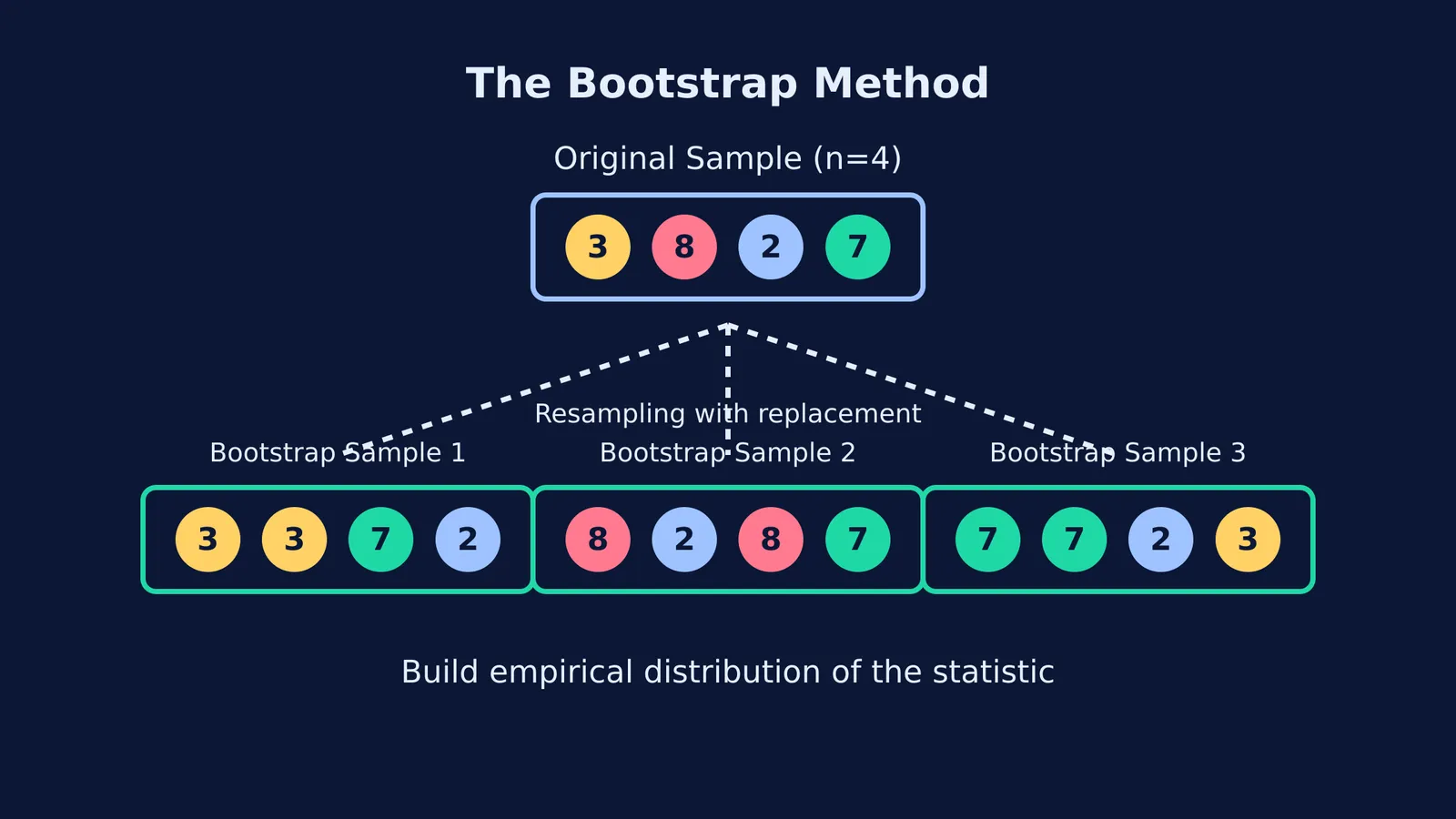
Efron's bootstrap bypassed the algebra by turning to the computer. The core idea is to treat your single observed sample as if it were the entire population. You draw thousands of new samples of the same size from your original data, with replacement. By calculating your statistic for every one of these bootstrap samples, you build an empirical distribution that reveals the true uncertainty of your estimate.
Why was "Another Look at the Jackknife" so important?
Efron's paper title refers to an older technique developed by John Tukey and Maurice Quenouille. The jackknife estimated uncertainty by systematically leaving out one observation at a time from a dataset and recalculating the statistic. (You can read more about Tukey's work in John Tukey and the box plot.)
In his 1979 paper, Efron proved that the jackknife was essentially a linear approximation of his new bootstrap method. The bootstrap was far more general and worked in situations where the jackknife completely failed, such as estimating the variance of a sample median.
The method democratised statistical inference. Xiao-Li Meng, a professor at Harvard University, described the bootstrap as "the best statistical pain reliever ever produced" because it solved seemingly hopeless problems in uncertainty assessment (IMS). Efron's breakthrough earned him the 2018 International Prize in Statistics, one of the field's highest honours.
How to calculate a bootstrap estimate?
The algorithm shifted the burden from human algebra to machine loops. Here is the exact plan a computer follows to run a bootstrap:
Start with your original sample of *n* observations.
Draw a new sample of size *n* from your original data, putting each drawn value back before the next draw (sampling with replacement). Some original values will appear multiple times; others will be left out.
Calculate the statistic (like the mean or median) for this new bootstrap sample and save the result.
Repeat steps 2 and 3 thousands of times.
Analyse the results: The standard deviation of those thousands of saved statistics is your standard error.
If you are learning data science and want to code this resampling loop yourself, Fermi's AI tutor can write the logic on a board and work through the problem alongside you. To physically see how drawing samples with replacement builds a normal-looking curve out of messy data, you can watch the distribution form in real time in the Fermi Simulation Lab.
Today, the bootstrap is woven into the fabric of modern science, cited in over 200,000 papers across medicine, astrophysics, and machine learning. It proved that sometimes the best way to understand a dataset is simply to ask it to sample itself.


