

On this page
In 1919, measuring the strength of the ionic bonds holding a crystal together was impossible. Physicists could estimate it using the electrostatic forces between ions, but they had no physical experiments to prove their numbers were right.
Two scientists, Max Born and Fritz Haber, found a way around the problem by combining thermodynamics with the new atomic theories of the time. They independently published their separate papers in 1919 in the *Verhandlungen der Deutschen Physikalischen Gesellschaft*. Their method, now called the Born-Haber cycle, became a landmark tool in chemistry that every Class 11 student learns today.
What is the Born-Haber cycle?
The Born-Haber cycle is a thermochemical cycle that calculates lattice energy—the energy released when gaseous ions bind to form a solid ionic crystal. Conversely, it calculates lattice enthalpy, which is the energy required to break that solid apart.
Because scientists cannot directly measure the heat of gaseous ions snapping together into a lattice, Born and Haber applied Hess's Law. This law states that the total energy change of a chemical reaction is the same regardless of the path taken. If you know the total energy of forming a solid from its raw elements, and you know the energy of every other step in between, you can find the lattice energy by subtraction.
To explore Hess's Law and other rules of thermodynamics in depth, the Fermi Concept Library holds every concept in physics and chemistry, each with its own lesson and its place in the map.
How to calculate lattice energy?
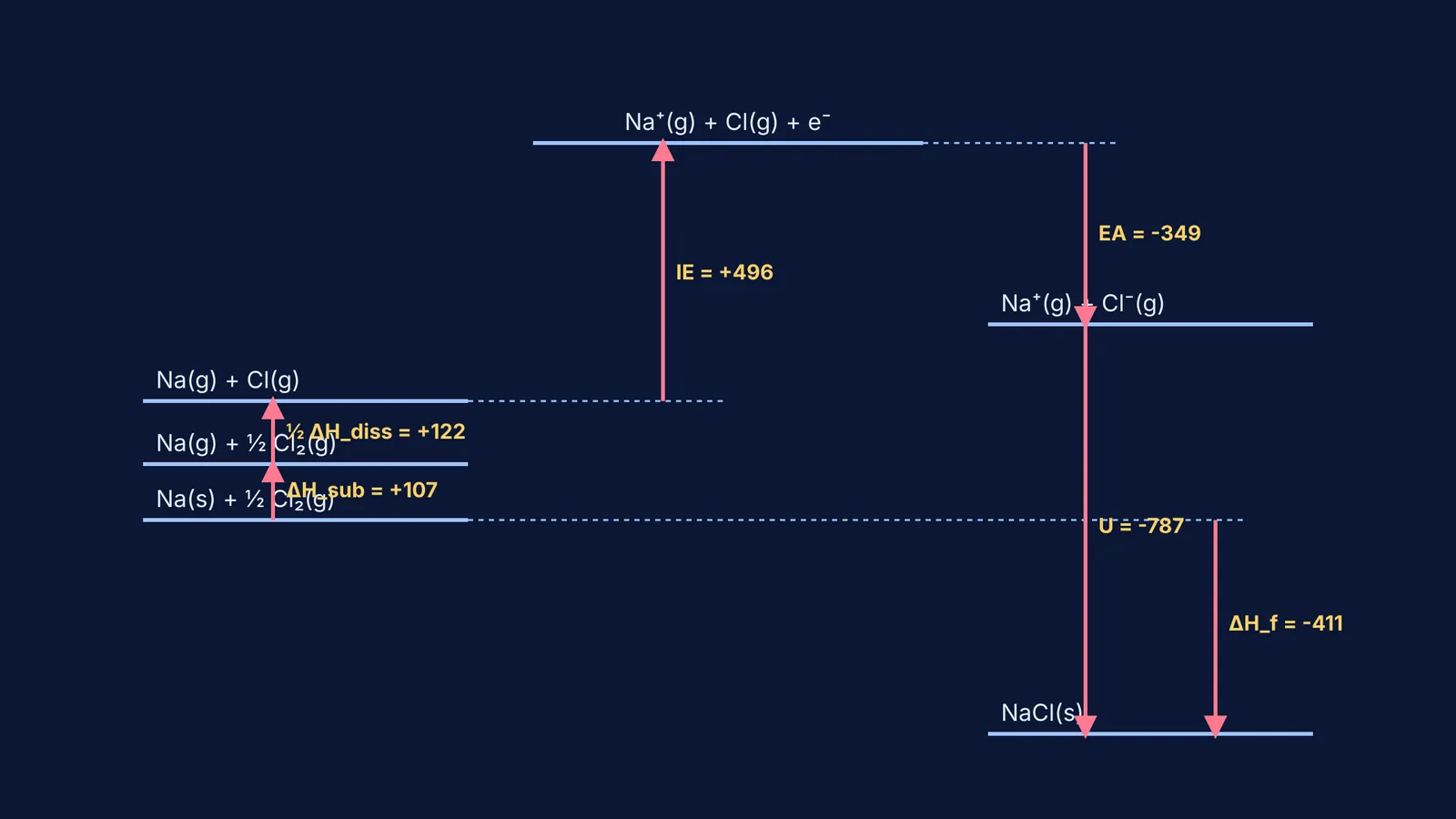
The calculation breaks the formation of an ionic solid, like sodium chloride (NaCl), into five measurable steps. According to standard thermodynamic data, the total enthalpy of formation for NaCl is −411 kJ/mol. Here is how the cycle matches that total:
Sublimation: Solid sodium turns into a gas. This takes energy. To compare this to other phase changes, review the differences between enthalpies of atomisation, sublimation and phase change.
Ionisation: The sodium gas loses an electron to become a positive ion.
Dissociation: Chlorine gas molecules split into single atoms.
Electron gain: The chlorine atom accepts an electron to become a negative ion. This releases energy.
Lattice formation: The gaseous sodium and chloride ions condense into a solid crystal. This is the unknown lattice energy.
By Hess's Law, the sum of these five steps equals the direct formation energy. When the energy required for the first three steps is offset by the energy released in electron gain, the remaining difference must equal the lattice energy. Solving the equation for NaCl gives −786 kJ/mol. Therefore, the lattice enthalpy—defined as the energy required to break one mole of the solid lattice apart—is +786 kJ/mol. The cycle assumes the bonds are perfectly ionic; for a look at real-world deviations, see how to find the percentage ionic character from dipole moment.
When setting up these equations for other halides, getting the signs right is the most common hurdle. The Fermi Problem Library has worked problems with a step-by-step solver that explains the reasoning rather than printing an answer.
A checklist for exam problems
When you face a Born-Haber cycle question in an exam, the trick is to keep your signs straight. Use this simple checklist to avoid losing marks:
Check the metal's state: Ensure the metal starts as a solid. If it is already a gas in the problem, you do not need to add the sublimation energy.
Count your moles: Halogens usually exist as diatomic molecules (like Cl₂ or F₂). If the formula only needs one atom (like in NaCl), you must halve the bond dissociation energy. If it needs two (like in MgCl₂), you use the full bond dissociation energy.
Add successive ionisation energies: For alkaline earth metals like magnesium or calcium, you must add both the first and second ionisation energies to reach the +2 state.
Watch the electron gain sign: The first electron gain enthalpy is usually negative (energy is released). However, if an atom takes a second electron (like oxygen forming O²⁻), the second electron gain is positive because the negative ion repels the incoming electron.
Draw the cycle: Always sketch the cycle out. Arrows pointing up represent energy taken in (positive), and arrows pointing down represent energy released (negative).
Why does the 1919 cycle matter today?
Before 1919, electron affinities (how much a non-metal wants an extra electron) were notoriously difficult to measure. The Born-Haber cycle gave chemists a backdoor. By measuring the heat of formation and estimating the lattice energy with physics, they could calculate the missing electron affinity of elements like chlorine.
The cycle also explains why certain compounds exist and others do not. For example, why does sodium form NaCl and not NaCl₂? The cycle shows that removing a second electron from sodium requires a massive burst of ionisation energy. Even though an NaCl₂ lattice would release more energy upon forming, it is never enough to pay the steep energy cost of that second ionisation.
If you are stuck on applying Hess's Law to different compounds and comparing their stabilities, Fermi's AI tutor works out what you already know and builds a plan for the session, writing on a board and checking your understanding as it goes.


