

On this page
In the early 1970s, computers were mostly isolated mainframes that processed batches of punch cards. That landscape changed rapidly when researchers were asked to connect dozens of early personal computers so they could share a single, very expensive laser printer. On May 22, 1973, computer scientist Bob Metcalfe wrote a memo at Xerox PARC proposing a new kind of local network. He called it "Alto Ethernet."
Why did Bob Metcalfe invent Ethernet in 1973?
Xerox PARC (Palo Alto Research Center) had just built the Alto, one of the first computers designed for a single person to use at a desk. The Alto featured a graphical user interface and a mouse, innovations that made computing far more personal. But having a standalone computer on every desk created a new problem: these machines needed to talk to each other and to the office's new high-speed laser printer to be truly useful.
Metcalfe drew significant inspiration from ALOHAnet, an early radio-based network built at the University of Hawaii to connect scattered islands. However, instead of using unpredictable radio waves, he and his co-inventor David Boggs decided to use a thick coaxial cable routed through the walls of the Xerox PARC building. Metcalfe called this central cable the "ether." He chose this name because he envisioned a completely passive medium that could carry data everywhere, much like the obsolete physics concept of the luminiferous ether that scientists once believed carried light waves through empty space.
The original network moved data at exactly 2.94 megabits per second. This specific, unusual speed was not chosen randomly; it was closely tied to the Alto's internal system clock. This rate was exactly 10,000 times faster than the clunky terminal networks it replaced.
How did the first Ethernet handle collisions?
When dozens of computers share one single cable, they cannot all talk at once. If two machines attempt to send data at the exact same moment, the electrical signals literally crash into each other on the wire, resulting in a spike in voltage that garbles the entire message.
Metcalfe solved this fundamental physics problem with a set of rules called Carrier Sense Multiple Access with Collision Detection (CSMA/CD). This logic allowed the network to manage traffic organically and scale up without requiring a central traffic controller or master computer. The underlying idea of breaking data into distinct packets and ensuring their reliable delivery is a cornerstone of computing history, standing right alongside the work of Richard Hamming and the codes that fix their own errors.
The CSMA/CD Checklist
When tracing how devices successfully share a single cable, you can step through this exact protocol:
Listen (Carrier Sense): Before sending anything, the computer listens. Is the cable currently carrying a voltage from another machine? If yes, it waits. If the line is quiet, it proceeds.
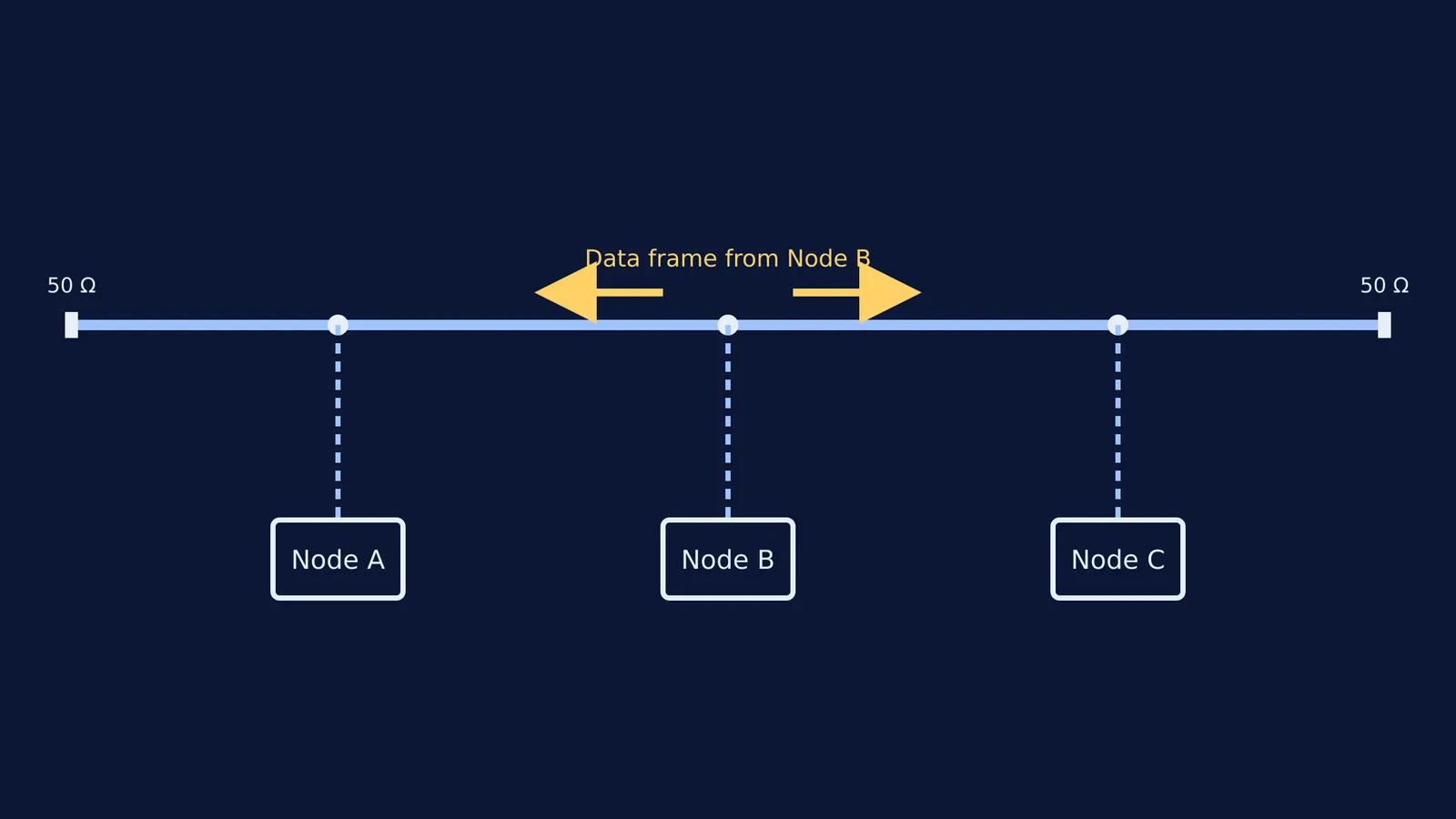
Transmit (Multiple Access): The computer sends its data frame onto the shared coaxial cable, where it propagates in both directions.
Monitor (Collision Detection): While sending its own data, the computer continues to watch the voltage on the wire. If the voltage suddenly spikes beyond the normal transmission level, it means another computer transmitted at the same time.
Jam and Backoff: If a collision is detected, the computer immediately stops sending data and broadcasts a brief "jam" signal so all other machines know the network is corrupted. It then pauses for a random "backoff" amount of time before returning to step one to try again.
How can you master network physics and logic?
Understanding how signals travel through a physical medium requires mixing electrical physics with computer science logic. You have to trace how electrical pulses move down a wire, drop, and reflect, which requires the same kind of careful spatial thinking as calculating physical coordinates for Douglas Engelbart and the computer mouse: how a pointer finds x and y.
If you are trying to picture how voltage spikes create data collisions or how data frames physically propagate across a bus topology, the Fermi Simulation Lab has interactive simulations for the ideas that are easier to see than to read. You can watch the waves travel along the virtual cable and see the physics of the network in motion, helping bridge the gap between abstract protocols and real-world electricity.
Bob Metcalfe's invention laid the critical groundwork for local area networks and the modern internet, a contribution that earned him the 2022 ACM A.M. Turing Award. By focusing on a simple, robust, and decentralized way to share a physical medium, he proved that the best engineering solutions often come from letting the physics of the wire and the math of the algorithm work together.


