

On this page
Birbal Sahni is best known as the founder of Indian palaeobotany, dedicating his life to uncovering the secrets of ancient plants. But in March 1936, his scientific curiosity led him to a completely different kind of fossil. During an investigation at the Khokhra Kot mound in Rohtak, Haryana, Sahni discovered thousands of terracotta fragments [Wikipedia].
When he examined the fragments closely, he realised they were not broken pots or building bricks. They were ancient coin moulds used by the Yaudheya republic, a powerful confederacy in northern India, dating back to approximately 100 BCE [Wikipedia].
What were the Rohtak coin moulds?
The Yaudheyas maintained a large economy and needed a reliable way to mass-produce uniform currency. Sahni's meticulous discovery revealed that they used a highly sophisticated "vertical stack" casting method, rather than striking individual coins with a die.
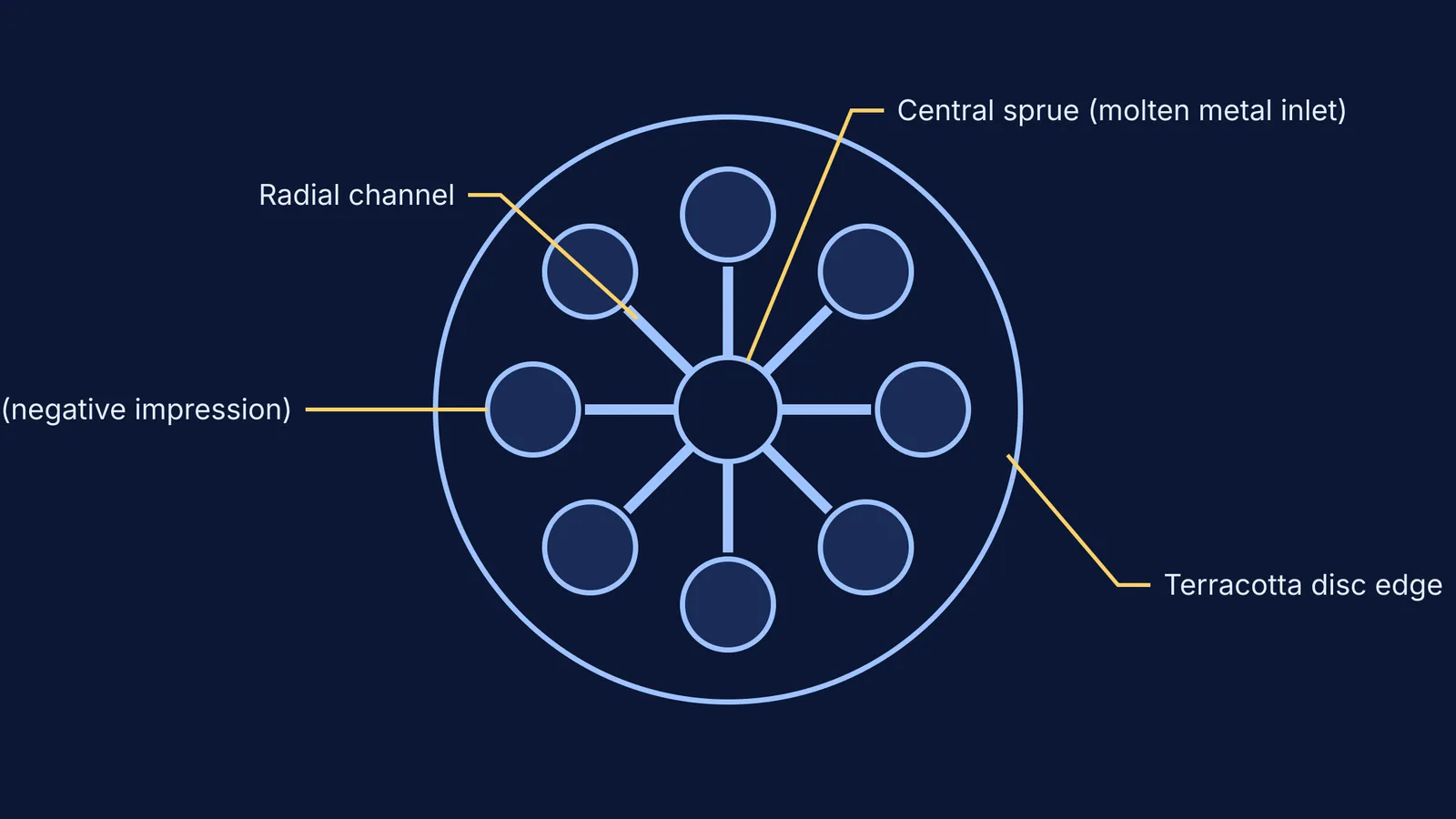
Each terracotta mould was shaped as a flat circular disc with a distinct hole in its centre. From this central opening, eight radial channels branched out to small circular sockets, resembling the spokes of a wheel [Wikipedia]. The sockets held the negative impressions of the coins, which typically featured the war god Kartikeya.
Instead of pouring metal into one horizontal mould at a time, the ancient moneyers stacked multiple discs on top of one another to form a tall cylinder. They luted—or sealed—the outside of the stack with a thick layer of clay to make it completely airtight. When molten bronze was poured down the central funnel, the liquid metal flowed evenly through the radial channels, filling all the individual sockets in the entire vertical stack at once.
How did a botanist decode ancient metallurgy?
Sahni famously believed that the methods of a palaeobotanist—interpreting the history of life from fragmentary, fossilised evidence—were fundamentally no different from those of an archaeologist [Wikipedia]. He did not simply catalogue the designs on the moulds; he applied rigorous scientific analysis to the materials.
He studied the chemical composition of the clay, noting how it was deliberately mixed with plant husk and other organic fibres. This composite material prevented the terracotta from cracking under the intense thermal shock of molten metal. If you are currently studying the extraction of metals for Class 10, you will recognise the extreme heat and precise material demands required for such metallurgical processes. Sahni also examined "virgin coins" that were still trapped inside unbroken moulds, which provided direct physical proof of how the liquid metal behaved as it cooled.
His detailed reconstruction of this industrial process was published in 1945 as a masterly monograph, *The Technique of Casting Coins in Ancient India*, for which the Numismatic Society of India awarded him the Nelson Wright Medal [Wikipedia].
Just as Sahni applied scientific observation to unearth the past, you can build a stronger foundation by seeing the connections between different subjects. The Fermi Concept Library contains every concept in physics, chemistry, biology, mathematics and computing, each with its own lesson and its place in the map.
How can you apply cross-disciplinary thinking?
Sahni's work at Rohtak is a perfect example of why studying science is not just about memorising isolated facts. It is about building a versatile toolkit for solving complex problems. When preparing for your exams, try adopting this interdisciplinary approach:
Look for the core mechanism: Whether you are studying fluid dynamics in physics or the flow of sap in a plant stem, the underlying mathematical principles often match. Recognising these patterns makes learning faster.
Transfer your tools: If you learn how to analyse a parabolic graph in mathematics, use that exact same skill to read a rate-of-reaction curve in chemistry. Do not leave your mathematical tools at the door when you open a biology textbook.
Visualise the unseen: Sahni had to picture how molten metal would flow through a sealed clay cylinder without being able to look inside it. For ideas that are easier to see than to read, the Fermi Simulation Lab provides interactive simulations.
Why does the Rohtak discovery still matter today?
The coin moulds from Khokhra Kot remain one of the most vital pieces of evidence for ancient Indian technology. Before Sahni's interdisciplinary study, historians knew very little about how ancient mints operated on an industrial scale.
His work proved that early Indian moneyers were advanced metallurgical engineers, capable of designing complex, heat-resistant moulds for rapid mass production. This spirit of resourceful, boundary-crossing observation is shared by other scientific pioneers. Just as Agnes Pockels measured surface films in her kitchen, Birbal Sahni turned a mound of discarded clay fragments into a masterclass on ancient engineering.


