

On this page
If you have ever taken a car trip, you already understand two types of motion. If you travel 60 kilometres in one hour, your average speed for the entire journey is 60 km/h. This single number is easy to calculate, but it hides all the details of your trip. Your speedometer tells a different story—when you are stopped at a traffic light, it reads zero, and when you are overtaking a truck, it might read 80 km/h. That exact reading at any given second is your true speed at that specific moment.
More than 800 years ago, the Indian mathematician and astronomer Bhaskara II formalised this distinction to track the planets. In doing so, he laid the mathematical groundwork for what we now call the derivative.
What is tatkalika gati?
In his 1150 CE treatise Siddhānta-Śiromaṇi, Bhaskara II needed precise mathematics to predict eclipses and planetary positions. The old methods relied on measuring a planet's movement over a large time interval, like a full day.
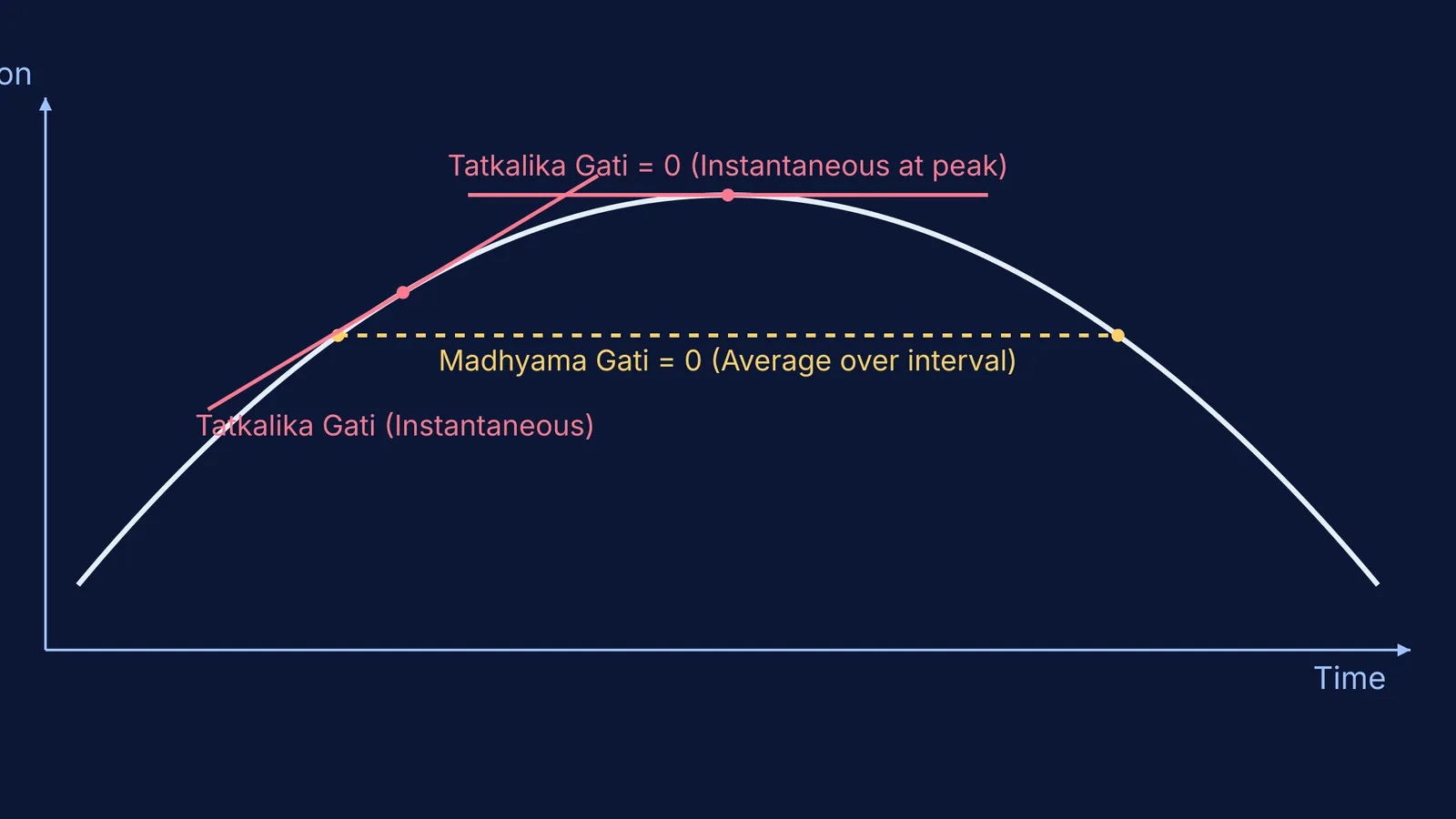
Bhaskara II distinguished between a planet's mean motion (madhyama gati) and its instantaneous motion (tātkālika gati) (Wikipedia). While average motion gives a rough estimate, tātkālika gati describes the exact speed of a planet at a single, specific moment in time.
To calculate this, Bhaskara II realised he had to look at an infinitesimally small interval of time—a concept completely missing from European mathematics at the time.
How did Bhaskara II calculate instantaneous speed?
Because planets appear to move at varying speeds from our perspective on Earth, ancient Indian astronomers used complex mathematical models involving epicycles to track their paths. In these models, a planet's apparent speed changes constantly, speeding up and slowing down in a pattern that closely follows a sine wave. To pinpoint a planet's exact location in the sky for predicting eclipses and conjunctions, average speeds were no longer sufficient. To find a planet's exact instantaneous speed, Bhaskara II needed to find the rate of change of the sine function itself.
By calculating the difference in position over an infinitesimally small moment, he arrived at a formula. For two angles x and y that are very close to each other, he showed that sin(y) − sin(x) ≈ (y − x) cos(y) (Wikipedia).
In modern calculus, this is exactly the rule that the derivative of the sine function is the cosine function, or d(sin x) = cos x dx. This was a monumental leap. He showed that you could find an exact rate of change at a single instant without dividing by zero.
What does tatkalika gati have to do with calculus?
Bhaskara II took his idea of instantaneous motion even further. He observed that when a planet's apparent motion reaches an extremum—its highest or lowest point in the sky—its instantaneous variation becomes zero (Wikipedia).
This observation is an early statement of Rolle's theorem, a fundamental principle in calculus named after the French mathematician Michel Rolle, who formalised it in 1691. The theorem states that any smooth, continuous curve that reaches a local maximum or minimum must have a derivative (a rate of change) of exactly zero at that turning point. If you throw a ball into the air, there is a tiny, exact instant at the very top of its arc where it is perfectly still before it begins to fall. Bhaskara II recognised this same principle in the motion of the planets across the heavens.
Centuries before Isaac Newton and Gottfried Leibniz formalised differential calculus, Indian mathematicians were already using its core principles to map the stars.
How can you master limits and change?
Calculus can be a stumbling block, especially when transitioning from the simple averages of Class 9 physics to calculating derivatives from first principles in Class 11.
When students struggle to visualise how an average rate becomes instantaneous, the Fermi Simulation Lab provides interactive simulations for the ideas that are easier to see than to read. And if textbook problems leave you staring at a blank page, the Fermi Problem Library offers worked problems with a step-by-step solver that explains the reasoning rather than printing an answer. If you want to explore the history of calculus further, you can trace the development of these ideas step by step.


