

On this page
Before dawn on 5 August 1888, Bertha Benz slipped quietly out of her home in Mannheim, Germany. Accompanied by her teenage sons Eugen, 15, and Richard, 13, as recorded in Mercedes-Benz Group historical archives, she pushed the three-wheeled Benz Patent-Motorwagen Model III down the street before cranking the flywheel. Her husband, Karl Benz, was an anxious perfectionist who hesitated to put his invention to a public test. Bertha knew that if the public only viewed the motor car as a fragile laboratory novelty, their enterprise would fail. Leaving a note on the table, she steered the car south toward her mother's home in Pforzheim.
Why did Bertha Benz take the Motorwagen on a 106 km journey in 1888?
Bertha was the foundational investor in the automobile. According to Encyclopaedia Britannica, she had her dowry paid early in 1870 to rescue Karl Benz's failing iron workshop. Under contemporary German law, marriage in 1872 stripped her of legal control over assets, preventing her name from appearing on patent filings.
The public remained sceptical of the internal combustion engine, viewing horseless carriages as dangerous and impractical. Historical archives from the Mercedes-Benz Group record that the route from Mannheim to Pforzheim covered over 100 km (roughly 106 km) across unpaved cart tracks. Bertha recognized that no advertisement could match a demonstration of utility. If a 39-year-old mother and two teenagers could complete an inter-city journey across rugged terrain, the vehicle would prove its commercial readiness.
How did Bertha Benz fix mechanical breakdowns on the road?
The journey lasted over 12 hours, demanding relentless roadside problem-solving. As documented in Encyclopaedia Britannica's record of Karl Benz, the Patent-Motorwagen Model III ran on a single-cylinder four-stroke engine with two forward gears, producing roughly 2.5 horsepower (about 1.9 kW) to propel the three-wheeled vehicle.
Because 1888 roads were rutted wagon tracks, every subsystem faced extreme stress:
Fuel starvation: When dirt clogged the fuel pipe, Bertha used her long hatpin to clear the line.
Electrical short-circuit: When an ignition cable wore through its casing, she used her garter to insulate the wire.
Cooling exhaustion: The evaporative cooling system boiled off water continuously, requiring refills at roadside fountains.
Brake failure: Downhill runs charred the wooden brake blocks against the iron rims. In Bauschlott, Bertha visited a cobbler and had leather strips nailed to the blocks, inventing the first brake linings.
Just as George Stephenson's work on locomotive friction established wheel adhesion limits in rail, Bertha's quick repairs showed that practical cars required modular, replaceable wear parts.
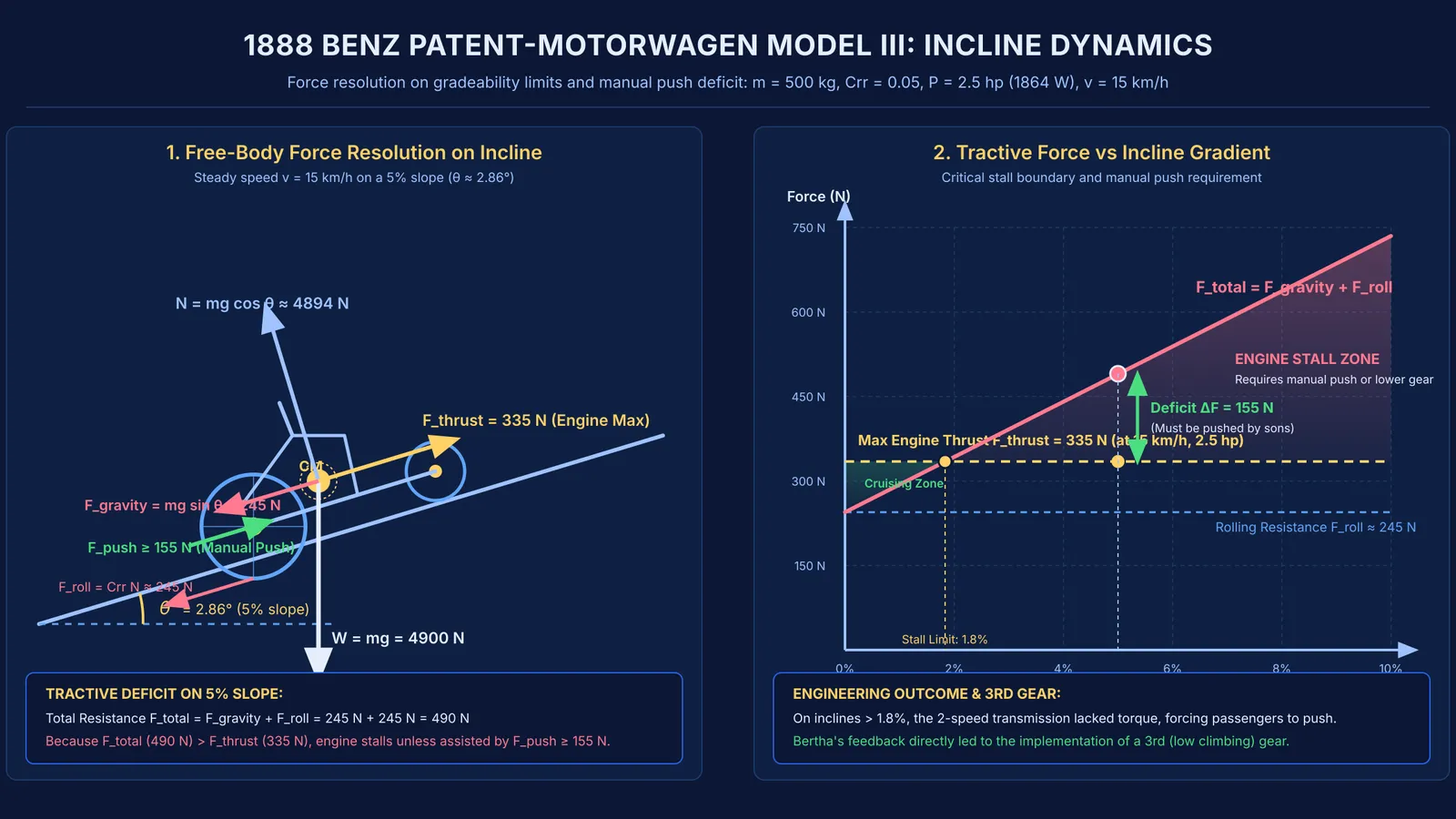
What physics problem forced her to push the car uphill?
While the car cruised at roughly 15 km/h on flat roads, hills revealed a critical gearing flaw. As recorded by Encyclopaedia Britannica, the Model III was equipped with only two forward gears, leaving it without sufficient torque for steep inclines.
Consider the force balance on a slope. For a vehicle and passengers with total mass m ≈ 500 kg, weight is W = mg ≈ 4900 N.
On an unpaved road with rolling resistance coefficient C_rr ≈ 0.05, rolling resistance is:
F_roll = C_rr × mg × cos θ ≈ 245 N
On a 5% slope (sin θ ≈ 0.05), the downward gravitational pull along the incline is:
F_gravity = mg × sin θ ≈ 500 × 9.8 × 0.05 = 245 N
The required tractive thrust is:
F_total = F_gravity + F_roll ≈ 245 N + 245 N = 490 N
At 15 km/h (4.17 m/s), an engine output of 2.5 horsepower (1864 W) at 75% mechanical efficiency produces only about 335 N of wheel thrust. Because 490 N exceeds 335 N, the engine stalled unless the boys pushed with at least 155 N of manual force.
After arriving in Pforzheim, Bertha telegraphed Karl and demanded a third, lower climbing gear, which he installed in later models.
To explore slope forces, angle of friction and incline mechanics explains how forces resolve across angles. When studying how gear ratios trade speed for torque, the Fermi Simulation Lab provides interactive simulations for ideas that are easier to see than to read.
What can modern engineering and science students learn from her drive?
Bertha Benz's journey is a blueprint for empirical testing. In STEM education—whether preparing for rigorous exams or designing a prototype for student engineering competitions—it is easy to mistake textbook formulas for working hardware.
Like Otto Lilienthal's systematic flight tests, Bertha showed that real understanding begins where ideal theory meets friction:
Test outside ideal conditions: Workbenches hide real variables like hill grades, road grit, and heat dissipation.
Treat failures as diagnostic clues: Each breakdown pinpointed a specific mechanical parameter that needed redesign.
Close the engineering loop: Field triage directly drove permanent improvements in braking materials and transmission ratios.
When working through multi-force dynamics step by step, the Fermi Problem Library offers worked problems with a step-by-step solver that explains the reasoning rather than printing an answer.
In his 1925 memoirs, as preserved in Mercedes-Benz Group tradition records, Karl Benz acknowledged this decisive contribution, crediting his wife with standing by him when his venture faced collapse and setting new sails of hope when the project seemed destined to sink.


