

On this page
In 1943, at the Radium Institute in Vienna, the physicist Berta Karlik and her colleague Traude Bernert showed that element 85, astatine, is not only something made in a laboratory. It forms, in tiny amounts, inside the natural radioactive decay series of uranium and actinium (Brigitte Strohmaier's biography of Karlik, English translation on arXiv). Their story also holds a useful trick for counting alpha and beta decays in exams.
Who was Berta Karlik?
Karlik was born on 24 January 1904 and died on 4 February 1990 (University of Vienna history page). She finished her studies in 1928 with a thesis on scintillations in zinc sulphide (same source), the tiny flashes of light that researchers then counted by eye to detect particles (Strohmaier). She became permanent director of the Radium Institute in 1947 (same source), and in 1956 the first woman appointed to a full professorship at the University of Vienna (University of Vienna).
How did Karlik and Bernert find astatine in nature?
Astatine was first made in 1940 at Berkeley, when Dale Corson, Kenneth MacKenzie and Emilio Segrè bombarded bismuth with alpha particles from a cyclotron (Corson, MacKenzie and Segrè, Physical Review, 1940; Fry and Thoennessen, Atomic Data and Nuclear Data Tables, 2012).
Karlik and Bernert asked a different question. Some nuclei in the natural decay chains were known to decay by either alpha or beta emission; could others? If a polonium nucleus (atomic number 84) emitted a beta particle instead of an alpha, it would become element 85 (Strohmaier).
Their first target was radium A, today called polonium-218, in the uranium-radium series (decay chain tables). Using an ionisation chamber, they measured the range of alpha particles from a radium A source and found a new alpha radiation, which they assigned to astatine-218 in a 1943 paper titled Eine neue natürliche α-Strahlung, a new natural alpha radiation (Fry and Thoennessen). From its total decay energy, 6.75 MeV, the Geiger-Nuttall relation gave a half-life of the order of seconds, which fitted their observations; the adopted value in that 2012 review is about 1.5 seconds (same source).
In 1944 they did the same in the actinium series. They found astatine-215, formed by beta decay of actinium A (polonium-215), with alpha radiation at about 5 per million relative to the actinium A alphas and a decay energy of 8.4 MeV (Fry and Thoennessen).
Why didn't Karlik and Bernert get to name astatine?
The American team had already made the element, and making an element counted as discovering it. So Karlik and Bernert were credited with finding its natural occurrence only, and they did not name it; they would have chosen Viennium (Strohmaier). The Austrian Academy of Sciences gave them the Haitinger Prize in 1947 for their work on element 85 (same source). The name astatine was officially accepted at the 15th IUPAC conference in Amsterdam in 1949 (Fry and Thoennessen).
Element 87 has a parallel story: read how Marguerite Perey discovered francium.
How many astatine atoms does a rare branch make?
Modern tables list polonium-218 as decaying 99.98% by alpha and 0.02% by beta, with a half-life of about 3.1 minutes (decay chain tables).
Suppose a radon sample produces 1,000,000 polonium-218 decays.
With a 0.02% beta branch, astatine-218 nuclei formed = 1,000,000 × 0.0002 = 200.
So about 200 astatine alphas hide among roughly a million polonium alphas. They stand out because they carry a different energy, and so travel a different distance in air.
In the actinium series, the 5 per million that Karlik and Bernert measured (Fry and Thoennessen) means about one astatine-215 alpha for every 200,000 from polonium-215. Modern tables give a smaller beta branch for polonium-215, about 2.3 per million (decay chain tables).
Does a branch change how many alpha and beta decays you count?
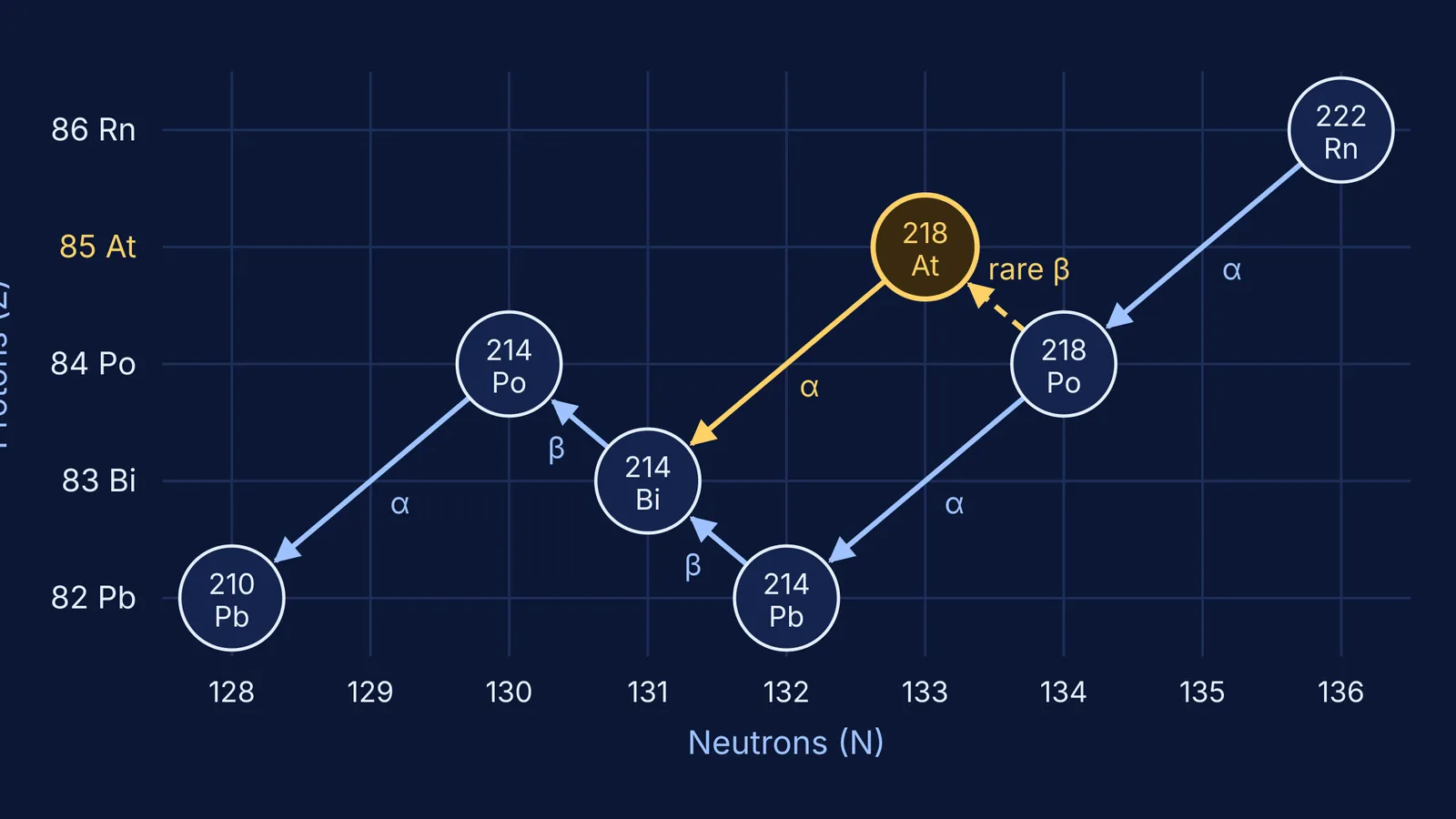
No, and this is the exam lesson. Follow both routes from polonium-218 to bismuth-214 in the diagram above:
Main route: polonium-218 (Z = 84) → alpha → lead-214 (Z = 82) → beta → bismuth-214 (Z = 83).
Karlik and Bernert's branch: polonium-218 → beta → astatine-218 (Z = 85) → alpha → bismuth-214 (Z = 83).
Both routes use one alpha and one beta. An alpha lowers mass number by 4 and atomic number by 2; a beta-minus leaves mass number unchanged and raises atomic number by 1, as the displacement law says (Frederick Soddy, isotopes and the displacement law). So between any two nuclei:
Number of alphas = (change in mass number) ÷ 4.
Number of betas = 2 × (number of alphas) − (drop in atomic number).
For polonium-218 to bismuth-214: alphas = 4 ÷ 4 = 1; betas = 2 × 1 − 1 = 1. The order of decays can change; the totals cannot. For more practice, see counting alpha and beta decays in a radioactive decay series.
If the counts keep tripping you up, the Fermi Problem Library has worked problems with a step-by-step solver that explains the reasoning rather than printing an answer.
Next time you see a decay series, look for the small side arrows. One of them is the route Karlik and Bernert measured in 1943.


