On this page
For many years, the medical community believed that diabetes was a failure of a single organ—the pancreas—caused solely by a lack of insulin. In the early 1920s, the isolation of insulin had saved patients, leading many to assume that the metabolic puzzle was fully solved. But the human body rarely relies on just one control dial for a critical system.
Bernardo Houssay, an Argentine physiologist born in Buenos Aires in 1887, suspected the story was far more complex. His lifelong study of the hypophysis (the pituitary gland) revealed that carbohydrate metabolism is maintained by a tug-of-war between multiple glands. For this work, he became the first Latin American in the sciences to win a Nobel Prize, awarded in 1947 1.
How did Houssay link the pituitary gland to diabetes?
Houssay was a child prodigy who entered the School of Pharmacy at just 14 years old and graduated at 17 1. Driven by an intense curiosity about human physiology, he later became a Professor of Physiology at the University of Buenos Aires. In a testament to his dedication to research, he founded the Institute of Biology and Experimental Medicine, creating a hub for scientific inquiry in Argentina. His most famous experiments focused closely on the anterior lobe of the pituitary gland and its effect on the body's metabolism.
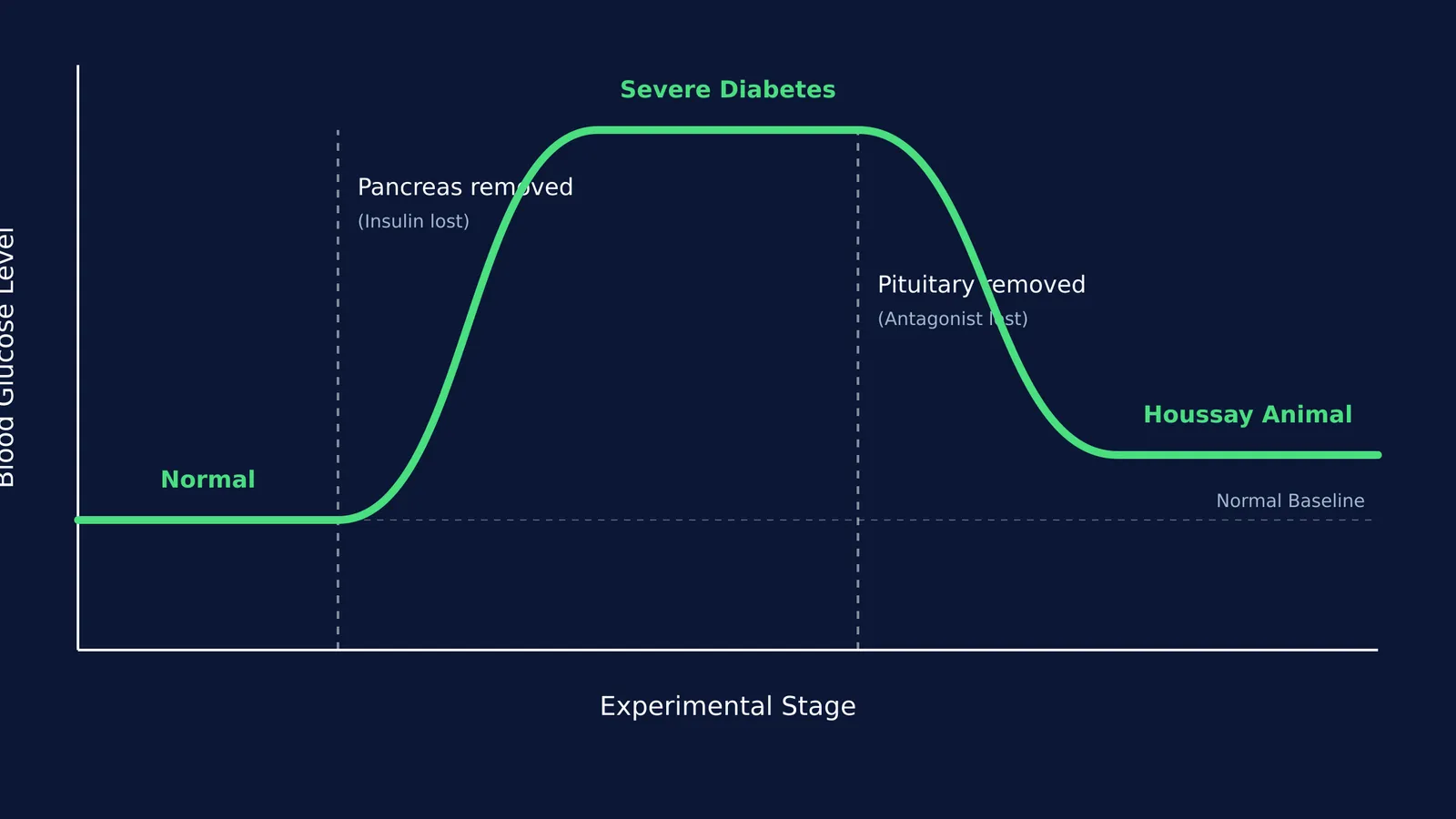
To understand the hidden relationship between different glands, Houssay performed precise experimental surgeries on laboratory animals. First, he removed an animal's pancreas. This predictably induced a state of severe diabetes, because the body could no longer produce the insulin required to lower blood sugar levels.
Then came the key step: he removed the anterior lobe of the pituitary gland from that same diabetic animal. Instead of worsening the animal's precarious condition, the diabetic symptoms were significantly alleviated 2. The animal's blood sugar dropped closer to normal levels.
This experiment created what became known in the medical world as the "Houssay animal." It provided physical proof that the anterior pituitary produces a hormone that acts as an antagonist to insulin. While insulin lowers blood sugar, the anterior pituitary hormone raises it.
Why does carbohydrate metabolism need opposing hormones?
Before Houssay's findings, the field of endocrinology often looked at glands in strict isolation. Houssay proved that metabolic health requires a complex, multi-glandular balance. If the pancreas completely fails, the unopposed pituitary hormones will drive blood sugar to dangerously high levels. Removing the pituitary gland in his experiments effectively removed that opposing upward force, bringing the animal's internal system into a lower, albeit fragile, state of equilibrium.
This constant push-and-pull is a classic example of how our bodies maintain homeostasis under changing conditions. Today, we know that the primary hormone Houssay was studying from the pituitary is growth hormone, which naturally decreases insulin sensitivity to ensure the brain always has enough circulating glucose.
For students preparing for biology exams, understanding these dynamic interactions is crucial. You can see how these regulatory systems are covered in our guide on Chemical coordination for NEET: glands, hormones and their actions, or explore the specific mechanics of Hormonal feedback loops: how the body keeps hormone levels steady.
How to study complex endocrine pathways?
Memorising isolated facts about the pituitary or the pancreas is rarely enough to master advanced biology. To truly understand physiology, you need to trace the causal chains: what happens if one hormone increases, and how does another specific gland respond to correct the shift?
To study any endocrine pathway effectively, use this simple three-step framework whenever you encounter a new hormone:
Identify the stimulus: What environmental or internal change triggers the gland? (e.g., high blood sugar after a meal).
Name the hormone and target: What chemical is released, and where does it go in the body? (e.g., insulin targets the liver and muscle cells).
Trace the antagonist: What opposes this action to restore balance later? (e.g., pituitary hormones or glucagon raise the sugar back up when you are fasting).
This is exactly where a responsive learning tool helps bridge the gap. The Fermi Concept Library includes every concept in physics, chemistry, biology, mathematics and computing, each with its own lesson and its place in the map, so you can see exactly how the endocrine system connects to cellular metabolism and overall health.
If you are struggling to picture a biological feedback loop in action, Fermi's AI tutor can teach you through it. It works out what you already know, builds a plan for the session, and teaches through it—writing on a board, drawing the figure, running the simulation, and checking understanding as it goes.
By following Bernardo Houssay's example of looking at the whole interconnected system rather than a single part, you can build a robust mental model of human physiology that relies on logic rather than rote memory.