On this page
Sir Bernard Lovell was a British physicist who worked on airborne radar systems during the Second World War. During the conflict, Lovell was part of the team that developed H2S, a radar system that allowed bomber crews to navigate and identify targets at night or through thick cloud cover. This intense wartime research gave Lovell a deep, practical understanding of how to send and receive high-frequency radio pulses.
After the war, he returned to the University of Manchester. His new goal was to study cosmic rays—high-energy particles from deep space that constantly bombard the Earth's atmosphere. He planned to detect the faint radar echoes produced when these particles ionized the air. However, Manchester was a bustling industrial city. The electrical interference from the sparking wires of the city's trams completely overwhelmed his sensitive receivers. To escape the noise, Lovell moved his ex-military radar equipment out to a quiet botanical research site in Cheshire called Jodrell Bank (Davies et al., 2016).
Like his contemporary in the field, Piara Singh Gill and the cosmic rays of India, Lovell had to build much of his own apparatus from scratch. What started as a few trailers in a muddy field soon grew into a permanent observatory as Lovell pushed for larger and more sensitive antennas.
Why was the Jodrell Bank telescope built?
To detect the faintest radio waves from distant galaxies, Lovell realised he needed a massive, movable receiver. A fixed antenna could only view the narrow strip of sky that passed directly overhead as the Earth rotated. A steerable dish, however, could track a specific star or galaxy for hours, gathering much more data.
He commissioned Charles Husband, an expert engineer, to design a 76-metre (250-foot) steerable dish, which was finally completed in the summer of 1957 (Morison, 2007). At the time, it was by far the largest steerable radio telescope in the world, suspended between two enormous steel towers built on a circular railway track.
However, constructing such an unprecedented machine proved incredibly difficult. Wind resistance, structural weight, and the need for precision motors caused the design to change repeatedly. As a result, the final cost soared to nearly ten times the original estimate, leaving the university with over £250,000 in debt (Davies et al., 2016). The British press and critics in Parliament ruthlessly attacked the project, calling it "Lovell's Folly." Because Lovell had authorized many of the expensive design changes himself, he was threatened with prosecution and prison for the unauthorized use of public funds.
How did the telescope track the Sputnik rocket in 1957?
The telescope, and Lovell's career, were saved by a historical accident. On October 4, 1957, the Soviet Union shocked the world by launching Sputnik 1, the first artificial satellite.
Western governments and military leaders were desperate to know the exact trajectory of the rocket. If the Soviet Union could put a satellite into orbit, it meant they had a functional intercontinental ballistic missile (ICBM) capable of striking anywhere on Earth. Because the empty booster rocket did not transmit its own signal, it had to be tracked passively by radar.
On the night of October 12, 1957, Lovell's team pointed their massive dish at the sky and detected a huge radar echo from the booster rocket moving through the upper atmosphere (Morison, 2007). The Jodrell Bank dish was the only instrument in the Western world powerful enough to detect a radar reflection from that distance. Overnight, "Lovell's Folly" transformed into a crucial strategic asset for national defense. The resulting public acclaim and international prestige brought in the funding necessary to clear the project's debts entirely.
The telescope, later renamed the Lovell Telescope, went on to track the trajectories of both American and Soviet lunar probes, cementing its place in the history of space exploration. If you want to see how these planetary trajectories work, try Understanding planetary orbits with a gravity simulation.
What is the physics of radar tracking?
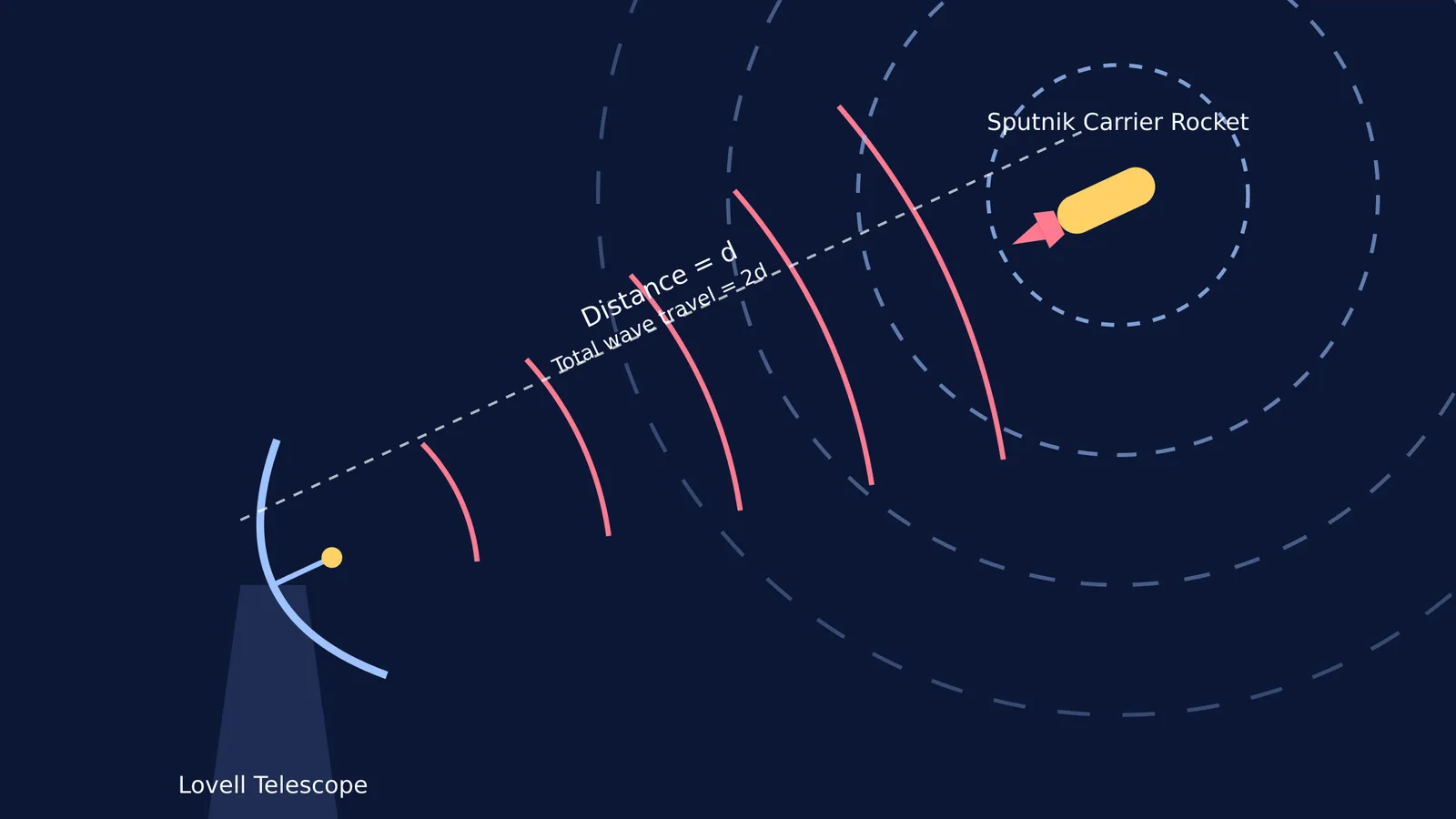
Radar (which stands for Radio Detection and Ranging) works by sending a short, highly focused pulse of radio waves into the sky. The telescope then switches to receiving mode and listens for the faint reflection, or echo, that bounces back when the waves hit a solid object like a rocket.
Because radio waves are a form of electromagnetic radiation, they always travel at the constant speed of light in a vacuum (c = 3 × 10⁸ m/s, LibreTexts/24%3A_Electromagnetic_Waves/24.03%3A_The_Electromagnetic_Spectrum)). By precisely timing how long the echo takes to return (Δt), you can calculate the exact distance to the target.
The crucial detail in radar physics is that the radio pulse has to make a round trip. It travels out to the rocket and then travels all the way back to the dish. Therefore, the total distance covered by the wave is twice the actual distance to the target. The formula for the target's distance d is:
d = c × Δt / 2
When you are solving kinematics problems that involve two-way travel times—like radar tracking a satellite or sonar mapping the ocean floor—it is very easy to forget to divide by two. If you are making wrong-method mistakes in kinematics, the Fermi Problem Library has worked problems with a step-by-step solver that explains the reasoning rather than printing an answer. This helps you build the habit of checking whether a wave has made a one-way or two-way trip.