

On this page
In 1768, Benjamin Franklin was working in London as the Deputy Postmaster General for the American colonies when he noticed a puzzling discrepancy. British mail ships sailing from England to New York were taking about two weeks longer than ordinary American merchant ships taking a longer route to Rhode Island, according to records held by the Library of Congress.
Franklin asked his cousin, Timothy Folger, a Nantucket whaling captain, for an explanation. Folger revealed that American whalers were deeply familiar with a powerful ocean current they used to track whales. The British captains, however, were unaware of it, and were losing weeks of time by sailing directly against the flow.
What did the Benjamin Franklin Gulf Stream map show?
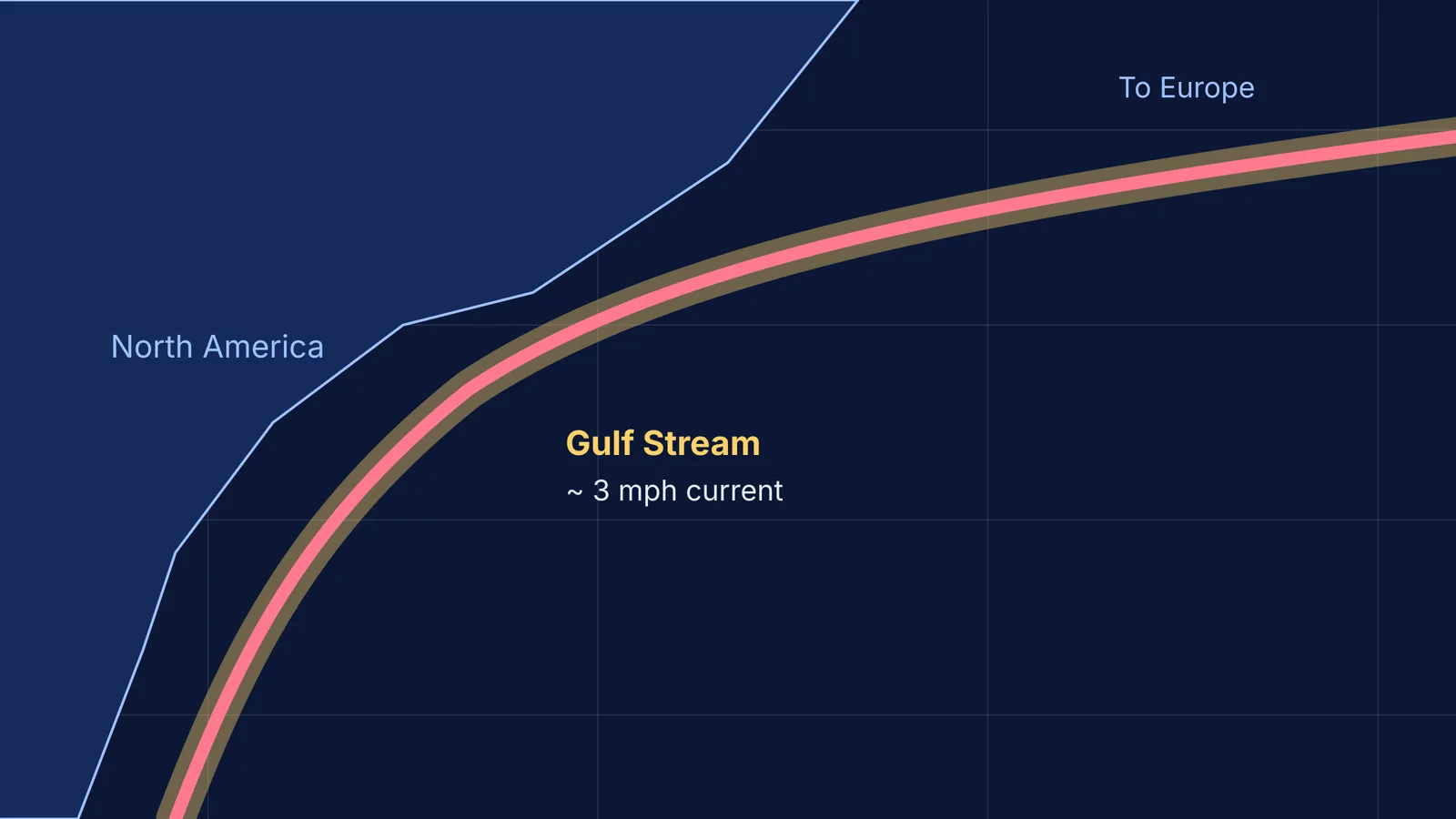
At Franklin's request, Folger sketched the current's dimensions and path onto a chart. Franklin had it engraved and published in London in 1768, giving us the first scientific map of what he called the Gulf Stream.
According to a later letter documented by Founders Online, the map revealed a "river in the ocean" flowing at about 3 miles per hour. If a ship sailed with the stream, it gained crucial time. If it sailed against it—what sailors called "stemming the stream"—it was effectively pushed backwards.
Folger told Franklin that American whalers had tried to warn the British captains when they saw them fighting the current. But the British commanders were "too wise to be counselled by simple American fishermen" and ignored the advice, condemning their ships to weeks of wasted effort.
Are you stemming the current in your studies?
The story of the British mail packets is one of the best analogies for how many students approach exam preparation.
You can put in long hours, show immense discipline, and still find yourself stuck—a common reason why some JEE aspirants plateau despite studying every day. If you are memorising formulas without understanding where they come from, or grinding through mock tests without reviewing your mistakes, you are stemming the current. You are doing hard work, but the structure of the subject is pushing against you.
This is why Fermi's AI tutor is built to teach, not just to give answers. When you bring a problem to Fermi, it works out what you already know and builds a plan for the session. It teaches through the gap in your understanding—writing on a board, drawing the figure, and checking your reasoning as you go. You stop fighting the material and start moving with it.
How can you map your own knowledge?
Franklin didn't just draw a map; he gave sailors a tool to know where they were. He pioneered the use of thermometers to track the Gulf Stream, knowing the current was significantly warmer than the surrounding Atlantic.
You need a similar feedback mechanism for your studies. Here is a framework to stop fighting the current:
Take your temperature: You cannot navigate blindly. You need regular feedback on where your gaps are. Use a structured review session to analyse a mock test, tracking exactly why you got a question wrong (was it a calculation error, a missing concept, or a trap?).
Find the core current: Not all topics carry the same weight. If you are struggling with a complex mechanics problem, the block is rarely the final equation; it is usually a foundational concept like drawing a free-body diagram. The Fermi Concept Library maps out every concept in physics, chemistry, biology, mathematics and computing, each with its own lesson and its place in the map.
Change course early: The British captains lost two weeks because they refused to change course when warned. If a study method isn't working after a month, drop it. Ask for help, change your approach, and let the structure of the subject do the heavy lifting for you.


