

On this page
In 1999, Ben Feringa and his research group at the University of Groningen published a paper in Nature describing a molecule that did something entirely new. It was a molecular motor that spun continuously in one direction, powered entirely by light.
Before this discovery, chemists had successfully built molecular switches—molecules that could flip back and forth between two distinct states when exposed to light or heat. However, Feringa's molecule achieved something far more complex: full 360-degree continuous rotation. This result proved that synthetic molecules could be carefully designed to convert external energy into directed mechanical motion, laying the foundation for the entire field of molecular machinery and earning Feringa a share of the 2016 Nobel Prize in Chemistry.
How does a light-driven molecular motor work?
The motor is built around an "overcrowded alkene". This is a specific type of chiral molecule consisting of two large, identical paddle-like halves connected by a central carbon-carbon double bond. In this system, the double bond acts as the central axle around which the two halves can rotate.
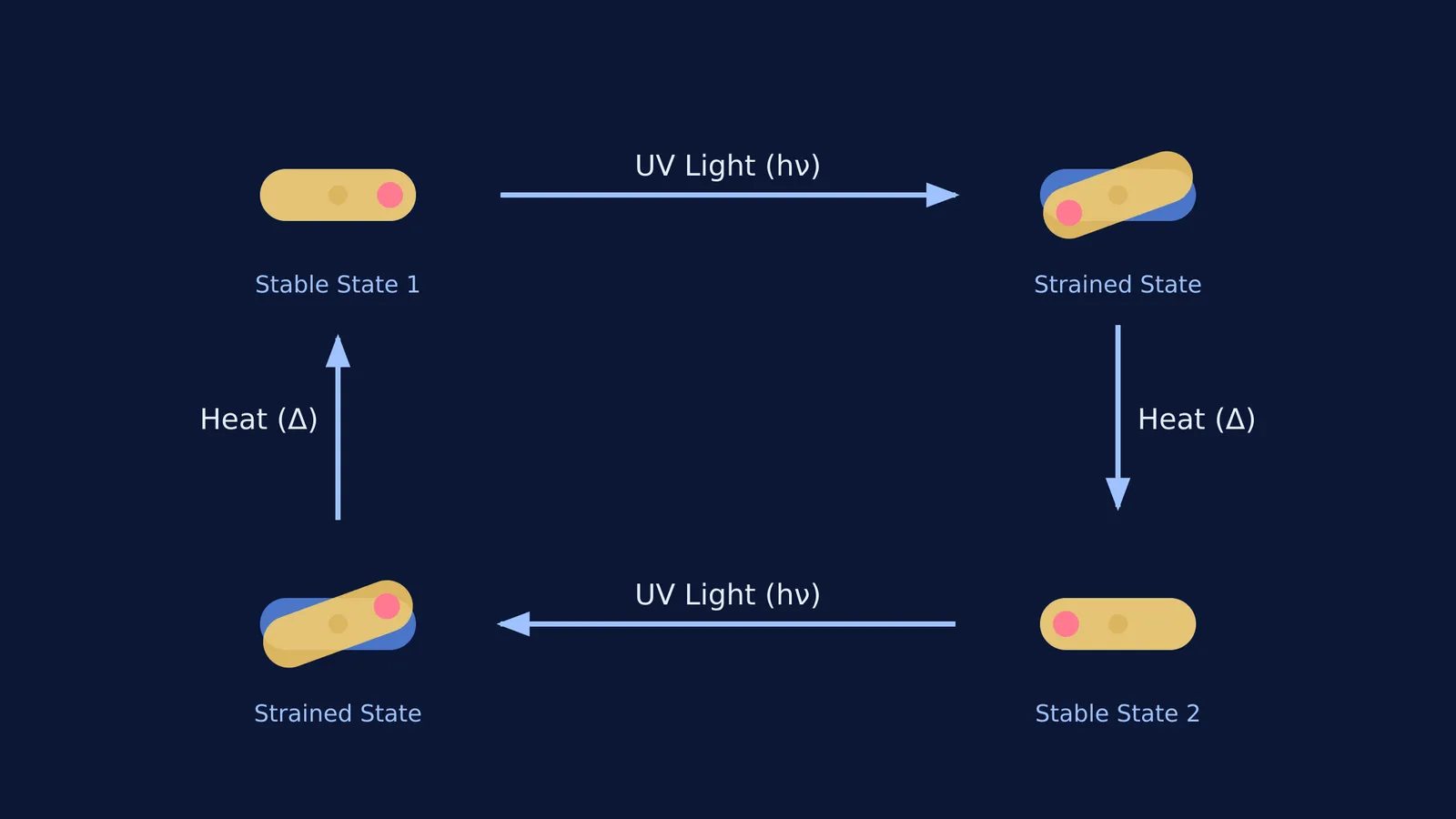
To spin, the motor completes a precise four-step cycle detailed in their 1999 paper that relies on alternating bursts of ultraviolet (UV) light and thermal energy (heat):
First light pulse: When UV light hits the molecule, it provides enough energy to temporarily break the pi bond of the central double bond, causing a *cis-trans* isomerisation. This forces the top half of the molecule to rotate by 180 degrees relative to the bottom half.
Thermal ratchet: Because the two halves of the molecule are so large, the new position is highly strained—the bulky parts of the molecule are physically squeezed together. Heat from the surrounding environment allows the molecule to undergo a slight structural shift, relaxing into a more stable state. This "helicity inversion" acts exactly like a mechanical ratchet. It locks the rotation in place, making it physically impossible for the molecule to spin backward.
Second light pulse: Another burst of UV light triggers a second *cis-trans* isomerisation, causing another 180-degree rotation in the same direction.
Second thermal ratchet: Heat once again allows the bulky groups to slip past one another into a relaxed state. This completes the full 360-degree cycle and returns the motor perfectly to its original starting configuration.
Why is unidirectional rotation so difficult to achieve?
In macroscopic engineering, getting a wheel or an engine to spin in one direction is straightforward. At the molecular level, however, it is incredibly difficult. Molecules exist in a chaotic environment where they are constantly bombarded by surrounding atoms and molecules—a phenomenon known as Brownian motion. This constant thermal jostling makes molecules spin, vibrate, and tumble randomly in all directions.
Feringa's key insight was designing a molecule where the chemical structure itself forced the rotation to follow a one-way street. The steric hindrance, or physical overcrowding, of the large groups on the molecule ensures that after each step in the cycle, the energy barrier to move forward is much lower than the barrier to go back. The molecule effectively harvests the random energy of its environment and channels it into a single, predictable direction.
From spinning motors to driving nanocars
Once the fundamental concept of a light-driven motor was established, Feringa's team began exploring how to use this microscopic mechanical motion to perform actual work.
The nanocar replaced the light-driven motors with a slightly modified version that could be powered by tiny pulses of electricity from a scanning tunneling microscope. By carefully controlling the stereochemistry of the four wheels, the team ensured that all four motors spun in a way that propelled the entire molecule forward, demonstrating that molecular machines could transport materials across surfaces. Today, researchers are working on using these motors to create "smart materials" that can bend, contract, or even heal themselves when exposed to light, mimicking the function of human muscles.
Mastering stereochemistry and organic mechanisms
If you are studying isomerisation, chirality, or the behaviour of double bonds for JEE or NEET, picturing 3D structures and steric hindrance in your head can be a major challenge. The Fermi Simulation Lab lets you interact with 3D molecular models, allowing you to see exactly how bulky groups interact and how these forces affect molecular stability.
If you get stuck on a tricky organic chemistry mechanism, or if you need help counting stereoisomers from the number of chiral centres, Fermi's AI tutor can work through it with you step by step. Rather than just giving you the final answer, the tutor draws the structures on a shared board as it explains the reasoning. You can also explore how these fundamental concepts apply to simpler molecules, like structural isomers in Class 10, ensuring you have a strong foundation before tackling complex mechanisms.