

On this page
Bartolomeo Eustachi (c. 1500–1574) was a pioneering Italian anatomist who, alongside Andreas Vesalius, helped found the modern study of human anatomy. He spent much of his career teaching in Rome at the Sapienza University. While earlier Greek thinkers like Aristotle had noticed a vague connection between the ear and the throat, Eustachi was the first to map its precise structure.
In his 1564 book *Opuscula Anatomica*, he detailed a narrow canal that runs from the middle ear to the nasopharynx (the back of the throat). His anatomical descriptions were accompanied by magnificent copperplate engravings. Sadly, these plates were lost in the Vatican Library after his death and remained unpublished for over 150 years. Despite this delay, his written work was so exact that the passage was forever named the Eustachian tube in his honour.
What does the Eustachian tube do?
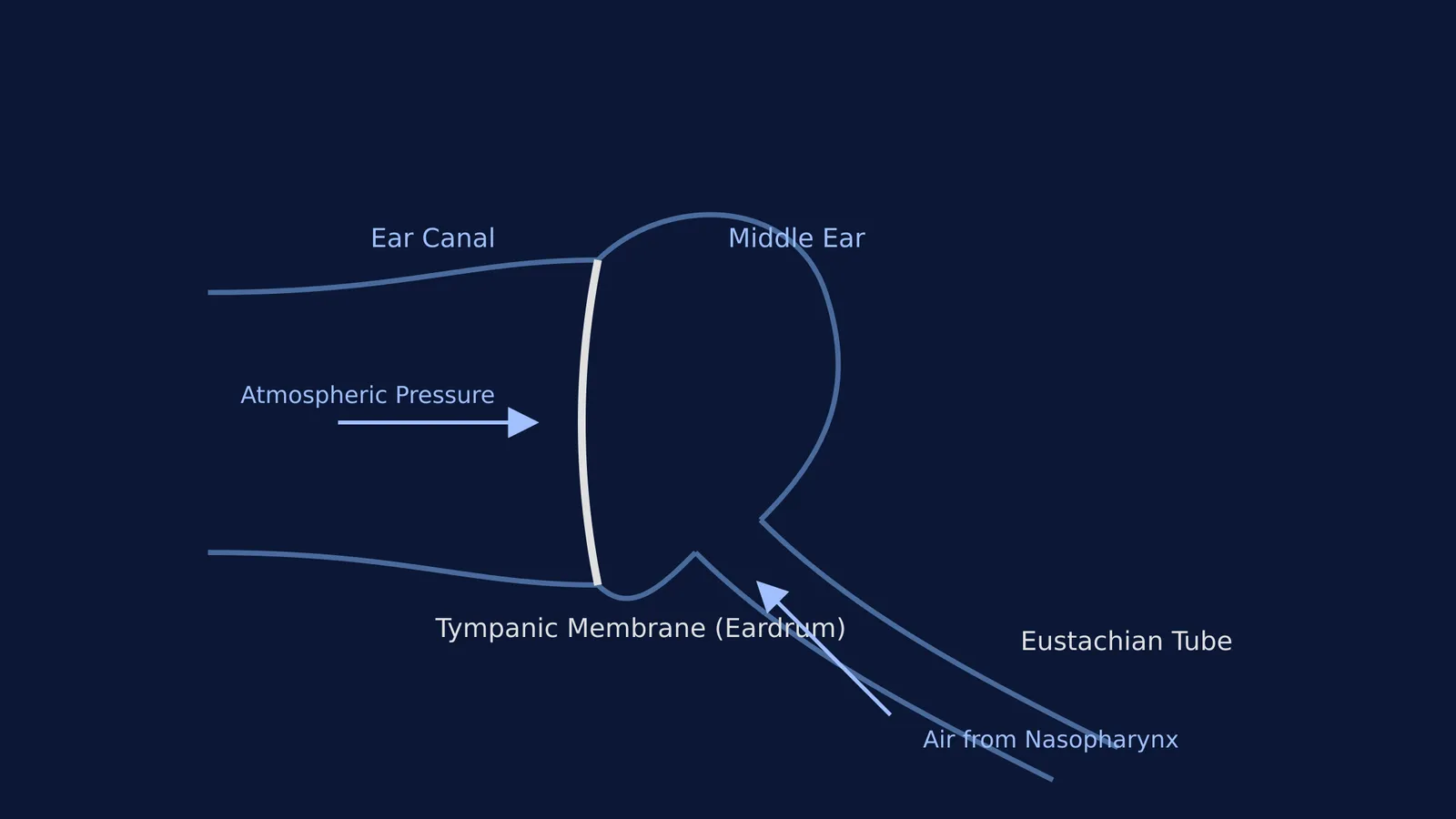
The middle ear is a small, air-filled cavity situated just behind your eardrum. For the eardrum to vibrate freely and transmit sound efficiently to the inner ear, the air pressure inside this cavity must perfectly match the atmospheric pressure outside.
In an adult human, the Eustachian tube is about 35 mm long and 3 mm wide. The first third of the tube, nearest the middle ear, is encased in rigid bone. The remaining two-thirds, which lead to the throat, are made of flexible cartilage.
The tube normally stays collapsed and closed. This keeps the middle ear protected from pathogens in the throat and blocks out the loud, resonant sounds of your own breathing and speaking. However, when you swallow, chew, or yawn, the muscles in your soft palate briefly pull the cartilaginous section of the tube open. This opening allows a tiny bubble of air to pass through, instantly equalising the pressure on both sides of the eardrum and draining any trapped mucus.
Tracing how structures like the Eustachian tube connect different body systems is a core skill in biology. You can explore these topics in the Fermi Concept Library, which has a lesson for every concept in biology, physics, and chemistry and its place in the map.
Why do your ears pop on an aeroplane?
When a plane takes off and climbs to cruising altitude, the atmospheric pressure inside the cabin drops. The air trapped inside your middle ear is now at a higher pressure than the cabin air, causing your flexible eardrum to bulge outwards. This stretching restricts its movement, muffling your hearing and causing an uncomfortable feeling of fullness.
When you swallow or chew gum, your Eustachian tube opens. The higher-pressure air escapes from the middle ear into your throat with a noticeable "pop", and your eardrum snaps back into its normal, flat position.
During descent, the reverse happens: cabin pressure rises rapidly, the middle ear is left at a lower pressure, and the eardrum is pushed inwards. This vacuum makes it physically harder for the Eustachian tube to open automatically, which is why descending is often more painful than climbing. Children are especially prone to this pain because their Eustachian tubes are shorter, narrower, and more horizontal than those of adults, making them harder to clear.
The physics of ear pain: a worked example
Why does a blocked Eustachian tube hurt so much? We can calculate the forces involved using basic physics principles.
The effective area of a human eardrum—the central portion that vibrates to transmit sound—is approximately 55 mm². According to blast overpressure data, a sudden pressure difference of 35 kilopascals (kPa) between the middle ear and the outside air can rupture the membrane.
Since pressure is force divided by area (P = F / A), we can rearrange the formula to find the total force pushing on the eardrum:
Pressure (P) = 35,000 N/m²
Area (A) = 55 × 10⁻⁶ m²
Force (F) = 35,000 × 0.000055 = 1.925 Newtons
A force of 1.9 Newtons is roughly the downward weight of a large apple. Having that weight concentrated directly on a delicate, paper-thin membrane explains why a blocked Eustachian tube from a cold or a rapid altitude change causes such severe pain. If you are struggling to connect physics formulas to real-world biological systems, the Fermi Problem Library has a step-by-step solver that explains the reasoning behind cross-disciplinary calculations like this.
Understanding the human body requires connecting the anatomy of early researchers like Eustachi with the physical laws of pressure and force. You can read more about how essential anatomical structures were discovered in our posts on Jacob Henle and the loop that concentrates urine or Sunao Tawara and the atrioventricular node of the heart.


