

On this page
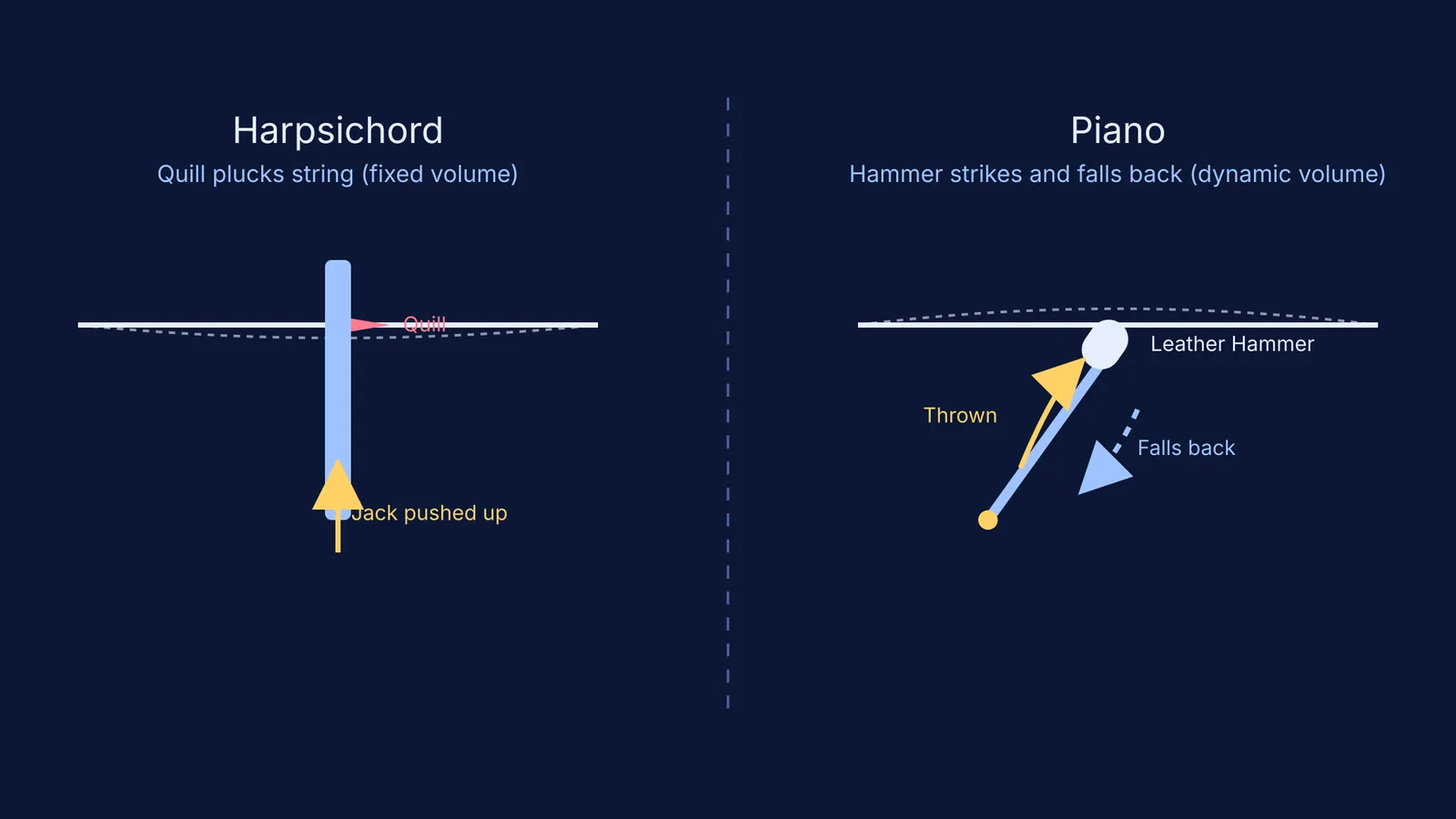
Before the year 1700, keyboard players had to choose between volume and expression. The harpsichord was loud enough for a concert, but it plucked its strings with a tiny quill attached to a vertical jack, producing the same volume no matter how hard you pressed the keys. The clavichord let you play softly or loudly by striking the strings with a metal tangent, but it was too quiet to be heard clearly over other instruments.
It took an Italian instrument maker named Bartolomeo Cristofori to solve the problem. Working in Florence, he invented a mechanism that changed music forever.
Who invented the piano and when?
Bartolomeo Cristofori invented the first true piano around the year 1700 while serving the Medici court in Florence. An inventory of the court's instruments from that year mentions an "arpicimbalo" (a harpsichord-like instrument) "newly invented" by Cristofori that could play both soft and loud.
By 1711, a writer described the invention as a *gravicembalo col piano, e forte*, which translates to "harpsichord with soft and loud". Over time, musicians and builders shortened the name to *pianoforte*, and eventually just piano.
Only three of Cristofori's original pianos survive today. The oldest, built in 1720, features a keyboard of 54 keys and is housed at the Metropolitan Museum of Art in New York.
How did Cristofori's hammer mechanism work?
The genius of Cristofori's invention lay in its mechanical action, which replaced the harpsichord's plucking quill with a leather-covered hammer.
For the instrument to work, the hammer had to strike the string with enough force to make it ring, but it could not stay pressed against the string. If the hammer rested on the string, it would act as a damper, immediately stopping the vibration.
Cristofori solved this with a mechanism called the escapement. When you press a key on a piano, a small lever pushes the hammer toward the string. But a fraction of a second before impact, the pushing mechanism slips away (or "escapes"). The hammer flies the rest of the distance on its own momentum, strikes the string, and instantly falls back, leaving the string free to vibrate.
He also added a "check" to catch the falling hammer. Without the check, a fast-moving hammer might bounce off its resting place and strike the string a second time, ruining the note. Finally, a separate damper rested on the string to silence it the moment the player released the key.
Why did the piano change music?
Because the hammer was thrown at the string rather than pushed into it, its speed depended entirely on how hard the player struck the key. A gentle press threw the hammer slowly, producing a quiet (*piano*) sound. A firm strike threw it quickly, producing a loud (*forte*) sound.
This dynamic control gave composers a new tool for emotional expression. They could now write music with sudden crashes, gradual swells, and fading whispers. In 1732, Lodovico Giustini published the first music written specifically for the piano, according to the Metropolitan Museum of Art, including dynamic markings like *più forte* (louder) and *più piano* (softer) that were impossible to play on a harpsichord.
The mechanical challenge of the escapement was so difficult that Cristofori's design remained the standard for the next 75 years, according to the Metropolitan Museum of Art. Understanding complex physical systems often requires seeing them in motion. Just as visualizing a mechanical escapement is easier with a working model, the Fermi Simulation Lab provides interactive simulations for the ideas in physics that are easier to see than to read. If you find yourself stuck on the mechanics of a physics problem, Fermi's AI tutor can work out what you already know and build a plan for the session, guiding you step by step.
How can you tell a harpsichord from an early piano?
If you encounter a historical keyboard instrument, look for these three clues:
Volume control: Can the player make the notes louder by striking the keys harder? If yes, it is a piano.
The action: Look inside the case when a key is pressed. If a small point plucks the string, it is a harpsichord. If a leather or felt hammer strikes the string and bounces back, it is a piano.
The dampers: When the player lifts their hands, does the sound stop immediately? Both instruments use dampers, but a clavichord's tangent stays on the string to sustain the note, while a piano and harpsichord lift their dampers when the key is released.


