

On this page
When you look at the Milky Way on a clear night, you might notice dark patches where stars seem to be missing. For a long time, astronomers thought these were simply "holes in the sky." One of the most famous examples, Barnard 68, is so opaque it completely blacks out the stars behind it. We now know these are not empty spaces, but incredibly dense clouds of interstellar gas and dust.
In 1947, astronomers Bart Bok and Edith Reilly published a landmark paper in *The Astrophysical Journal* identifying the smallest and most isolated of these dark nebulae. Bok famously described them as being "similar to insect's cocoons" that hide developing stars. Today, we call them Bok globules.
Just as the discovery by Williamina Fleming and the first white dwarf helped explain how stars die, Bok and Reilly's work provided the first real clue as to how they are born.
What happens inside a Bok globule?
A typical Bok globule is about one light-year across and contains between 2 and 50 solar masses of material. They are composed mostly of molecular hydrogen and helium, with about 1% silicate dust. Because they are isolated from larger giant molecular clouds, they offer astronomers a relatively simple environment to study how stars form.
Shielded from the radiation of outside stars, Bok globules are some of the coldest objects in the natural universe. This extreme cold is exactly what a gas cloud needs to build a star.
What is the Jeans mass?
To understand why a cloud becomes a star, you have to look at the balance of forces. A star only forms if a cloud can overcome its own internal gas pressure.
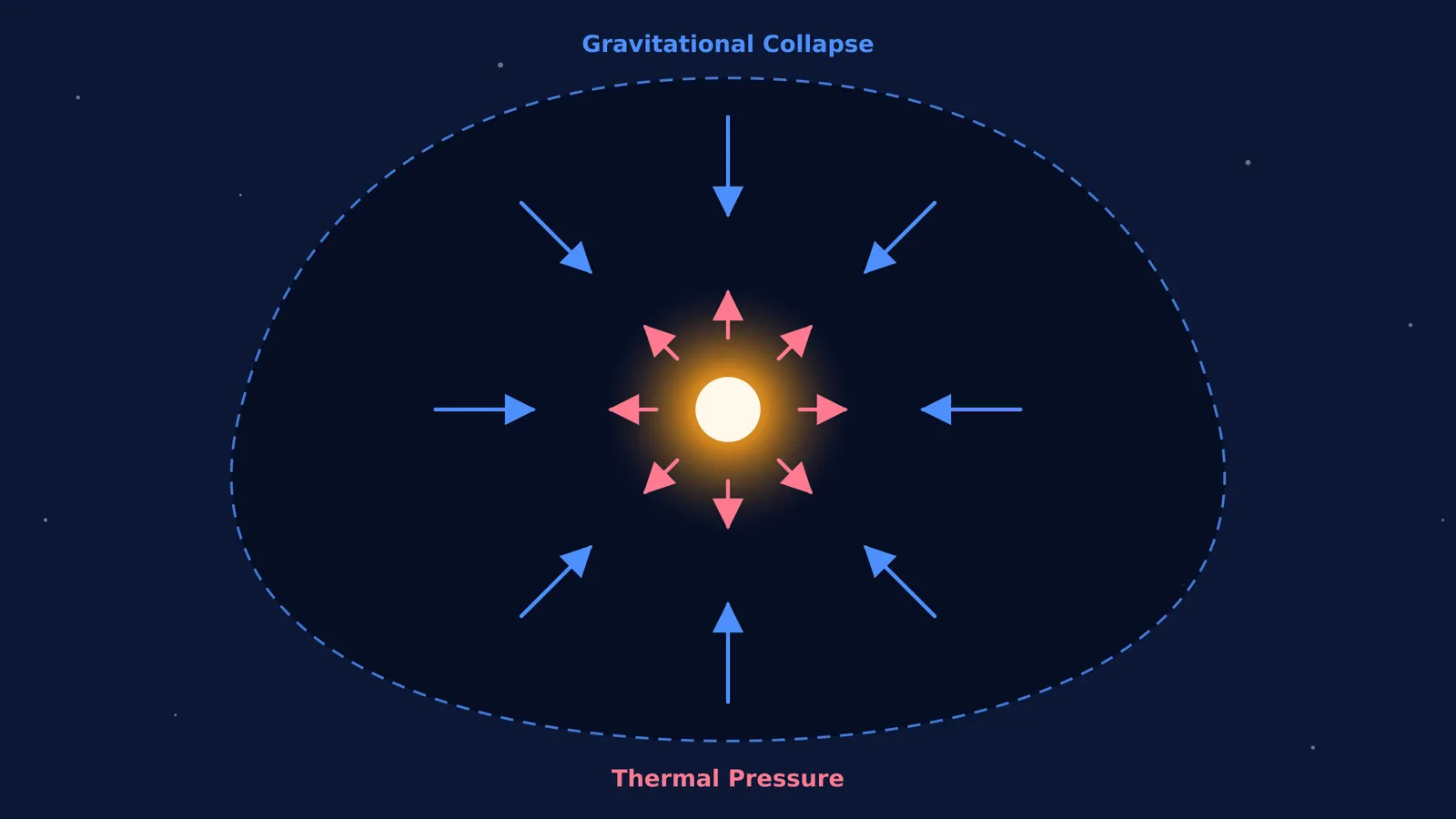
This requires two opposing forces to fight it out:
Inward pull: Gravity tries to pull all the gas and dust towards the centre of the cloud.
Outward push: The thermal pressure of the gas molecules bouncing off each other tries to expand the cloud.
Sir James Jeans first calculated this balance in 1902. He found that a cloud will only collapse if its mass is greater than a critical limit known as the Jeans mass. This limit depends on two things:
Density: A denser cloud has stronger gravity.
Temperature: A colder cloud has weaker thermal pressure.
If the cloud is too hot, the outward thermal pressure wins, and the cloud disperses. But because Bok globules are so cold, their thermal pressure is very weak. Gravity takes over, and the cloud begins to shrink in a process called gravitational collapse. If you are trying to picture how gravity and pressure compete, the Fermi Simulation Lab lets you interact with physical models to see the effects directly.
How did we prove Bok and Reilly were right?
In 1947, Bok's cocoon hypothesis was highly controversial. The dust in a Bok globule is so thick that visible light cannot escape it, meaning telescopes of the era could not see what was happening inside. For decades, it remained a brilliant but unproven guess.
The breakthrough came much later, in 1990, when astronomers turned near-infrared telescopes towards these dark clouds. Because infrared light has longer wavelengths than visible light, it can pass straight through thick cosmic dust. Just as Vesto Slipher and the first redshifts of galaxies gave us a new way to measure the universe, infrared astronomy gave us a new way to see it.
Through the infrared lenses, the dark blobs were no longer empty space. They were glowing from the inside with the heat of newly forming protostars, finally proving that Bok and Reilly's "cocoons" were indeed hatching new stars.
Interestingly, observations show that a single Bok globule rarely forms just one star. As the core collapses, it often fragments to form double- or multiple-star systems. If you are studying the equations of gravity and pressure behind stellar evolution, Fermi's AI tutor can work out what you already know and build a plan for the session, guiding you through the physics step-by-step.


