

On this page
Nature is the ultimate chemist, building incredibly complex molecules like proteins and DNA with perfect precision. For decades, human chemists tried to imitate nature by building complex molecules from scratch, atom by atom. But these traditional methods were slow, created unwanted by-products, and rarely worked with the perfect efficiency seen in living cells.
Barry Sharpless, a chemist at Scripps Research, decided to change the rules. Instead of forcing unwilling atoms together, he proposed a simpler method: find molecular building blocks that naturally want to join, and simply let them "click" together (nobelprize.org). This idea transformed how we create new drugs, map DNA, and build modern materials.
What is click chemistry?
In a seminal 2001 paper, Sharpless and his colleagues introduced the concept of click chemistry. The name describes a functional, modular approach to chemistry where molecules snap together reliably, much like the two halves of a seatbelt buckle.
To count as a "click" reaction, a chemical process must be modular, wide in scope, and give very high yields (doi.org40:11%3C2004::AID-ANIE2004%3E3.0.CO;2-5)). The reaction should generate only inoffensive by-products that can be easily removed without complex chromatography. Finally, it needs to run under robust conditions, such as in water rather than expensive or toxic organic solvents.
Because traditional reactions often involve many slow, difficult steps where material is lost along the way, the ability to join molecules efficiently changed the mindset of chemists globally. When you are trying to learn complex reaction mechanisms and see how building blocks combine, you can use the Fermi Concept Library, which has a lesson for every concept in chemistry and its place in the wider map.
How does the copper-catalysed click reaction work?
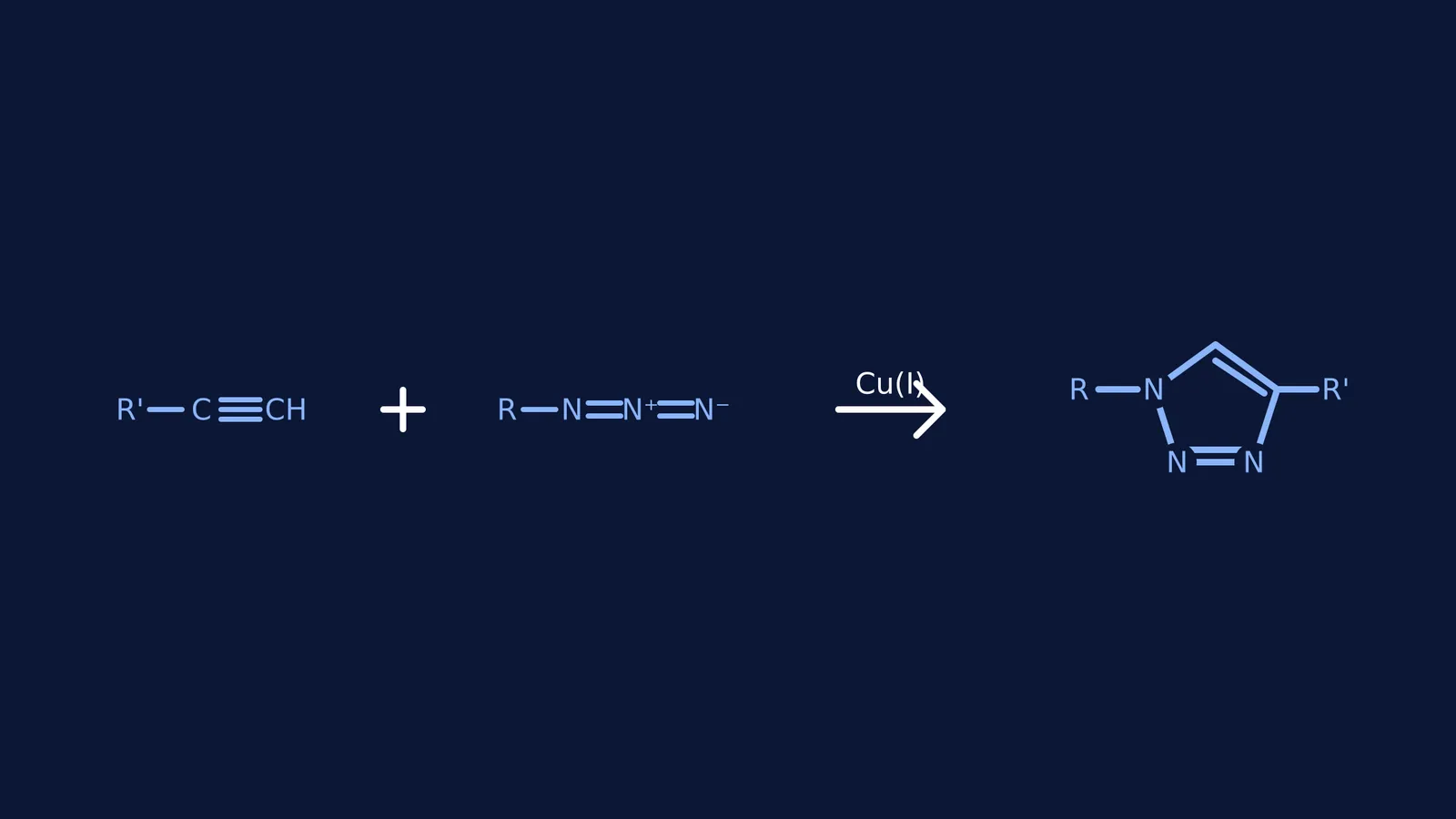
The idea of click chemistry was a brilliant framework, but it needed a perfect reaction to prove it worked in practice. Around 2002, Sharpless and Morten Meldal independently discovered what is now the epitome of click chemistry: the copper-catalysed azide-alkyne cycloaddition, or CuAAC (nobelprize.org).
This reaction joins an azide (a molecule containing a chain of three nitrogen atoms) to an alkyne (a molecule containing a carbon-carbon triple bond). Under normal conditions, these two molecular groups react very slowly, if at all. However, Sharpless and Meldal showed that adding a small amount of copper to the mixture acts as a perfect catalyst, causing the azide and alkyne to snap together instantly to form a stable triazole ring.
This specific reaction is now used in laboratories worldwide. Just as organic chemistry students learn classic named reactions like the Cannizzaro reaction and the Williamson ether synthesis, the copper-catalysed click reaction has become a fundamental tool. It allows chemists to join two molecular pieces without disturbing the rest of their structure.
Why did Barry Sharpless win two Nobel Prizes?
Barry Sharpless is one of only five people in history to receive two Nobel Prizes (nobelprize.org). He first won the Nobel Prize in Chemistry in 2001 for his work on chiral catalysts, which are molecules that guide a reaction to produce only one specific mirror-image form of a compound (nobelprize.org). This discovery was vital for the pharmaceutical industry, as the "handedness" of a molecule can determine whether a drug is safe or harmful.
In 2022, he shared the Nobel Prize in Chemistry with Carolyn R. Bertozzi and Morten Meldal for the development of click chemistry and bioorthogonal chemistry (nobelprize.org). While Sharpless and Meldal laid the foundation with their copper-catalysed reaction, Bertozzi found a way to make these click reactions work inside living cells without using toxic copper. Her reactions are "bioorthogonal," meaning they occur without disrupting the normal chemistry of the cell.
Today, these methods are used to map DNA, track how cells function, and design more targeted cancer treatments. If you are working through problems involving catalysts or molecular geometry and get stuck, the Fermi Problem Library has worked problems with a step-by-step solver that explains the reasoning rather than simply printing an answer.
This elegant simplicity is the heart of Barry Sharpless's legacy. By accepting that chemists should stop fighting nature and instead use reactions that want to happen, he gave the scientific world a highly reliable way to snap the building blocks of life together.


