

On this page
In 1751, Swedish mineralogist Axel Fredrik Cronstedt isolated nickel while examining mineral specimens from the Los cobalt mines in Hälsingland, Sweden. Miners had long cursed the reddish ore, which looked deceitfully like copper but yielded only noxious vapours and brittle slag in their furnaces. By moving beyond sensory appearance and applying systematic wet chemistry alongside blowpipe reduction, Cronstedt demonstrated that the stubborn ore contained a previously unknown metal.
Nickel is a silvery-white transition metal with atomic number 28 that remains ferromagnetic at room temperature. Today, global industry directs about 65% of all refined nickel into the manufacture of corrosion-resistant stainless steel alloys, as documented by the Royal Society of Chemistry. Yet before Cronstedt published his initial report in the 1751 proceedings of the Royal Swedish Academy of Sciences, the metal was masked by centuries of superstitious folklore, as recounted in Nature.
Why was kupfernickel called the copper demon?
Throughout the 17th and early 18th centuries, German miners in Saxony regularly encountered veins of a pale reddish-bronze mineral that closely resembled cuprite or native copper. When they attempted to smelt it, the ore failed to produce a single drop of malleable copper metal. Instead, the furnace emitted toxic, garlic-scented fumes of arsenic oxide and left behind a hard, unusable mass.
Convinced that mischievous earth sprites had cursed the lode, miners named the mineral *kupfernickel*, combining *Kupfer* (copper) with *Nickel*, a mountain goblin in Saxon folklore akin to "Old Nick", as explained by Encyclopaedia Britannica. The moniker meant "copper demon" or "false copper". The mineral, known today as niccolite or nickeline, is chemically nickel arsenide (NiAs). Rather than suspecting a new element, mineralogists of the era classified rocks primarily by external attributes such as colour and lustre, assuming kupfernickel was merely corrupted copper.
How did Axel Cronstedt isolate pure nickel?
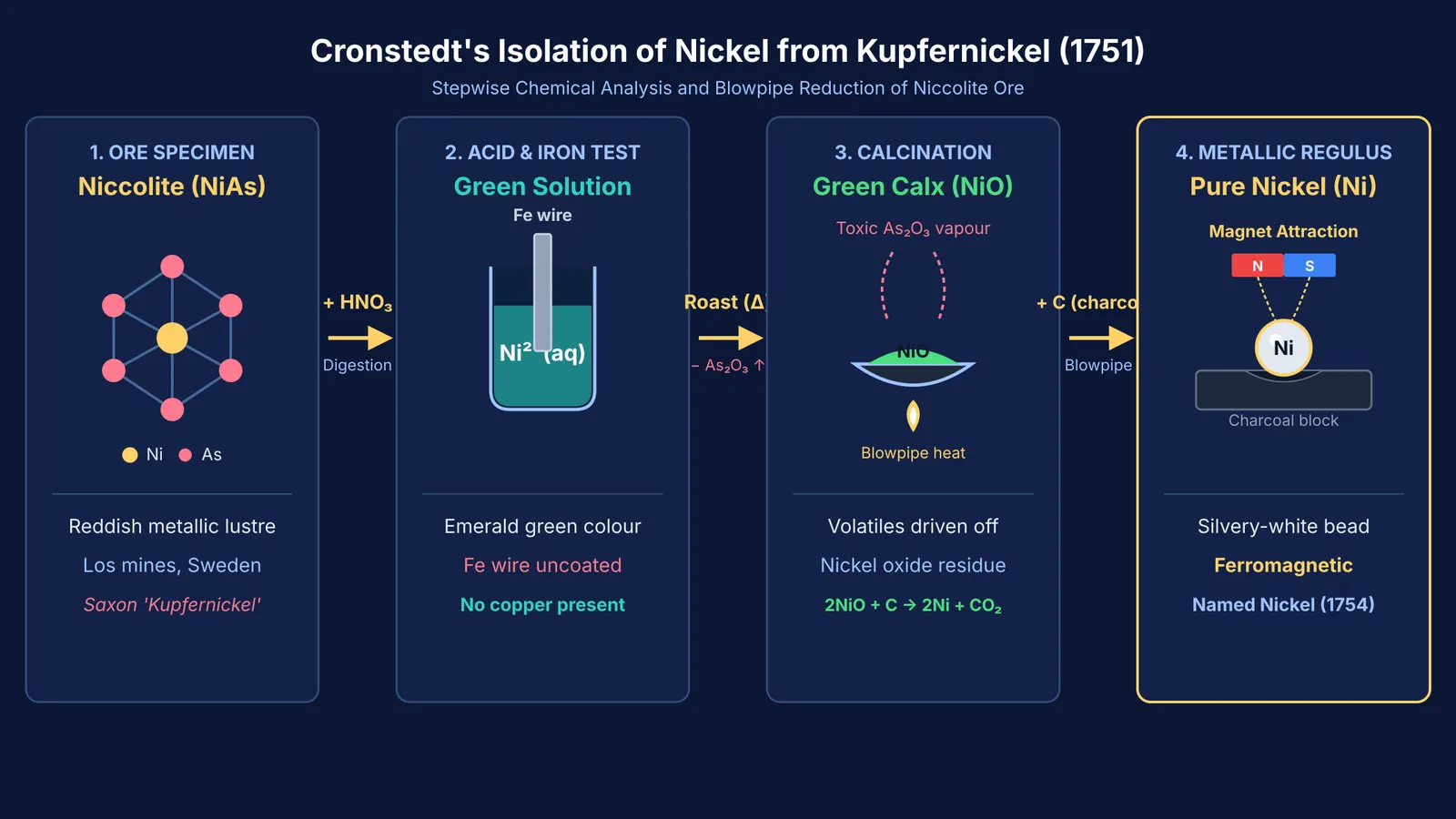
Cronstedt approached the Los ore not through external folklore, but through chemical reactivity. He first dissolved the mineral in concentrated nitric acid (aqua fortis). The reaction produced a rich green solution, which contemporaries took as confirmation of copper salts.
To test this assumption, Cronstedt immersed a clean iron wire into the green liquid. When copper ions are present in an aqueous solution, iron readily displaces copper metal, plating out a distinct red film onto the iron surface:
Fe(s) + Cu²⁺(aq) → Fe²⁺(aq) + Cu(s)
In Cronstedt's vessel, no copper plated onto the iron wire. The green colour did not stem from copper. In aqueous solution, iron readily displaces copper because copper lies well below iron in the activity series, but iron does not displace nickel from acidic solution, a fundamental distinction tested in reactivity series and displacement reactions.
Cronstedt then roasted the mineral in open air to drive off volatile arsenic as arsenic trioxide vapour. The remaining residue was a green calx (nickel oxide, NiO). Understanding the principles governing the roasting, calcination and reduction of ores allowed him to heat this calx with powdered charcoal on a refractory block under a blowpipe flame:
2NiO(s) + C(s) → 2Ni(s) + CO₂(g)
The reduction yielded a dense, metallic bead or "regulus" that was hard, brittle, silvery-white, and attracted to a compass needle. In 1754, Cronstedt shortened the old miners' term and formally named the new metal *nickel*, as recorded in the Journal of Chemical Education. Although skeptics alleged the bead was a mixture of cobalt and iron, Swedish chemist Torbern Bergman confirmed nickel's elemental purity in 1775. Later discoveries highlighted nickel's oxidation resistance and the versatile catalytic properties of transition metals.
How does Cronstedt's blowpipe test work for metal identification?
Cronstedt's systematic use of the blowpipe transformed mineralogy from speculative collecting into an analytical science, later compiled in his landmark 1758 treatise *Försök til mineralogie*. A student analyzing unknown ores can follow Cronstedt's diagnostic sequence:
Acid digestion: Dissolve a mineral grain in nitric acid. Note whether the solution is blue (copper), pink (cobalt), or emerald green (nickel or iron).
Displacement verification: Introduce metallic iron. If copper plates out, copper is present. If the solution stays green without metallic displacement, nickel is indicated.
Calcination (roasting): Heat the powder in an oxidising flame to expel volatile arsenic and sulphur, observing the colour of the stable oxide calx.
Blowpipe reduction: Place the calx into a hollowed charcoal block and heat it in the reducing flame cone to yield an elemental regulus.
Magnetic probe: Test the cool metallic bead with a compass needle. While copper is diamagnetic, nickel demonstrates ferromagnetism.
When preparing for competitive chemistry examinations, understanding the physical rationale behind metallurgical reduction and displacement tests prevents memorisation traps. The Fermi Problem Library provides worked problems with a step-by-step solver that explains the reasoning rather than printing an answer. To explore how transition metal configurations dictate oxidation states and magnetism across the periodic table, the Fermi Concept Library maps every concept in physics, chemistry, biology, mathematics and computing, each with its own lesson and its place in the map.


