

On this page
Why was rural telephone access so difficult in 1990s India?
In the early 1990s, fewer than one in a hundred people in India had a telephone, and rural teledensity hovered near 0.1%. Connecting a subscriber with copper wires required digging trenches and stringing vulnerable cables. According to an analysis in IEEE Communications Magazine, installing a single copper line cost roughly ₹40,000 (around $1,000). To recover that capital cost, providers needed an average revenue per user (ARPU) of ₹1,000 per month—a sum fewer than 5% of Indian households could afford.
The physics of copper wire pairs also limited reach. As explored in our look at Alexander Graham Bell and the physics of the telephone, electrical resistance attenuates analog signals over distance, demanding costly repeaters and regular maintenance. In rural areas, buried and overhead lines suffered constant damage from floods and roadworks, while imported cellular networks were far too expensive for agrarian communities needing basic voice and market access.
How did corDECT adapt cordless radio for long-range telephone networks?
In 1991, Professor Ashok Jhunjhunwala, Bhaskar Ramamurthi, and Timothy A. Gonsalves formed the Telecommunications and Computer Networking (TeNeT) Group at IIT Madras. Their insight was both physical and economic: radio waves propagate through the atmosphere for free, bypassing the civil engineering costs of buried cables.
Instead of inventing a bespoke protocol, the team adapted the European DECT standard. Operating in the 1880–1900 MHz band with MC/TDMA/TDD multiplexing, DECT was originally specified for indoor cordless handsets with a 50-metre range.
TeNeT transformed the standard into corDECT, a fixed Wireless Local Loop system documented in IEEE Communications Magazine:
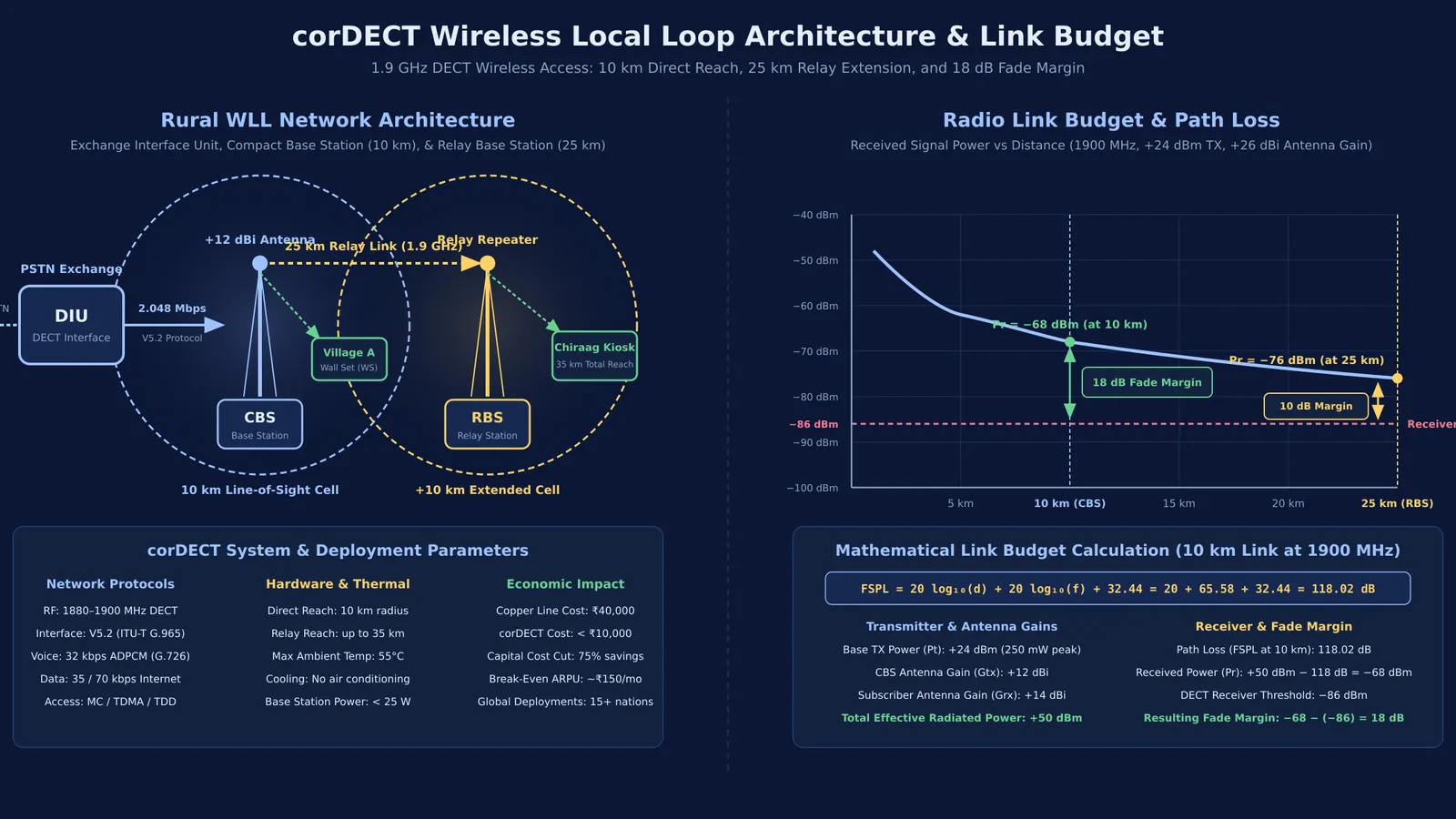
A DECT Interface Unit tied into the telephone exchange over 2.048 Mbps E1 lines running the ITU-T G.965 V5.2 protocol.
Compact Base Stations on masts provided direct line-of-sight coverage across a 10 km radius.
Relay Base Stations repeated signals to reach subscribers 25 km away.
Subscriber Wall Sets linked standard telephone handsets and computer modems.
The system used 32 kbps Adaptive Differential Pulse Code Modulation under ITU-T Recommendation G.726. This preserved toll-quality speech and DTMF tone transparency, enabling simultaneous voice calls and 35 kbps (or 70 kbps) internet connections over one radio channel.
How much did corDECT reduce per-line telecom costs?
By replacing physical wiring with radio links, corDECT cut capital costs per line from ₹40,000 to under ₹10,000, as reported in IEEE Communications Magazine. That 75% saving reduced the break-even monthly ARPU to roughly ₹150, making telephone access viable for millions of rural households.
corDECT was also built for rural infrastructure. Western base stations demanded sealed, air-conditioned enclosures and drew kilowatts of power. As detailed in the IETE Technical Review, IIT Madras engineered base stations to operate in ambient heat up to 55°C without air conditioning on under 25 watts, allowing a small solar panel and 12-volt battery to sustain operation through grid blackouts.
To manufacture the system, TeNeT pioneered academic incubation:
Partnered with Analog Devices for signal processing hardware.
Incubated Midas Communication Technologies to build base stations and subscriber sets.
Launched n-Logue Communications to roll out village 'Chiraag' kiosks across districts including Madurai, Nellikuppam, and Dhar.
As recorded in the IETE Technical Review, corDECT was deployed across thousands of Indian villages and exported to 15 nations, including Egypt, Kenya, Nigeria, South Africa, and Brazil. Jhunjhunwala was awarded the Padma Shri in 2002 for this breakthrough.
How do wireless engineers calculate a rural link budget?
To guarantee that signals reach remote subscribers 10 km away, engineers calculate a link budget accounting for transmitter power, antenna gains, and electromagnetic path loss.
In free space, radio signal intensity diminishes following the inverse-square law. Engineers express this with the Free-Space Path Loss equation: FSPL (dB) = 20 log₁₀(d) + 20 log₁₀(f) + 32.44 where d is distance in kilometres and f is frequency in megahertz.
For a 10 km corDECT link operating at 1900 MHz:
Distance loss: 20 log₁₀(10) = 20 dB.
Frequency loss: 20 log₁₀(1900) ≈ 65.58 dB.
Path loss: FSPL ≈ 20 + 65.58 + 32.44 = 118.02 dB.
Transmitter power: Base station delivers +24 dBm (roughly 250 mW peak).
Antenna gain: +12 dBi base antenna and +14 dBi subscriber directional antenna provide +26 dBi total gain.
Received power: Pr = 24 dBm + 26 dBi − 118.02 dB ≈ −68 dBm.
With a DECT demodulation sensitivity of −86 dBm, the link provides an 18 dB fade margin against monsoon downpours and atmospheric attenuation. These principles reflect foundational milestones in wave physics, connecting Edwin Armstrong and the FM radio built to beat static with Sisir Kumar Mitra and the radio study of India's upper sky.
What can young engineers learn from the IIT Madras model?
Ashok Jhunjhunwala demonstrated that university engineering could produce frugal, robust technology tailored to domestic realities rather than relying on costly imports. To institutionalize this model, Jhunjhunwala subsequently spearheaded the IIT Madras Research Park, providing shared infrastructure for startups in clean energy and telecommunications.
When studying wave attenuation, antenna gain, and circuit theory, abstract formulas become tangible when applied to practical link design. In the Fermi Problem Library, students can work through electrodynamics and communication problems with a step-by-step solver that explains the underlying reasoning. Learners can also experiment with wave propagation and oscillatory circuits inside the Fermi Simulation Lab, observing how changes in frequency and distance govern signal reception.


