

On this page
In 1992 and 1993, a new strain of cholera nicknamed "Bengal cholera" spread through India, Bangladesh and several other countries and killed thousands of people, according to Lawrence Berkeley National Laboratory. Ashok Gadgil, a physicist at the lab, set out to build a water disinfector that a village could afford. The result, UV Waterworks, used ultraviolet light, gravity and very little electricity, and you can check its numbers with Class 11 and 12 physics.
Who is Ashok Gadgil?
The National Inventors Hall of Fame records that Gadgil studied physics at the University of Mumbai (1971), took a master's degree at IIT Kanpur (1973) and earned a master's (1975) and his doctorate (1979) at UC Berkeley. It inducted him in 2014 for UV Waterworks, US Patent 5,780,860.
In a 1998 review in the Annual Review of Energy and the Environment, Gadgil wrote that about 1.1 billion people lacked safe drinking water and that contaminated drinking water killed 400 children under five every hour. For more cholera history, see John Snow and the Broad Street pump and how Sambhu Nath De found cholera toxin in Kolkata.
How does ultraviolet light kill germs in water?
Passing water through ultraviolet light inactivates the DNA of pathogens, as a 1998 Berkeley Lab report put it. In practice, a microbe whose DNA is badly damaged cannot copy itself and multiply.
The usual light source is a low-pressure mercury lamp. The US EPA's UV toolkit states its drinking-water UV doses with reference to 254 nm light from a low-pressure mercury vapour lamp.
Each 254 nm photon carries about 1240/254 = 4.9 eV, using the shortcut in our post on the E = 1240/λ photon-energy formula. Red light at 700 nm carries about 1.8 eV.
What made Gadgil's design so cheap?
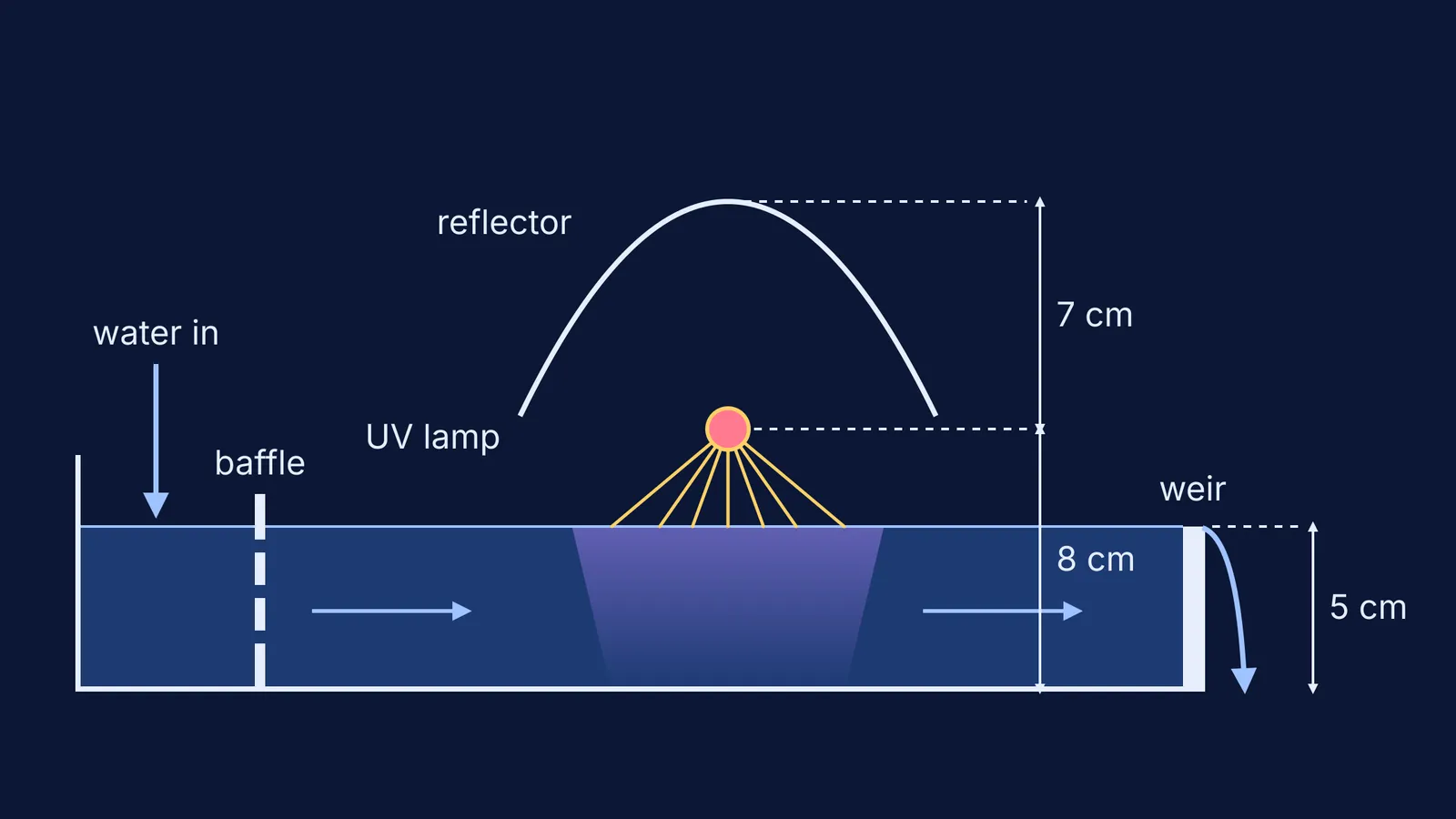
Most UV units put the lamp inside the water, wrapped in a quartz or Teflon jacket. Gadgil's patent, US 5,780,860, filed with Vikas Garud in 1996, says these jackets have "the complications of high cost, as well as of leakage, fouling with biomasses, films and with chemical deposits". So the design changed four things:
Lamp out of the water. A bare lamp hangs with its axis 8 cm above the tray floor and 7 cm below a curved reflector.
Smooth flow. Water enters through a perforated baffle wall that makes the flow laminar, so it moves through the tray evenly.
Gravity, not pumps. The patent says the water's progress is "powered solely by gravity", with a maximum throughput of 15 litres a minute.
Fail-safe. If power cuts out, a solenoid at the inlet closes off incoming water.
The Hall of Fame adds that hanging the lamp above the water prevents algae building up on it, and that the unit runs on 60 watts. Berkeley Lab described a unit the size of a microwave oven, weighing 7 kg, that could run on a car battery or a 60-watt solar cell (Berkeley Lab, 1998).
Can you check the numbers yourself?
Here is a worked example using figures from the patent, the Hall of Fame and the EPA toolkit.
Cost per person. The Hall of Fame says one unit could serve 2,000 people for $70 a year. 70 ÷ 2,000 = $0.035, or 3.5 US cents per person per year. The patent's own estimate was 5 to 7 cents.
How many bacteria died. In the patent's tests, water seeded with 100,000 E. coli per 100 mL came out with 0 or 1. That is a drop by a factor of at least 100,000, a "5-log" reduction: 99.999% gone.
What intensity is needed. UV dose = intensity × time. The patent gives the shortest time any water spends in the device as about 10 seconds. The EPA table asks for 22 mJ/cm² for 4-log credit against Giardia, so 22 ÷ 10 = 2.2 mW/cm² on average. For viruses the EPA lists 186 mJ/cm², which needs 18.6 mW/cm² in the same 10 seconds.
Why murky water matters. The patent puts the UV extinction coefficient of pure distilled water at 0.007 per cm and says inlet water can have 0.3 per cm, as high as average US waste-water plant discharge and about 43 times larger. Dirty water absorbs light quickly, so the layer must stay shallow.
What happened to UV Waterworks after the lab?
The technology was licensed to WaterHealth International; by early 2010 it was installed in more than 10 countries and serving over 2 million people, according to Berkeley Lab. The Hall of Fame now says WaterHealth uses it to supply tens of millions of people in India and Africa.
UV has limits. The EPA toolkit calls UV transmittance the most important water-quality factor in UV design, and US surface-water systems must still keep a disinfectant residual in their distribution pipes alongside UV.
If photon energy and wavelength still feel abstract, the Fermi Simulation Lab has interactive simulations for ideas that are easier to see than to read. The Fermi Concept Library gives every concept in physics, chemistry and biology its own lesson, from photon energy to how DNA is copied.


