

On this page
In 1934 a mother in Oslo, Borgny Egeland, brought her two children to Asbjørn Følling, a doctor at Oslo University Hospital with an unusual dual background in chemistry and metabolic medicine. Liv was six and Dag was four. Both had been healthy at birth and later developed intellectual disability, and both gave off a strong musty odour. Følling's answer showed a disease caused by one chemical step going wrong, whose harm could later be limited with diet.
How did Asbjørn Følling discover phenylketonuria?
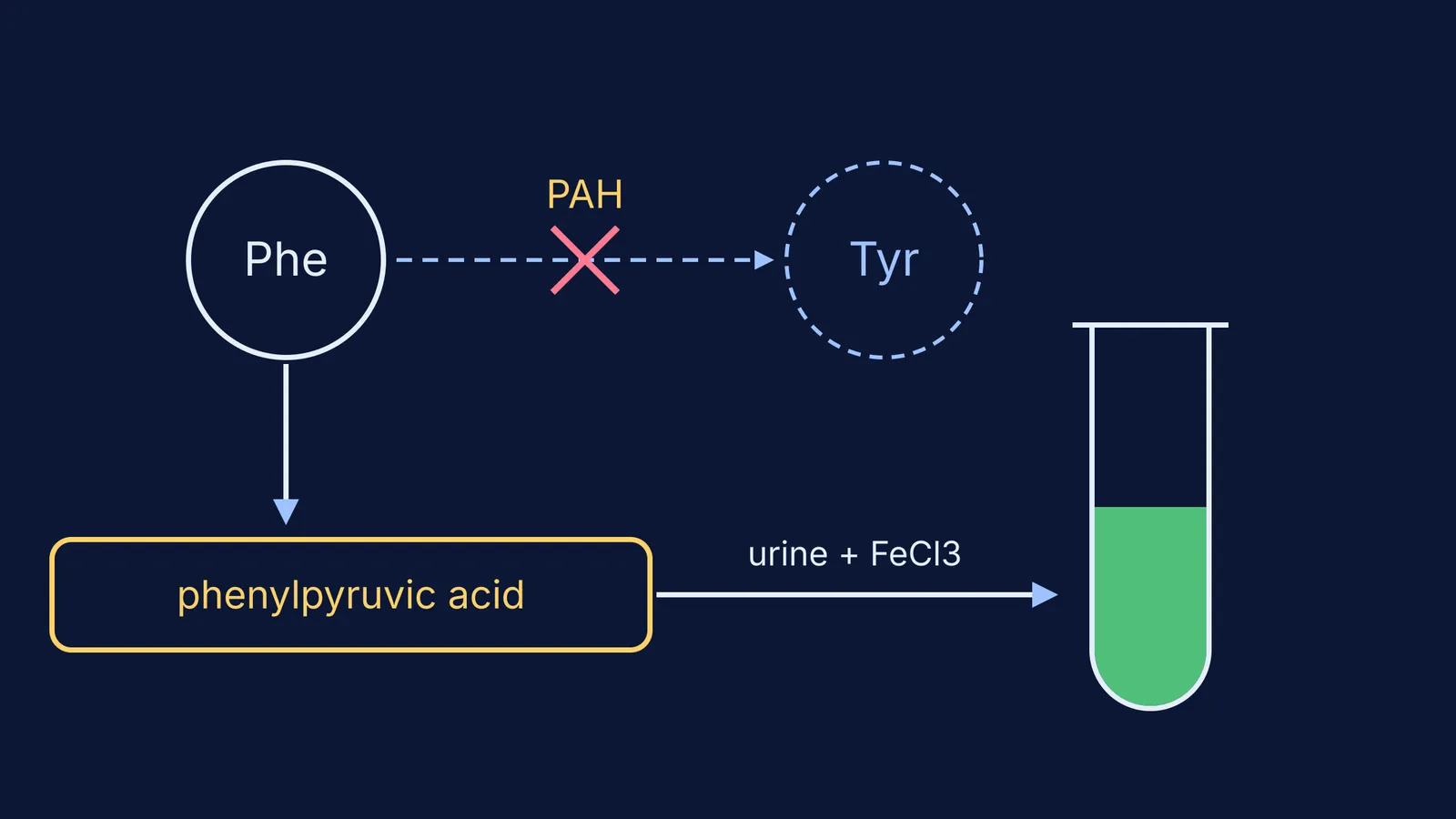
He started with a routine test. According to the Science History Institute's account, Følling added ferric chloride to the children's urine, a check then commonly used to detect acetoacetic acid, a sign of complications of diabetes or possibly starvation. Instead of the expected result, the samples turned a deep green, a reaction he had never seen before.
Følling spent four weeks of trial and error working out how to extract and purify the unknown substance, and because it reacted with oxygen in the air, he worked under nitrogen. Two months and 22 litres of the children's urine later, he concluded the substance was phenylpyruvic acid (Science History Institute).
Then he checked whether this was one family's quirk or a pattern. He used his ferric chloride test on 420 patients at institutions around Oslo and found eight who tested positive, giving 10 cases in all (Science History Institute). Because the condition tended to affect siblings, he proposed that it was probably inherited recessively. He published the work in 1934 in Hoppe-Seyler's Zeitschrift für physiologische Chemie and called the condition “imbecillitas phenylpyrouvica”. Today it is called phenylketonuria, or PKU.
What is phenylketonuria, and why does it happen?
Phenylketonuria is an inherited disorder that raises the level of the amino acid phenylalanine in the blood (MedlinePlus, US National Library of Medicine).
The cause is a variant in the PAH gene, which carries the instructions for the enzyme phenylalanine hydroxylase. That enzyme normally converts phenylalanine into other important compounds (MedlinePlus). When it does not work, phenylalanine builds up, and by-products such as phenylpyruvic acid end up in the urine. That is the substance Følling's test picked up.
In the United States, PKU occurs in 1 in 25,000 newborns (MedlinePlus). Without treatment, children develop permanent intellectual disability, and the excess phenylalanine can cause a musty or mouse-like odour, like the one the Egeland children gave off.
The idea that a missing chemical step can be inherited goes back to Archibald Garrod and inborn errors of metabolism. It also connects to the later work of Beadle, Tatum and the one gene, one enzyme idea.
How did a diet become the treatment for PKU?
If too much phenylalanine causes the harm, the logical fix is to take in less of it. In 1953 Horst Bickel, John Gerrard and Evelyn Hickmans reported in The Lancet90473-5) on the influence of phenylalanine intake in PKU, work that the James Lind Library describes as the first dietary treatment for the condition. The Science History Institute describes how the girl they treated, Sheila, crawled, stood and climbed on chairs after several months on the diet (Science History Institute).
A diet helps most when it starts early. In 1963 Robert Guthrie and Ada Susi described a rapid, economical blood test for screening large numbers of newborns, and reported results for 682 infants (Pediatrics). Today PKU can often be managed with a diet low in phenylalanine, which includes avoiding the sweetener aspartame (MedlinePlus). Liv and Dag were born too early to benefit.
How do you solve a PKU inheritance question?
PKU is a common textbook example of autosomal recessive inheritance, where both copies of the gene must carry a variant to cause the disorder (MedlinePlus). Here is how to work through one.
Write the alleles: P is the working allele, p the faulty one. A carrier is Pp and usually has no symptoms.
Two carrier parents: Pp × Pp.
Draw the Punnett square: PP, Pp, Pp, pp.
Read it off: 1 in 4 chance of PKU (pp), 2 in 4 of being a carrier (Pp), 1 in 4 of neither (PP). The National Human Genome Research Institute puts it the same way: roughly a quarter of the children of two carriers will have the disease.
Check yourself: the odds apply to each child separately, so two affected siblings, like Liv and Dag, does not mean the odds changed.
If words like allele, carrier or enzyme still feel fuzzy, the Fermi Concept Library gives every concept in biology and chemistry its own lesson and its place in the map. For practice, the Fermi Problem Library has worked problems with a step-by-step solver that explains the reasoning rather than printing an answer.
What should parents take from this story?
The first step came from Borgny, a parent who sought answers for her children. Ask your paediatrician which conditions your baby will be screened for. For any question about diet or diagnosis, talk to a doctor. For another check every newborn meets in the first minutes of life, read about Virginia Apgar and the 10-point newborn score.


