

On this page
In 1998, Arunachalam Muruganantham discovered that his wife, Shanthi, was using rags and old newspapers because commercial sanitary pads were too expensive. He realised the raw materials cost roughly ₹10, but the packaged pads were sold for 40 times that price Wikipedia. Determined to fix this, the school dropout from Coimbatore spent years uncovering the closely guarded manufacturing methods of multinational corporations.
His persistence led him to build a low-cost, semi-automatic machine that brings the production of sanitary pads out of large factories and into village self-help groups.
What is Arunachalam Muruganantham's sanitary pad machine?
The machine is a small-scale assembly line designed to run on a 1 HP single-phase motor National Innovation Foundation, meaning it can operate on the electricity available in rural areas. While a traditional industrial pad-making factory costs upwards of ₹35 million, Muruganantham's machine costs around ₹65,000 Wikipedia.
This reduction in capital cost changes who can make the pads. Instead of a large corporation shipping products across the country, a group of three or four women can set up the equipment in a small room. They can produce between 900 and 3,000 pads a day, depending on whether they use the manual or semi-automatic set. At this scale, the production cost of a single pad drops to between ₹1.00 and ₹1.50, making them affordable for the community National Innovation Foundation.
What materials do low-cost pads use?
Muruganantham initially tried to make pads out of cotton, but it failed to hold its shape when wet. After two years of research, he discovered that commercial brands relied on cellulose fibers derived from pine bark wood pulp Wikipedia. These fibers absorb liquid effectively without losing their structure.
Alongside the wood fiber, the machine uses thermo-bonded non-woven fabric for the top layer, a polyethylene barrier film to prevent leaks at the bottom, and release paper for the adhesive backing National Innovation Foundation. If you are exploring how different plant structures manage water, or why certain polymers repel it, the Fermi Concept Library holds clear explanations of these biological and chemical properties.
How does the sanitary pad machine work?
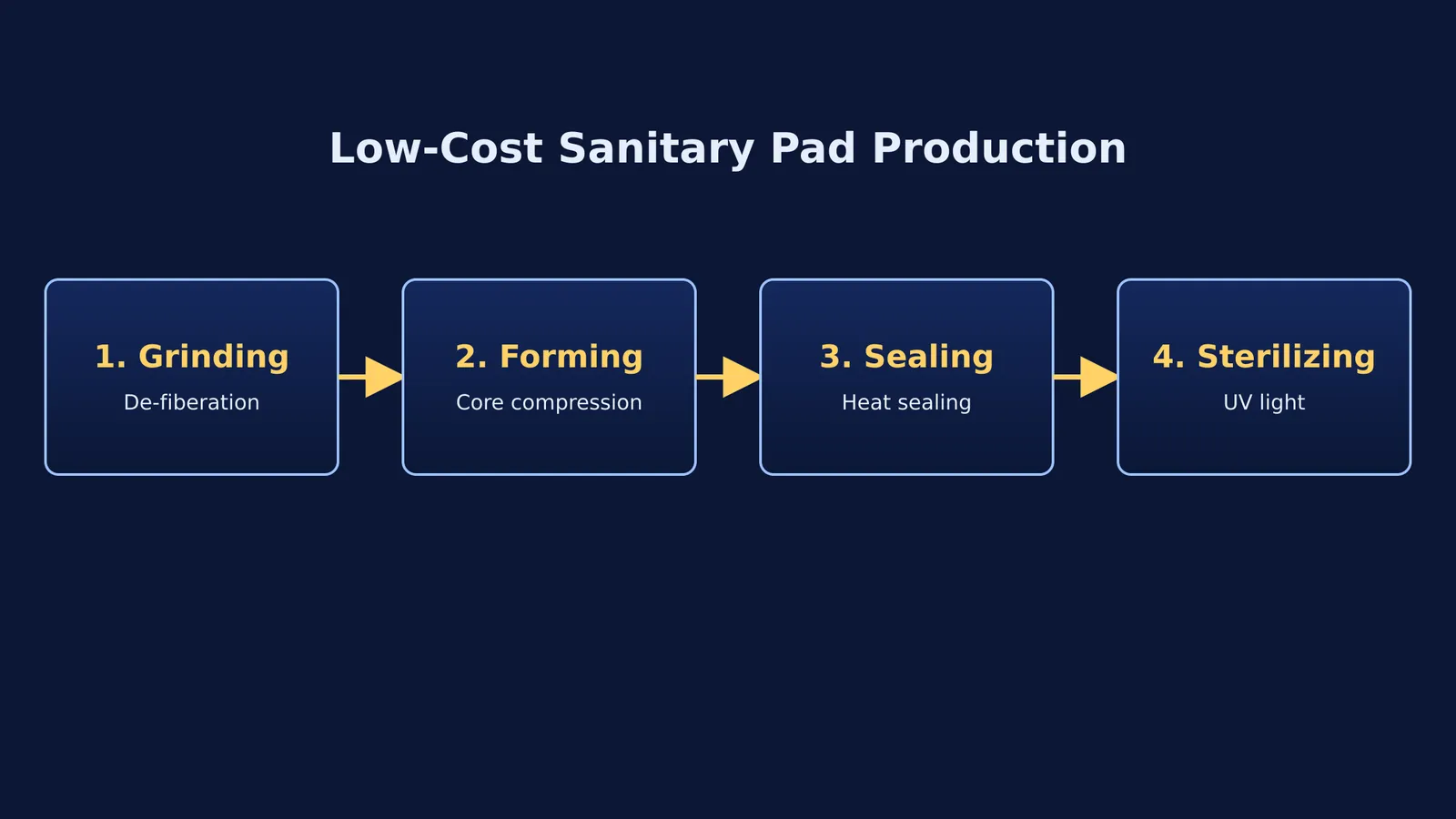
Rather than an unbroken, automated belt, the low-cost process is divided into four distinct, manually operated stations National Innovation Foundation:
Grinding: A motorized de-fiberation unit with four blades breaks down sheets of raw pine wood pulp into soft, absorbent fibers at a rate of 150 grams per minute.
Forming: An operator uses a foot pedal to compress the loose fibers into a food-grade aluminum mould, packing more material at the bottom of the pad for better absorption.
Sealing: The core is wrapped in the non-woven fabric and sealed using a heated press. The press uses a cam-operated switch for rapid heating and cooling, sealing a pad in just two seconds.
Sterilizing: The finished pads are placed in a closed container and exposed to ultraviolet (UV) germicidal lamps for 10 seconds to ensure hygiene before packing.
Understanding the mechanics of a cam-operated switch or how UV light breaks down bacterial DNA bridges the gap between textbook physics and practical engineering. If you need to master these principles, Fermi's AI tutor works out what you already know and builds a plan for the session, so you sit down to a clear next step.
How did Arunachalam Muruganantham test his idea?
Testing the early prototypes was his biggest hurdle. Due to the deep social taboos surrounding menstruation in rural India, Muruganantham could not find any volunteers to try his pads.
He decided to test them himself. He filled a football bladder with animal blood and wore it under his clothes, squeezing it as he walked and cycled to see how well his prototypes absorbed the fluid. His community, misunderstanding his actions, temporarily ostracized him. However, his work eventually gained national recognition, winning an award from the National Innovation Foundation (NIF) and earning him the Padma Shri in 2016 Wikipedia. Like Otto Wichterle's contact lens machine built from a bicycle dynamo, or Agnes Pockels' surface film trough used in her kitchen, Muruganantham's work proves that important tools do not require pristine laboratories.
Who runs the machines today?
Muruganantham founded Jayaashree Industries to market his invention, but he consistently refuses to sell his technology to corporate entities. Instead, he supplies the machines directly to women's self-help groups. This model creates local employment and ensures that the financial benefits stay within the community. Today, his machines have been installed in 23 states across India, allowing thousands of women to earn a livelihood while improving public health Wikipedia.


