

On this page
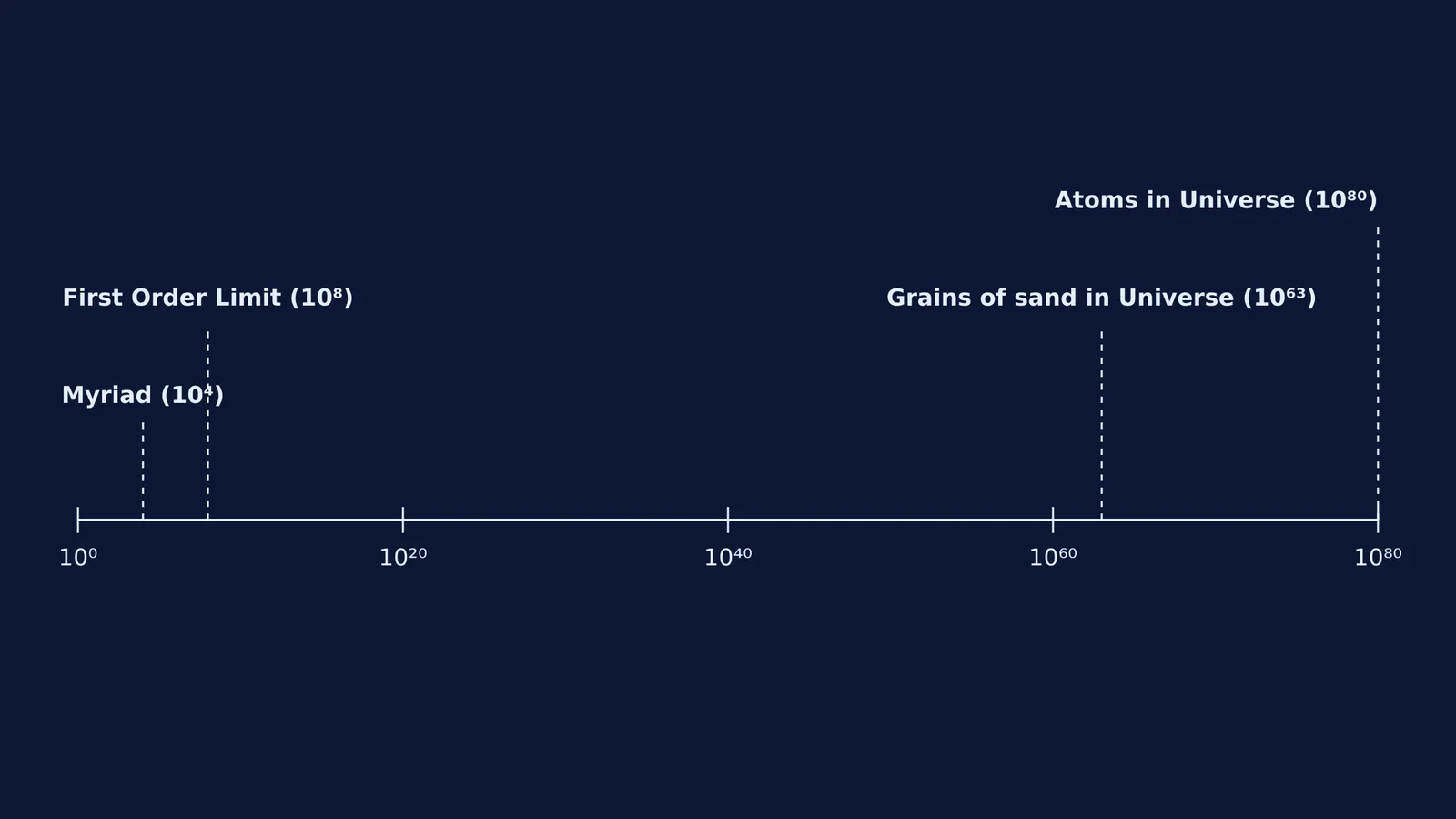
In the 3rd century BC, Greek mathematics had a hard limit: the largest number with a name was a myriad, which is 10,000. For most people counting coins or cattle, this was plenty. But the mathematician Archimedes wanted to prove that no quantity was too large to be named.
To show this, he set himself the most absurdly large problem he could imagine: calculating how many grains of sand it would take to completely fill the universe.
His work, *The Sand Reckoner*, is a masterpiece of early physics and mathematics. In it, Archimedes built a logical path from a single poppy seed to the edge of the cosmos.
How big was Archimedes' universe?
Before he could fill the universe with sand, Archimedes had to decide how big it was.
He rejected the standard Earth-centred models of his day, which were widely accepted by his contemporaries. Instead, he used the heliocentric (Sun-centred) model proposed by Aristarchus of Samos, because it was the largest universe anyone had ever described. By applying a series of geometric assumptions to Aristarchus' model, Archimedes estimated the diameter of the universe to be roughly 10¹⁴ stadia (1). In modern terms, that is about two light-years across.
While this is tiny compared to the billions of light-years we measure today, it was unimaginably vast for the ancient world.
How did he write numbers that large?
To count the sand filling a sphere 10¹⁴ stadia across, Archimedes needed numbers much larger than a myriad.
He invented a new system by taking a myriad (10,000) and multiplying it by itself. A "myriad myriads" is 100,000,000, or 10⁸, which Archimedes made the base unit of his new scale. Numbers up to 10⁸ belonged to the "first order," while the "second order" went from 10⁸ up to (10⁸)², or 10¹⁶. He continued chaining these powers upwards until he reached the myriad-myriadth period, enabling him to name numbers as large as 10^(8 × 10¹⁶), a 1 followed by 80 quadrillion zeros (1). This was a staggering leap for a society that had previously stopped naming numbers after reaching just 10,000.
In doing this, Archimedes effectively discovered and proved the law of exponents (xᵃ × xᵇ = xᵃ⁺ᵇ), centuries before formal algebraic notation even existed. If you are ever struggling to picture how these exponential jumps work, the Fermi Concept Library holds every concept in mathematics, each with its own lesson and its place in the map.
How many grains of sand fill the universe?
With his number system ready, Archimedes began a steady chain of estimation, starting with something he could see.
He assumed that 40 poppy seeds laid side by side equalled one dactyl (a Greek finger-width), and that one poppy seed contained 10,000 grains of sand (1). From there, he scaled up to the volume of a sphere one stadium across, and finally to the volume of the 10¹⁴-stadium universe.
His final answer? He concluded that the maximum number of grains of sand required to fill the entire universe was less than "one thousand myriad myriad eighth numbers." In our modern scientific notation, that is 10⁶³ (1).
Why does this matter for your exams?
You will not be asked to fill a universe with sand, but you use Archimedes' ideas every time you sit a chemistry or physics paper.
Scientific notation is the direct descendant of the orders and periods Archimedes invented. You use the exact same law of exponents he proved when you simplify exponents and standard form in Class 8 or solve complex physics equations. By expressing numbers in standard form—a number between 1 and 10 multiplied by a power of ten—scientists can easily compare massive distances or microscopic sizes without writing out endless zeros. Here is a quick worked example of the exponent rules he helped pioneer, which you will need for chemistry or physics:
Write down Avogadro's number, whose existence was proven by Jean Perrin: 6.02 × 10²³.
Suppose you have 100 moles of a substance. That is 10² moles.
To find the total atoms, multiply them: (6.02 × 10²³) × 10².
Using the law of exponents, simply add the indices: 23 + 2 = 25.
The answer is 6.02 × 10²⁵ atoms.
If you find yourself dropping marks on these massive numbers because you mixed up your powers of ten, the Fermi Problem Library has worked problems with a step-by-step solver that explains the reasoning rather than printing an answer.
Archimedes' true achievement was not the final count of the sand. It was proving that the human mind, armed with the right mathematics, can grasp the infinite.


