

On this page
In 1955, the National Advisory Committee for Aeronautics (NACA, which later became NASA) hired a young mathematician to work as a "human computer" Wikipedia. Annie Easley would spend the next 34 years at the agency, eventually developing software for NASA's Centaur rocket that powered some of humanity's farthest journeys into space.
Her career shows how a strong foundation in mathematics allows a scientist to adapt to radical shifts in technology.
What did Annie Easley do at NASA?
Easley began her career performing complex manual calculations for engineers. As mechanical computers arrived, she did not let her role become obsolete; instead, she learned programming languages like FORTRAN and SOAP Wikipedia.
She played a significant role in developing the software for the Centaur high-energy booster rocket. Beyond spaceflight, she applied her programming skills to Earth's energy problems. She conducted simulations for early hybrid vehicles, battery technology, and alternative energy sources such as solar and wind power Wikipedia. While working full-time, she also earned a Bachelor of Science in Mathematics from Cleveland State University in 1977 Wikipedia.
In addition to her technical work, Easley served as an Equal Employment Opportunity (EEO) counselor, working to address workplace discrimination and encouraging minorities to pursue STEM. In 2021, the International Astronomical Union named a lunar crater "Easley" in her honour Wikipedia.
Why was the Centaur rocket software so important?
The Centaur upper stage was significant because it was the first to use a high-energy propellant mix of liquid hydrogen and liquid oxygen Wikipedia. This combination provided greater thrust than earlier fuels, allowing rockets to carry heavier payloads and reach deeper into space.
Easley's software was responsible for analysing the performance of this complex booster. The code had to model fuel burn rates, thrust, and orbital mechanics to ensure the stage ignited exactly when needed.
Her programming laid the foundation for several landmark missions. The Centaur stage was crucial for launching the Voyager probes to the outer solar system and the Cassini probe to Saturn Wikipedia. This era of space exploration relied on brilliant women working behind the scenes; just as Nancy Grace Roman championed the plan for the Hubble Space Telescope and Yvonne Brill invented the thruster that keeps satellites in orbit, Easley ensured the rockets had the software needed to reach their destinations.
When students study orbital mechanics today, they are learning the same physics that Easley had to translate into computer code. If you are struggling to picture how physical systems change over time, the Fermi Simulation Lab offers interactive simulations for the ideas that are easier to see than to read.
How does an upper stage rocket work?
To understand the challenge Easley faced, you have to look at how rockets reach space. Getting off the launch pad requires immense power to overcome Earth's gravity and dense lower atmosphere. This is the job of the first stage, which usually burns heavy, dense fuels like kerosene.
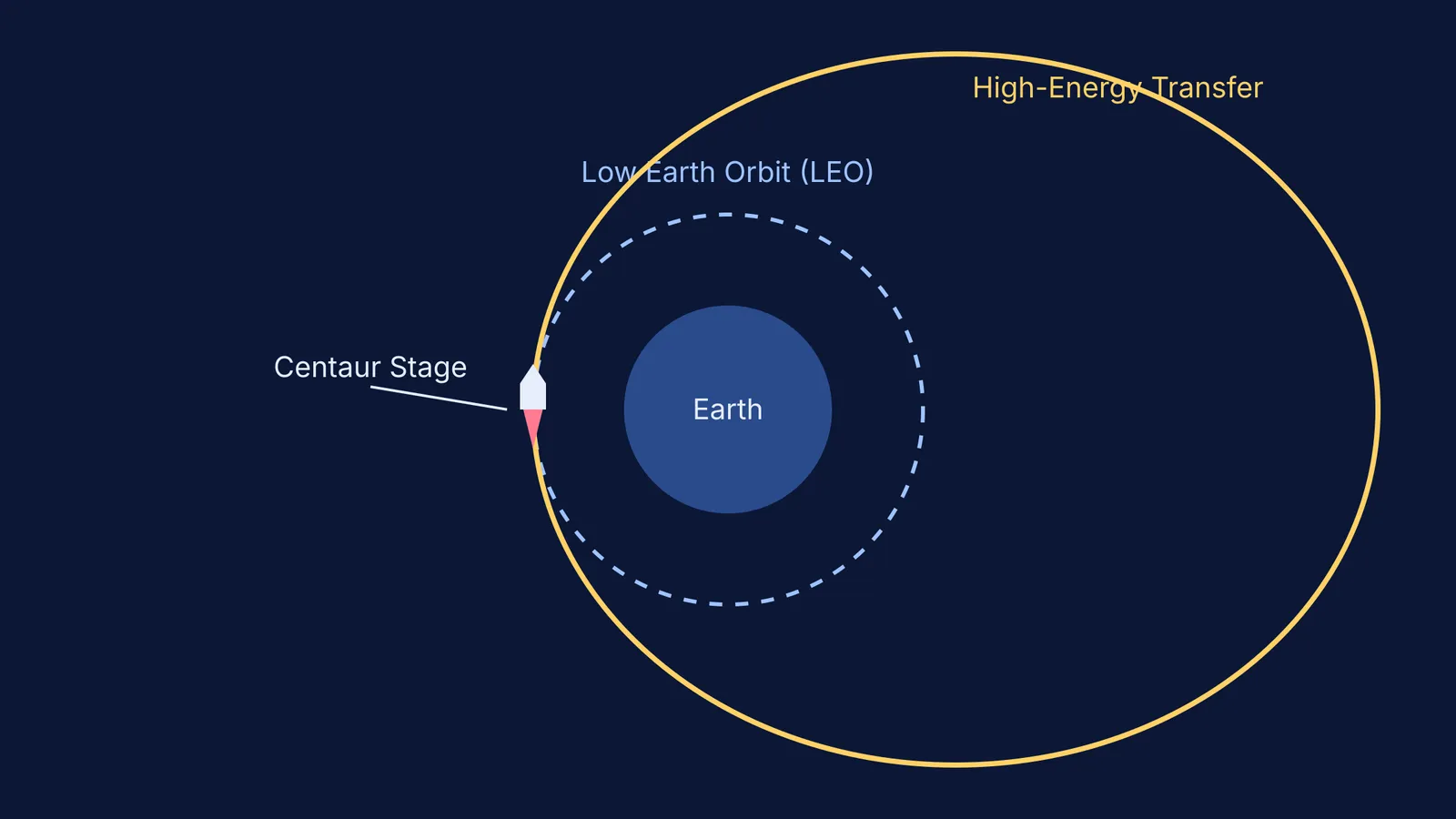
Once the rocket is above the thickest part of the atmosphere, it sheds the heavy, empty first stage. Now, the goal changes from simply fighting gravity to building up the immense horizontal speed needed to stay in orbit—or to escape Earth's gravity entirely. This is where the upper stage takes over.
The Centaur was designed specifically for this role in the vacuum of space. Because it carried payloads to the Moon and beyond, it needed to be highly efficient. Liquid hydrogen is incredibly light and packs a huge amount of energy per kilogram, but it is notoriously difficult to handle because it must be kept at extremely low temperatures. Easley's software had to model the thermodynamic and physical behaviour of these propellants, ensuring the rocket could reignite its engines hours after launch.
When you are solving complex equations involving thermodynamics or motion, the Fermi Problem Library has worked problems with a step-by-step solver that explains the reasoning rather than printing an answer.
How to adapt when technology changes?
Easley's transition from a human computer to a software engineer is an excellent example of career resilience. When mechanical computers replaced her manual calculations, she mastered the very tools that threatened her old job.
You can apply this to your own studies or career using the following framework for upskilling:
Spot the shift: Notice when a new tool or method begins to do your routine tasks faster.
Learn the tool: Do not avoid it. Take a course or read the manual, just as Easley studied FORTRAN.
Bring your domain knowledge: A tool is only as good as the person using it. Easley's deep understanding of mathematics is what made her an excellent programmer. The machine did the arithmetic, but she had to write the equations.
When you hit a concept gap while learning a new mathematical or physical model, Fermi's AI tutor can work out what you already know, build a plan for the session, and teach through it by drawing the figure or running the simulation.


