

On this page
After graduating with a degree in electrical engineering from MIT in the early 1950s, Amar Bose embarked on a personal crusade. He wanted to invent a stereo loudspeaker that would reproduce the vivid sound of a live concert hall in a home. He spent the next decade embarking on research that shifted the focus of audio engineering from the electronics of the speaker to the physics of the room.
Why did early speakers sound unnatural?
Traditional speakers were designed with a straightforward goal: point the sound directly at the listener. This created a "sweet spot"—a small, specific area in the room where the audio sounded best, while the rest of the room received lower-quality sound. Because the sound was highly directional, moving just a few feet out of this optimal position dramatically altered the balance and clarity of the music.
However, this point-source approach felt artificial because it did not mimic how sound behaves in a real acoustic space. In a real venue like a concert hall, sound does not just travel in a straight line from the stage to the audience; it scatters, reflects, and diffuses across the environment. To understand the basics of this behaviour, you can review how we study sound in Class 9: waves, echoes and the range of human hearing. The direct approach of early home audio speakers entirely ignored these essential echoes, treating the listening room as a problematic environment to be overcome rather than an acoustic tool to be used.
What did Amar Bose discover about reflected sound?
Bose challenged the audio industry by arguing that objective measurements—such as plotting a flat frequency response on a graph—did not correlate well with human perception. As a student at MIT, his research revealed a crucial number: 80% of the sound heard by an audience is indirect, meaning it bounces off the ceiling, floor, and walls before reaching the ear [[1]](https://lemelson.mit.edu/resources/amar-bose). Only a small fraction travels directly from the stage.
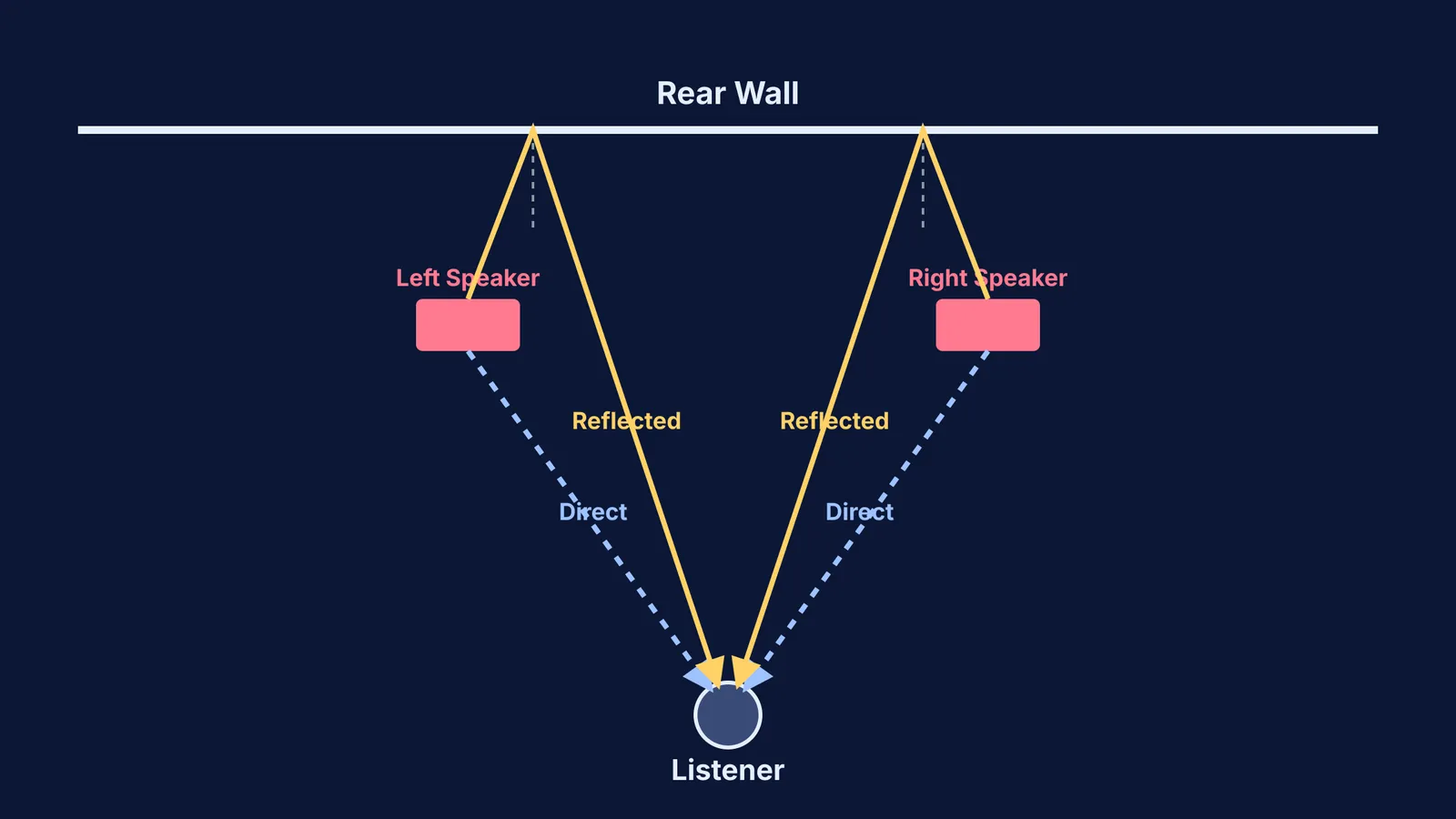
This time delay between the arrival of direct and reflected sound is exactly how the human brain calculates the size and shape of a space. When a sound wave hits a hard surface, it bounces back, scattering its energy (you can read the mathematical details of this in our guide to the reflection of waves at fixed and free ends).
If you sit 3 metres from a speaker, the direct sound travels at 343 m/s and reaches your ear in 8.7 milliseconds. A sound wave that reflects off a side wall and travels a total of 5 metres takes 14.6 milliseconds. The brain uses that 5.9 ms gap to sense the room's dimensions. In a large concert hall, these delays are longer and far more complex, giving the music its rich, spacious quality.
How did the Bose 901 use the room?
To bring concert-hall acoustics into a living room, Bose designed the 901 Direct/Reflecting speaker system in 1968 [[1]](https://lemelson.mit.edu/resources/amar-bose). Instead of firing all the audio forward, it was one of the first stereo loudspeakers to utilize the space around them rather than operating as if it were in a vacuum.
By bouncing the majority of the sound off the room's surfaces, the speaker recreated the spatial realism of a live venue. This design turned the bare walls of the living room into part of the musical instrument itself. It scattered the acoustic energy so widely and evenly that the stereo effect could be heard almost anywhere in the room, effectively eliminating the narrow "sweet spot" of conventional speakers and providing a more immersive, lifelike listening experience for everyone present.
Much like Carl Wieman: why a Nobel physicist moved beyond the lecture in his teaching methods, Bose realised that traditional, established models were not producing the desired real-world results. He pioneered the use of psychoacoustics—the study of how humans actually perceive sound—as the ultimate metric of success.
How do sound waves behave in spaces?
Visualising how waves reflect and interfere in three dimensions can be difficult from a textbook alone. Fermi's Simulation Lab provides interactive simulations for the ideas that are easier to see than to read, letting you generate waves and watch them bounce off boundaries in real time.
For a deeper breakdown of the formulas that govern these mechanics, Fermi's Concept Library contains every concept in physics, chemistry, biology, mathematics and computing, each with its own lesson and its place in the map.
Amar Bose's breakthrough is a powerful reminder for students and engineers alike: the best theoretical models and technical specifications only matter if they accurately reflect how humans actually experience the physical world.


