

On this page
In the 1950s, X-raying pregnant women was considered a harmless, routine way to check a baby's position before birth. That changed when a British epidemiologist, Alice Stewart, noticed an unusual rise in childhood leukaemia cases and decided to investigate. Her subsequent findings changed medical practice and offered a lesson in how to rigorously test ideas.
Why did doctors X-ray pregnant women?
During the early 1950s, X-rays were widely seen as a major medical advance. Doctors routinely used them on pregnant women to determine the position of the foetus, the size of the mother's pelvis, or to confirm the presence of twins.
At the time, the prevailing scientific consensus held that a low dose of radiation was completely safe and would not harm the developing baby. No one suspected that routine diagnostics were contributing to a rise in childhood illnesses.
What did Alice Stewart's 1956 survey find?
Stewart initiated the Oxford Survey of Childhood Cancers to investigate the spike in childhood malignancies. Because the disease was rare, she designed a large case-control study. Her team identified 1,416 children in England and Wales who had died of cancer or leukaemia before the age of 10 between 1953 and 1955.
She matched each "case" with a "control"—a living, healthy child of the same age, sex, and locality. Interviewers then visited the mothers of both groups to ask detailed questions about their medical history during pregnancy, specifically focusing on whether they had received abdominal X-rays.
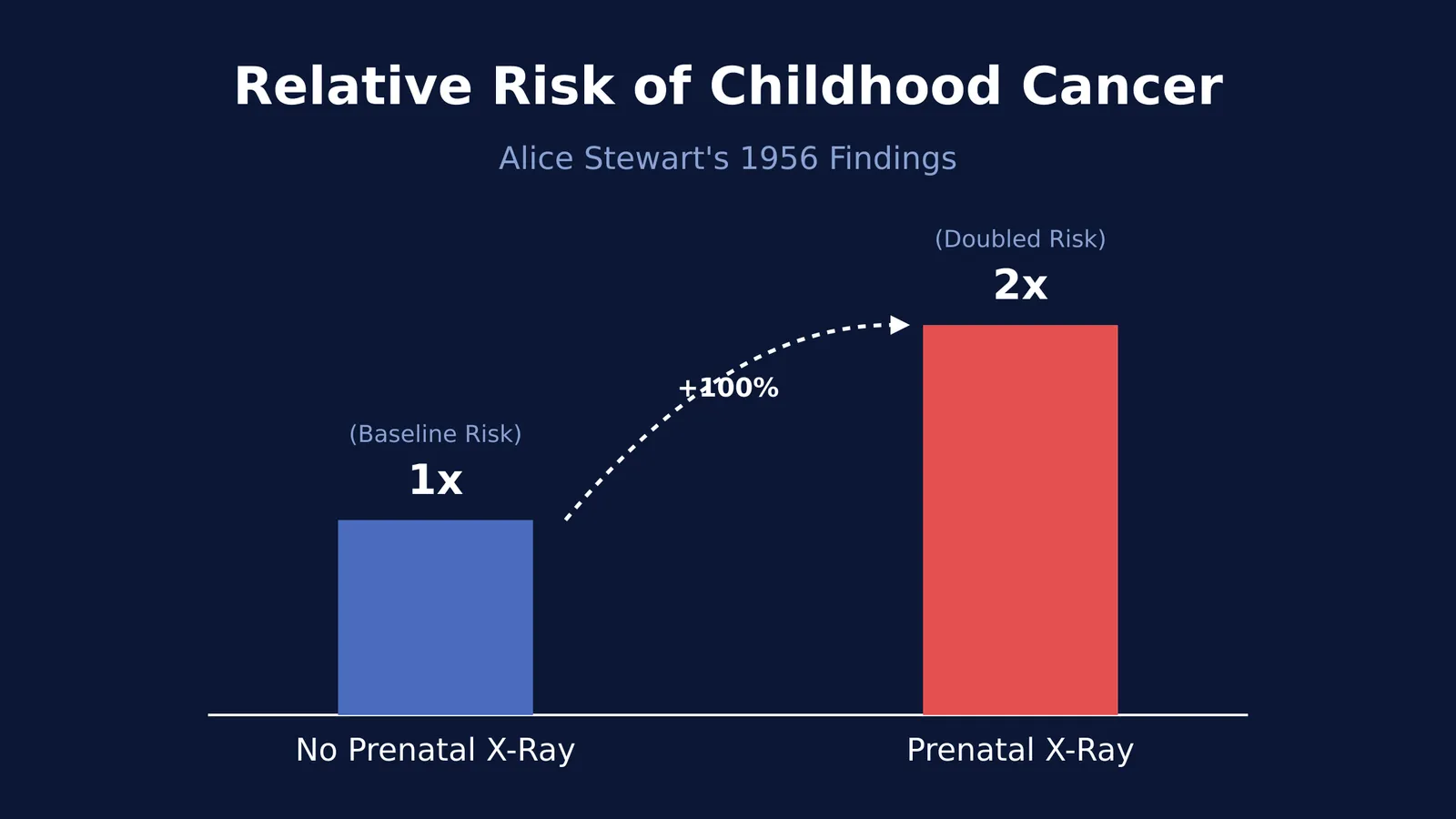
In 1956, her preliminary report in *The Lancet*91923-7) revealed that children whose mothers had received even a single pelvic X-ray during pregnancy were twice as likely to develop cancer before the age of 10.
How long did it take to stop the practice?
The medical establishment resisted Stewart's findings. Critics argued that her study was flawed by "recall bias," suggesting that mothers who had lost a child might simply remember medical events more vividly in an attempt to explain the tragedy.
Because her data challenged both clinical practices and the growing nuclear industry, Stewart faced years of professional isolation and funding struggles. Her work was finally vindicated in 1962 when American epidemiologist Brian MacMahon published a study using hospital records rather than mothers' memories, eliminating the recall bias argument and confirming Stewart's results.
Despite this, it took nearly 25 years for medical bodies worldwide to fully abandon routine prenatal X-rays in favour of safer alternatives like ultrasound. In 1986, Stewart received the Right Livelihood Award for bringing the dangers of low-level radiation to light.
How can a "thinking partner" improve your study habits?
One of the reasons Stewart could stand her ground for decades was her partnership with statistician George Kneale. As Margaret Heffernan describes in her TED talk on daring to disagree, Kneale saw his primary job as trying to prove Stewart wrong. He crunched the data in every possible way, hunting for a flaw. When he couldn't find one, it gave Stewart the confidence that her conclusions were robust.
When you study alone for exams, it is easy to convince yourself that your logic is sound. Finding your own "George Kneale"—a method or a person to actively challenge your reasoning—is one of the most effective ways to learn.
If you are stuck on a difficult proof or preparing for a competitive exam, you can apply this framework:
Explain it out loud: Teach the concept to a friend and ask them to spot the holes in your logic.
Seek the disproving case: If you think a mathematical rule always works, try to find the one edge case where it breaks.
Use a tutor: Fermi's AI tutor works like a thinking partner. Rather than just giving you the answer, it holds a line of reasoning across the session, checking your understanding as it goes and noticing where you are stuck.
Finding out why you are wrong is often the fastest route to being right.
To learn more about the biological processes of early development, read our guides on parturition and lactation: the hormones behind birth and milk and from fertilisation to implantation: the first week of pregnancy.


