

On this page
Why did factory owners blame workers for lead poisoning?
During the early twentieth century, American heavy manufacturing ran on lead. Smelters refined ores, paint factories churned out basic lead carbonate pigments, commercial potteries dipped crockery in lead glazes, and foundries sprayed enamel onto bathtubs. Yet as thousands of laborers developed abdominal colic, tremors, and wrist palsy, plant managers routinely dismissed the illness as personal worker negligence.
Management insisted that lead entered the body only through the digestive tract when laborers ate with unwashed hands or chewed tobacco. By framing toxicity as poor personal hygiene, companies avoided installing ventilation machinery or paying compensation. As demonstrated in Paracelsus and the dose-response relationship, toxicity depends on systemic dose. Early twentieth-century factory owners ignored that reality, insisting their shops were safe.
How did Alice Hamilton investigate workplace toxins?
In 1910, Illinois Governor Charles Deneen appointed physician Alice Hamilton to direct medical investigations for the newly formed Illinois Commission on Occupational Diseases, as documented by the American Chemical Society. Hamilton had graduated from the University of Michigan Medical School in 1893 and lived since 1897 at Hull-House, observing the physical toll of industrial labor on immigrant families.
Because the commission lacked legal authority to inspect private factories, Hamilton pioneered an investigative approach she called "shoe-leather epidemiology," analyzed in the American Journal of Public Health. She gained access to smelters and paint mills through persuasion, observing shop floors and cross-referencing operations against hospital ledgers and pharmacy records. To keep her findings legally watertight, Hamilton logged only confirmed cases displaying unequivocal signs, such as radial nerve palsy ("wrist-drop") or Burton's blue line along the gums.
Her 1910 state survey identified over 70 lead-using processes and documented 578 poisoning cases, as confirmed by the American Chemical Society. In bathtub enameling, she found dusting powders contained up to 20% soluble lead. Confronted with 22 severe cases traced to his factories, National Lead Company president Edward Cornish agreed to install mechanical exhaust systems and institute regular physician screenings.
How does lead enter the body and cause damage?
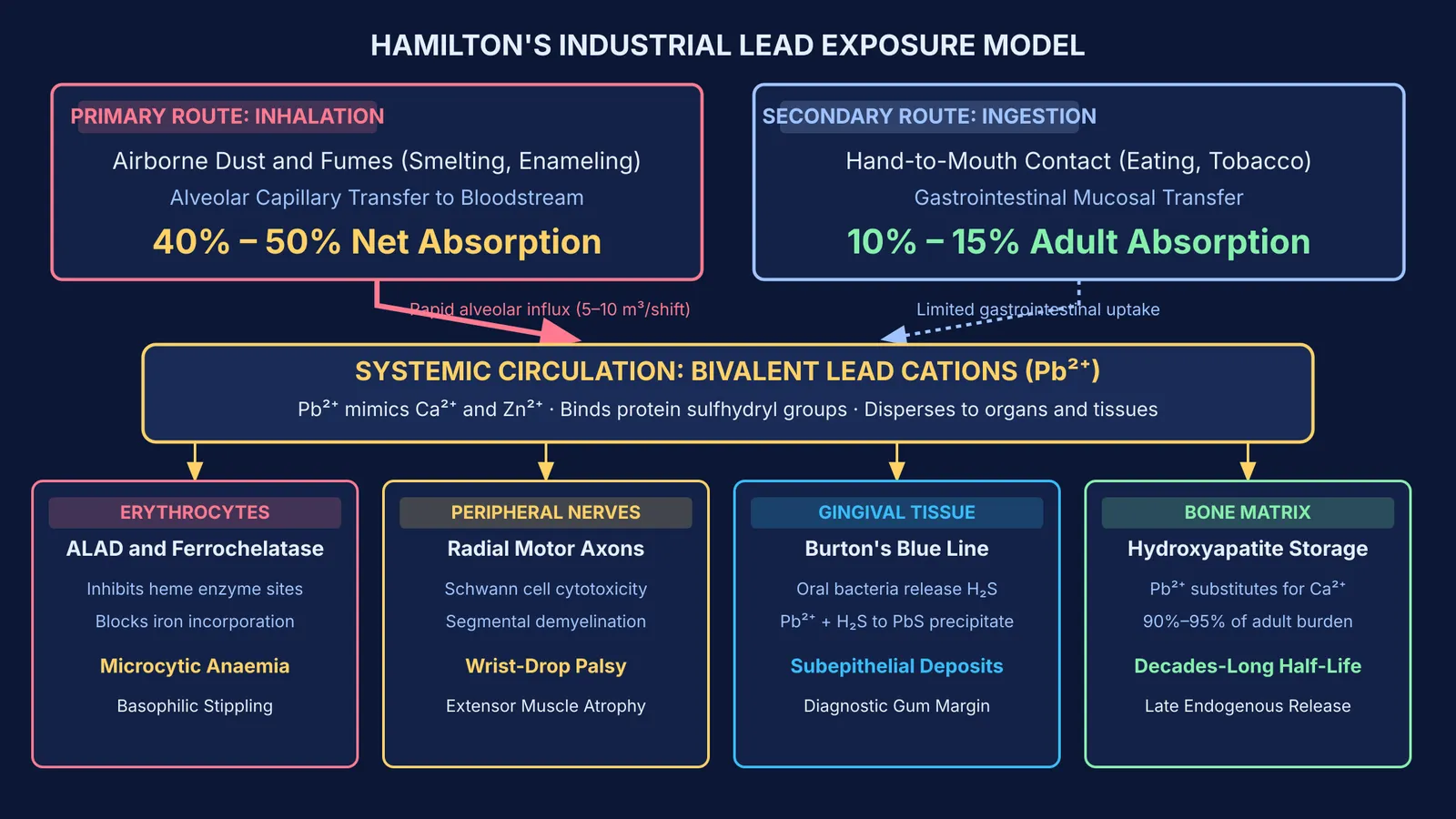
Hamilton revolutionized industrial toxicology by proving the primary exposure route was inhaling airborne dust and fumes, as documented in her 1914 study in the American Journal of Public Health. While the adult digestive tract absorbs only 10% to 15% of ingested lead, the respiratory system absorbs 40% to 50% of inhaled fine particulates directly across the alveolar-capillary membrane into circulating blood. During an eight-hour shift of heavy physical labor, a factory worker breathes 5 to 10 m³ of air, inhaling dangerous milligram quantities of lead that bypass digestion entirely.
At the molecular level, divalent lead (Pb²⁺) mimics physiological cations like Ca²⁺ and Zn²⁺. It binds sulfhydryl groups on functional proteins, inhibiting two vital enzymes in heme biosynthesis: δ-aminolevulinic acid dehydratase (ALAD) and ferrochelatase. This blockade prevents iron incorporation into protoporphyrin IX, causing cellular anaemia and basophilic stippling. Circulating lead also damages Schwann cells and demyelinates motor axons, paralyzing the radial nerve and causing wrist-drop. In oral tissues, lead reacts with bacterial hydrogen sulphide to precipitate insoluble lead sulphide (PbS), forming Burton's blue line along the gums. As explored in Clair Patterson and environmental lead contamination, these heavy metal hazards ultimately spread far beyond factory walls into ambient air.
What changed after the Illinois and federal surveys?
Hamilton's findings dismantled the claim of worker negligence and established occupational medicine as an empirical discipline, as recorded by the Science History Institute. In 1911, the Illinois legislature passed the Occupational Disease Law of 1911, requiring employers in dangerous trades to install ventilation, provide separate lunchrooms, and fund monthly medical examinations. That same year, the federal government appointed Hamilton as a special investigator for the U.S. Bureau of Labor to survey factories nationwide.
Her academic and policy influence transformed American public health:
In 1919, Harvard University appointed Hamilton assistant professor of industrial medicine, making her the first woman on the Harvard faculty.
In 1925, she published *Industrial Poisons in the United States*, the first definitive American textbook on the subject, and testified warning against adding volatile tetraethyl lead to commercial gasoline.
Her lifelong research provided the factual foundation for the landmark Occupational Safety and Health Act of 1970, passed three months after her death at age 101.
Much like Ellen Swallow Richards and the chlorine map of clean water established baseline surveillance for municipal water, Hamilton established chemical surveillance for ambient factory air. Today, the National Library of Medicine honors her as a foundational pioneer of American occupational health.
When you are studying how toxic metal ions bind to enzymes or reviewing heavy-metal biochemistry, the Fermi Concept Library offers detailed conceptual lessons that break down molecular mechanisms step by step.
How do scientists evaluate industrial chemical hazards today?
Hamilton's field investigations established the core principles modern industrial hygienists use worldwide, as reflected in safety frameworks recognized by the American Chemical Society. Evaluating workplace chemical hazards follows a structured five-stage pathway:
Hazard identification: Catalog the chemical species, oxidation state, and physical state (solid dust, fume, vapor, or aerosol).
Primary route determination: Distinguish between respiratory inhalation, dermal absorption, and accidental ingestion to focus engineering controls.
Quantitative exposure calculation: Measure ambient air concentrations in milligrams per cubic metre and multiply by shift breathing volumes to determine worker intake across an 8-hour shift.
Biological monitoring: Track internal body burden through blood lead levels and urinary biomarkers before irreversible organ or nerve damage occurs.
Hierarchy of controls: Prioritize eliminating toxic agents or substituting safer chemicals, followed by enclosure and local exhaust ventilation, before relying on respirators.
For students practicing multi-step calculations in chemical concentration and stoichiometry, the Fermi Problem Library has worked problems with a step-by-step solver that explains the reasoning rather than printing an answer.


