

On this page
Sir John Harington described a forerunner to the modern flush toilet in 1596, but it had a severe flaw: the waste pipe dropped straight down into a cesspool. This open channel allowed noxious sewer gases, including hydrogen sulphide and methane, to drift freely back into the home. For nearly two centuries, people preferred chamber pots because indoor plumbing meant bringing the eye-watering smell of the sewer indoors.
During this era, the "miasma theory" of disease dominated medicine. People believed that foul odors and sewer gases directly caused diseases like cholera and dysentery. Solving the smell of the flush toilet was not just a matter of comfort; it was considered an urgent public health puzzle.
How does an S-bend water trap work?
Alexander Cumming was a Scottish watchmaker and instrument inventor, a profession that gave him a deep understanding of precise mechanisms, valves, and fluid dynamics. In 1775, he was granted UK patent No. 1105 for a modified water closet that finally solved Harington's odor problem. Cumming introduced a double bend in the waste pipe, shaped like the letter "S."
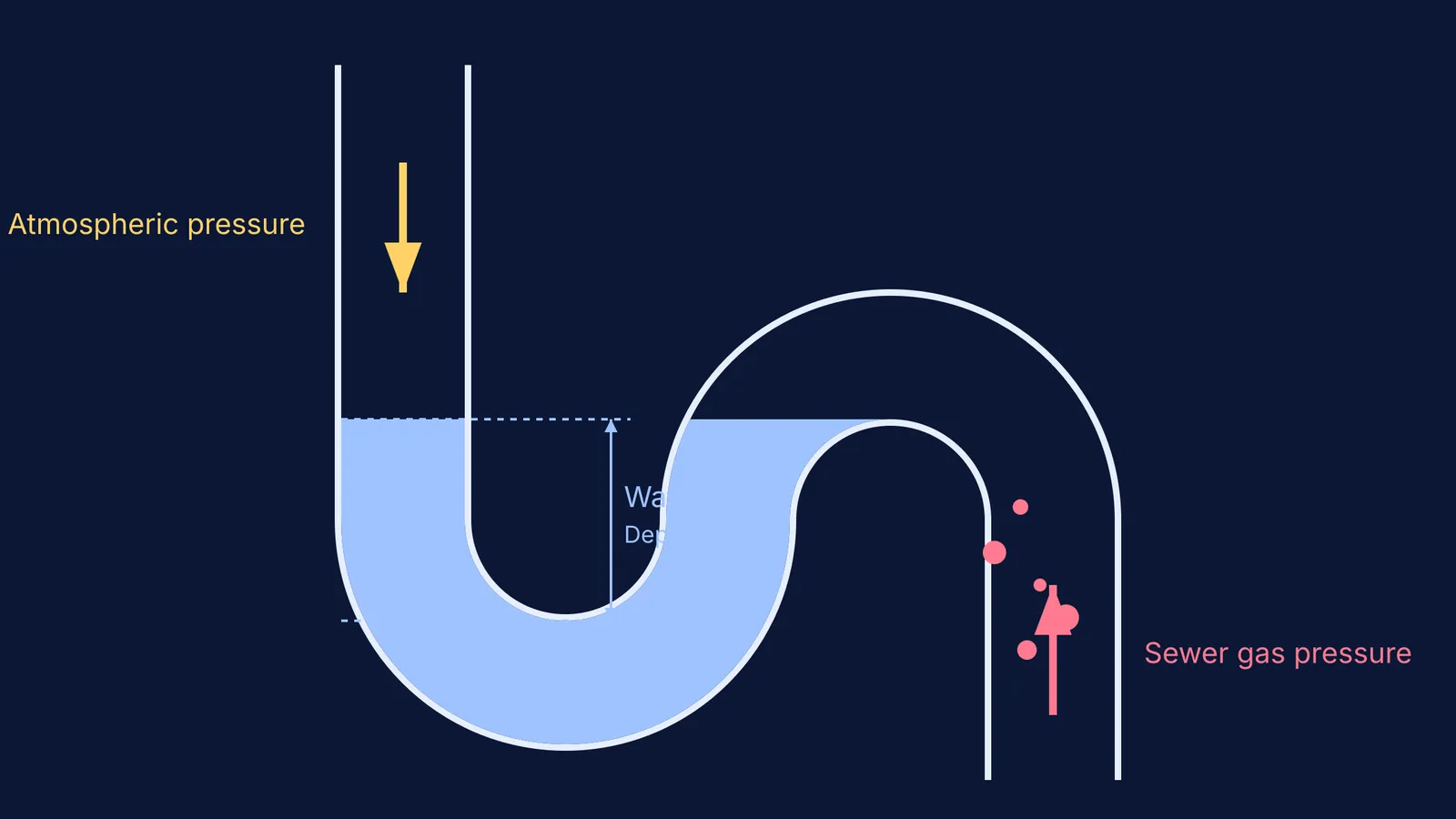
When the toilet was flushed, the final rush of clean water settled in the lower dip of the curve, creating a permanent liquid seal. This plug of water acted as a physical barrier. While Cumming's patent also included a complex sliding valve to clean the basin—a mechanism later improved by Joseph Bramah in 1778—it was the elegant simplicity of the S-bend that changed sanitation forever. Every time you run a sink or flush a toilet today, you leave behind a fresh water seal based entirely on Cumming's original principle.
Why is the water seal at least 51 mm deep?
The trap relies on a delicate balance of forces, behaving much like a U-tube manometer measuring gas. When studying fluid mechanics, the balance of forces in these tubes can be hard to picture. The Fermi Simulation Lab lets you interact with fluid columns directly, while Fermi's AI tutor can draw out the hydrostatic pressure differences step-by-step and explain why the water holds its ground.
For the seal to work effectively, the water must be deep enough to resist the pressure from the sewer without causing drainage blockages. Modern plumbing codes typically require a minimum seal depth of 51 mm (2 inches).
Using the formula for hydrostatic pressure (P = ρ × g × h), a seal depth of 0.051 m multiplied by the acceleration of gravity (9.8 m/s²) and the density of water (1,000 kg/m³) yields roughly 500 Pascals of resistance. This is only about 0.5% of standard atmospheric pressure, but it is more than enough to push back against typical sewer gas pressure fluctuations. The atmospheric pressure pushing down from the bathroom side keeps the water firmly in place. If the sewer pressure ever spikes above 500 Pascals, the gas will break the seal, bubbling violently through the water.
How can you restore a dry trap?
If a guest bathroom or a basement floor drain smells strongly like rotten eggs, the S-bend or P-trap has likely lost its water seal. Here is a framework to diagnose, fix, and prevent it:
Rule out siphonage: If you hear a gurgling sound in the sink when you flush a nearby toilet, the rush of water is pulling air from shared pipes, creating a temporary vacuum that sucks the water seal out. This requires a plumber to check the ventilation pipes.
Identify evaporation: If the drain simply smells bad after weeks of non-use, evaporation is the culprit. A 51 mm seal naturally evaporates over a few weeks in a dry climate.
Restore the seal: Pour a jug of water down the offending drain. This immediately replaces the water in the curve and re-establishes the 500-Pascal barrier.
Slow the evaporation: If the drain is rarely used, pour a layer of cooking oil or mineral oil down it after the water. The oil floats on top of the water seal, blocking evaporation and keeping the sewer gas trapped for months.


