

On this page
Between 1944 and 1974, American nuclear scientist and electrical engineer Albert Ghiorso co-discovered 12 chemical elements, extending the periodic table from americium (atomic number 95) to seaborgium (106). According to Guinness World Records, this total of 12 elements stands as the world record for the most chemical elements discovered or co-discovered by an individual. Originally trained in electrical engineering at UC Berkeley, Ghiorso advanced experimental nuclear chemistry by designing electronic detectors, accelerators, and collection techniques that made detecting single, short-lived atoms possible.
Which 12 elements did Albert Ghiorso discover?
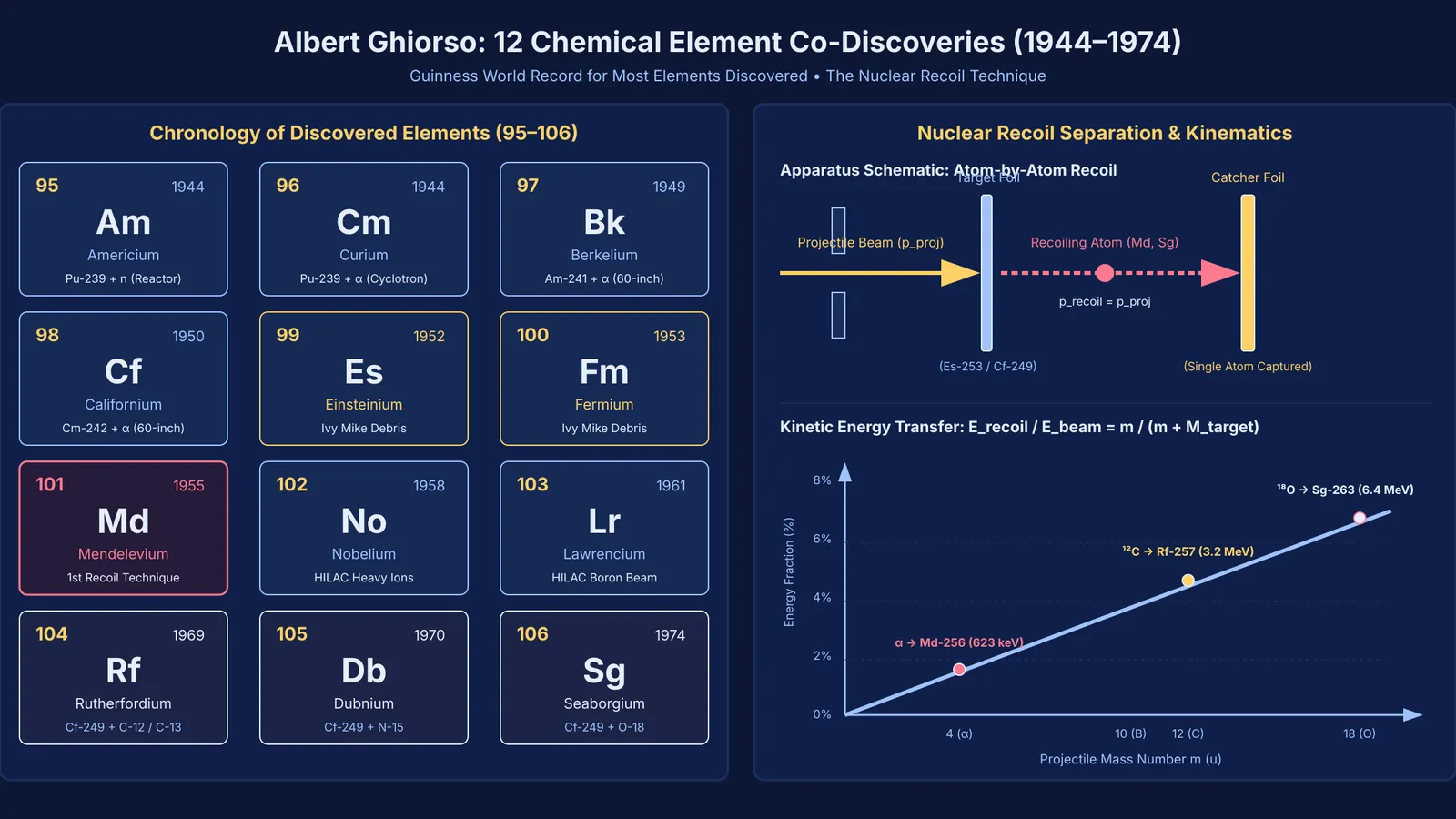
As recorded by the Atomic Heritage Foundation, Ghiorso's co-discoveries spanned three decades at the University of Chicago and Lawrence Berkeley National Laboratory:
Americium (95) and Curium (96): Synthesized in 1944 by bombarding plutonium with neutrons and alpha particles.
Berkelium (97) and Californium (98): Created in 1949 and 1950 by bombarding americium and curium with helium ions.
Einsteinium (99) and Fermium (100): Identified in 1952 and 1953 from "Ivy Mike" thermonuclear test debris.
Mendelevium (101): Discovered in 1955, marking the first element identified atom by atom.
Nobelium (102) and Lawrencium (103): Synthesized in 1958 and 1961 using heavy-ion beams in the Heavy Ion Linear Accelerator.
Rutherfordium (104), Dubnium (105), and Seaborgium (106): Produced between 1969 and 1974 by bombarding californium-249 with heavy ions.
Ghiorso collaborated closely with Nobel laureate Glenn Seaborg and the actinide series on nine of these elements—including americium through nobelium, and later seaborgium. As documented in his Physics Today biography by Robert Schmieder, Ghiorso's core strength was instrumentation. During World War II, he built a 48-channel pulse-height analyzer that sorted alpha particles by energy, enabling researchers to isolate rare transmutations from intense background radiation.
How did the recoil technique detect single atoms?
Before 1955, radiochemists separated new elements by dissolving bombarded target foils in acids. When Ghiorso and his colleagues attempted to create element 101, that classical method failed. As detailed in their Physical Review discovery paper, the team had only about 10⁹ atoms of einsteinium-253—less than a picogram—and calculated that each cyclotron run would yield only one or two atoms of the new element. Dissolving the target after each run would destroy it.
Ghiorso solved this limitation by inventing the nuclear recoil technique. The team electroplated einsteinium onto a thin gold foil and bombarded it from behind with alpha particles. When an alpha particle fused with an einsteinium nucleus, momentum conservation kicked the newborn mendelevium atom out of the target.
The recoiling atoms embedded into a gold catcher foil millimetres away. The catcher foil was dissolved and analysed while leaving the valuable einsteinium target intact. Across multiple runs, the team confirmed 17 atoms of mendelevium-256.
Momentum conservation also dictates the recoil of the daughter nucleus in alpha decay, where decay energy divides between the alpha particle and daughter atom.
How did particle accelerators make new elements possible?
Alpha particles from cyclotrons could not synthesize elements beyond mendelevium because heavier target isotopes decayed too quickly to accumulate. Continuing up the periodic table required bombarding available actinide targets with heavier projectile ions.
As outlined by the Atomic Heritage Foundation, Ghiorso led the design and construction of Berkeley's Heavy Ion Linear Accelerator (HILAC), which accelerated carbon, boron, and oxygen ions to roughly 10 MeV per nucleon.
With the HILAC and its upgraded successor, the SuperHILAC, Ghiorso replaced static foils with moving tapes and rotating wheels. Recoiling nuclei were caught on a wheel rim and spun past semiconductor detectors, capturing half-lives lasting fractions of a second. In 1974, Ghiorso's team announced the discovery of seaborgium (element 106) in Physical Review Letters by bombarding californium-249 with oxygen-18 ions. These experiments directly influenced modern naming procedures, described in our overview of IUPAC names for elements above 100.
Worked example: how do you calculate nuclear recoil energy?
To understand why Ghiorso's recoil technique worked, consider the kinematics of an incident projectile fusing with a stationary target, as formulated in the team's Physical Review discovery paper.
Suppose an alpha particle with mass number 4 and kinetic energy 40 MeV strikes a stationary einsteinium-253 nucleus (mass number 253), fusing into a compound mendelevium nucleus of mass number 257:
Find projectile momentum:
Using p = √(2 m E), the incident momentum is: p_proj = √(2 × 4 u × 40 MeV)
Apply momentum conservation:
Because the target is at rest, the compound nucleus of mass M = 257 u absorbs all projectile momentum: p_recoil = p_proj
Compute recoil kinetic energy:
E_recoil = p_recoil² / (2 M) = (4 / 257) × 40 MeV ≈ 0.623 MeV = 623 keV
A recoil kinetic energy of 623 keV provides ample energy to eject the newborn atom from the target monolayer into the catcher foil, while unreacted target atoms remain anchored to the foil substrate.
How can students master nuclear chemistry concepts?
Mastering nuclear reaction equations, collision kinematics, and decay chains requires moving beyond passive memorisation to active problem-solving.
If you find it difficult to picture particle trajectories, collision geometry, and detector apparatus, visual models clarify the underlying physics. The Fermi Simulation Lab provides interactive simulations for the ideas that are easier to see than to read.
When solving numerical problems involving mass defects, binding energies, or recoil velocities, structured practice ensures step-by-step accuracy. The Fermi Problem Library features worked problems with a step-by-step solver that explains the reasoning rather than printing an answer, helping you master each derivation.


